Mumbai Play 'Kheyechish?' Explores Urban Hunger and Artistic Struggle
Many people leave home to pursue dreams and learn survival in new cities. They face conflicting emotions like missing family, seeking belonging, and desiring a better life. Mumbai-based Meghna Roy Choudhury captures this universal experience in her bilingual play Kheyechish?. The performance uses Hindi and English with a touch of Bengali.
A Story Set in Mumbai's Fast-Paced Reality
The play follows a theatre practitioner and educator in her mid-twenties living in Mumbai. She grapples with job insecurity, grief, urban loneliness, ambition, hope, and hunger. In her hectic daily routine, tender moments come only from her mother's gentle question: "Kheyechish? Have you eaten?"
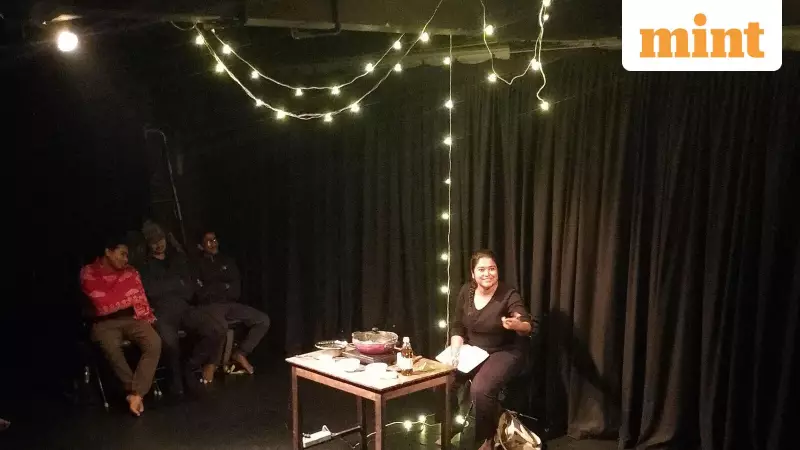
The primary set is a kitchen where Meghna cooks two Bengali dishes live onstage. She prepares aloo posto, a potato curry with ground poppy seeds, and phena bhaat, a rice gruel or porridge. These recipes originated during the Bengal famine that ravaged the region between the 18th and 19th centuries.

Cooking as a Theatrical Device
As she cooks, the protagonist narrates her daily life in Mumbai. She earns ₹18,000 per month, spending ₹11,500 on rent. Only ₹6,500 remains for groceries and unpaid theatre rehearsals. With no food left and no money to buy more, she finally confesses to her mother that she has not eaten.
The food cooked on stage and savored by the audience after the show serves as an important theatrical device. Meghna dexterously performs, moving between multiple characters while cooking. She never allows the culinary action to distract from the performance. Instead, it adds a layer of intimacy and warmth, making the play immersive.
This approach brings to mind another play, Saag Meat, written by Bhisham Sahni and performed by Seema Pahwa. In that work, the narrator tells her life story while cooking a one-pot meat dish.
A Letter to the Tired and Hungry
According to Meghna, the play is a letter to everyone who has ever been tired, broke, replaced, hopeful, or just hungry. "It's for those who've lied to their mothers about what they've eaten, and those who've survived on dreams and vada pavs," she adds in a press note.
The piece draws inspiration from Bertolt Brecht's poem, The Shopper. Meghna studied Brecht in drama school but felt disconnected from Communist ideology after witnessing its failure. She later encountered Brecht's Refugee Conversations, where two refugees from Nazi Germany discuss the state of the world.
While one character talks about "true art," the other brushes it off and asks, "Have you ever had the pleasure of eating a delicious beef dish?" This paradox of artistic integrity versus basic sustenance deeply resonated with Meghna.
Highlighting Unseen Labor in Theatre
Kheyechish? has received support from the Niloufer Sagar Alumni Production Grant. The play features sharp, often humorous observations about the realities theatre practitioners and educators face. Meghna recalls a theatre actor who worked as a production manager to earn money.
"Despite a severe back injury, she carried heavy sets, deciding to seek medical care in her home town as she couldn't afford it in Mumbai," she says. Meghna calls this chosen hunger and chosen migration.
"But then this raises questions like: Is this financial structure okay? Is it valid? Is hunger valid? While experiencing this, I was also observant about a lot of things that we just ignore. I could see everybody going through this," she observes.
From Physics to Theatre: A Personal Journey
Meghna holds a master's degree in Physics and trained in Bharatanatyam and Kalaripayattu. She graduated from the Drama School, Mumbai. A poignant moment led her to transition to theatre. "The 2012 Nirbhaya tragedy affected me," she says. It highlighted the importance of speaking out.
"Bharatanatyam is very codified, it has strict boundaries, so it was not enough to voice what I felt. I found theatre a strong medium as you can speak about what you think directly to the people, which is why I chose it," she adds.

Kheyechish? is not only a story of urban survival but also a recognition of the unseen labor of theatre practitioners and educators who keep the arts alive. Special mention goes to Dhanesh Gopalakrishnan's voiceover, which functions as a second actor in the production.
The play will be performed on 15 January at 7.30 pm at The Cube, Nita Mukesh Ambani Cultural Centre in Mumbai.