The Enduring Legacy of Pablo Neruda: A Voice for the Ages
Pablo Neruda stands as one of the most influential and celebrated poets of the 20th century, renowned for his deeply emotional, politically charged, and symbol-rich writing. Born as Ricardo Eliécer Neftalí Reyes Basoalto in 1904 in Parral, Chile, he adopted the pseudonym "Pablo Neruda" during his teenage years to circumvent his father's disapproval of his literary aspirations. This name would later become his legal identity and the hallmark of his global fame.
Early Life and Formative Influences
Neruda's childhood in the small town of Temuco, surrounded by lush forests, flowing rivers, and expansive landscapes, profoundly shaped his poetic vision. The loss of his mother shortly after his birth further deepened his sensitivity. Nature emerged not merely as a backdrop in his poems but as a vibrant, living entity intricately linked to human emotions. These early experiences of solitude and immersion in the natural world fostered a reflective and empathetic spirit that became central to his later work.
Rise to Literary Prominence
Neruda's passion for poetry ignited at a young age. In 1924, at just 19 years old, he published his breakthrough collection, Twenty Love Poems and a Song of Despair. This work catapulted him to immediate fame across the Spanish-speaking world, captivating readers with its raw exploration of love, longing, sexuality, and heartbreak. It remains one of the best-selling poetry collections in Spanish history, praised for its ability to convey profound feelings through simple yet powerful language.

Political Awakening and Evolution of Style
Neruda's career took a significant turn in the 1930s when he served as a diplomat in countries such as Burma, Sri Lanka, Spain, and Mexico. His time in Spain during the Spanish Civil War was particularly transformative, exposing him to violence, injustice, and the suffering of ordinary people. This experience heightened his political consciousness, leading him to embrace leftist ideologies and join the Chilean Communist Party. His poetry evolved from personal and romantic themes to address broader social and collective issues, advocating for justice, equality, and resistance against oppression.
One of his most monumental works from this period is Canto General, an epic collection that chronicles the history of Latin America from ancient civilizations to struggles against colonialism and imperialism. This masterpiece is regarded as a pinnacle of political poetry and a vital contribution to world literature, giving voice to the land, its people, and their shared heritage.
Artistic Style and Universal Appeal
Despite his political engagement, Neruda never abandoned his lyrical and imaginative style. A hallmark of his writing is the seamless fusion of the personal and the universal, imbued with a strong emotional core whether discussing love, nature, or revolution. He masterfully employed vivid imagery, metaphors, and symbols to evoke deep feelings, often using elements like the sea, wind, or night to render abstract emotions tangible.
Neruda's poetry is also celebrated for its accessibility. In contrast to the complex language of some modernist poets, he frequently wrote in a clear, straightforward manner that retained poetic depth, making his work resonate with both everyday readers and literary scholars. This balance of simplicity and profundity has ensured his enduring popularity.
Celebrating the Ordinary
A distinctive aspect of Neruda's oeuvre is his celebration of everyday objects. In his Elemental Odes, he penned verses about mundane items like tomatoes, onions, bread, and salt, transforming the ordinary into the extraordinary. Through these works, he highlighted the beauty in life's simplest facets, asserting that poetry should encompass not only grand ideas but also the small, routine aspects of human existence.
Challenges and Later Years
Neruda's life was marked by adversity, including persecution for his political beliefs in Chile, which forced him into hiding and exile. During this period, he traveled extensively, continuing to write and advocate for his causes. His exile deepened themes of identity and belonging in his later works.

In 1971, Neruda received the Nobel Prize in Literature, honored "for a poetry that, with the action of an elemental force, brings alive a continent's destiny and dreams." This accolade solidified his status as a global literary icon. He returned to Chile in his later years, remaining active in politics and literature as a staunch supporter of President Salvador Allende. Following the military coup in 1973 that overthrew Allende's government, Neruda's health deteriorated rapidly, and he passed away just days later. The circumstances of his death remain a subject of debate, with ongoing discussions about whether it resulted from illness or other factors.
Lasting Impact and Legacy
Pablo Neruda's literary contributions have left an indelible mark on poetry, demonstrating its capacity to intertwine the personal with the societal. His works serve as tools for love, protest, remembrance, and self-discovery, continuing to be read, studied, and admired worldwide. He has influenced countless writers and readers, proving that poetry can bridge the earthly and the ethereal.
In essence, Neruda was more than a poet; he was a voice for humanity, articulating the beauty of love, the anguish of loss, the power of nature, and the struggle for justice. His legacy endures as a testament to poetry's ability to connect reality with the infinite.
Reflection on a Poetic Quote
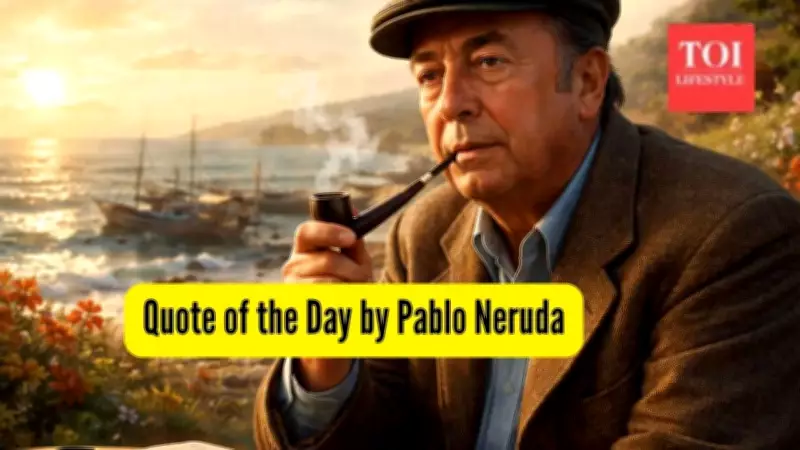
One of Neruda's most poignant lines encapsulates his philosophy: "What did the earth teach the trees? How to speak to the sky." This metaphor likely explores the relationship between roots and expression. The "earth" symbolizes grounding elements like history, identity, struggles, and pain—realities Neruda faced through political turmoil and exile. The "trees" represent individuals who grow from these experiences, learning to "speak to the sky," which may signify freedom, imagination, hope, or spiritual connection.
The contrast between the stable, silent earth and the limitless, meaningful sky highlights a recurring theme in Neruda's work: art is inspired by real life. Here, life (earth) teaches the poet (tree) to express beauty, emotion, and truth (sky), reinforcing his belief that poetry springs from lived experience rather than abstract contemplation.