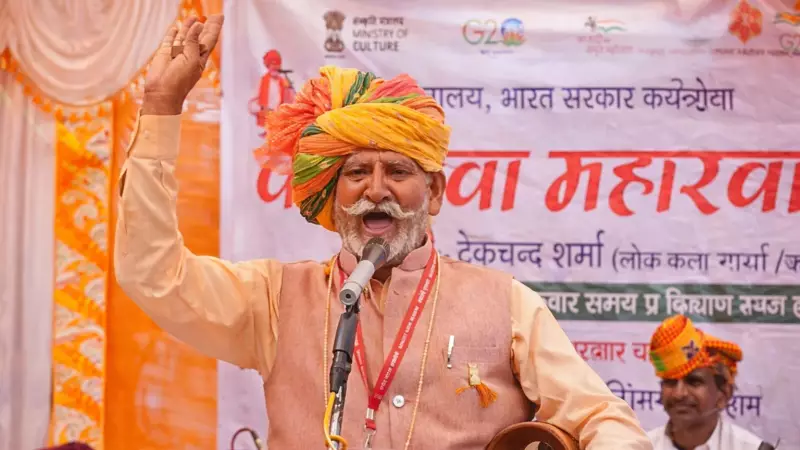
In a significant recognition of India's rich cultural heritage, two distinguished Rajasthani folk artists, Gafruddin Mewati Jogi and Taga Ram Bheel, have been honored with the prestigious Padma Shri awards in the 'unsung heroes' category. The announcement, made on Sunday, highlights their lifelong dedication to preserving and promoting traditional folk music and unique musical instruments that are integral to Rajasthan's artistic legacy.
Gafruddin Mewati Jogi: The Master of the Talking Drum
Gafruddin Mewati Jogi, aged 68, is celebrated for his expertise in folk and traditional music, with a special focus on the bhapang, often referred to as the 'talking drum'. This rhythmic percussion instrument is crafted from a hollow dry pumpkin shell mounted with goatskin, producing distinctive sounds that have captivated audiences for generations.
Hailing from the Mewati Jogi community, Gafruddin's musical journey began under the tutelage of his father, Budh Singh Jogi. "I learnt bhapang from my father. We used to perform together; he played the jogiya sarangi, and I accompanied him on the bhapang, with other family members on harmonium and dholak," Gafruddin shared in an interview.

A Legacy of Cultural Preservation
Gafruddin's contributions extend beyond performance; he is recognized as the last surviving folk artist who knows and performs all the 2,500-plus dohas of Pandun ka kada, a rendition of the Mahabharata. This remarkable feat earned him the Sangeet Natak Akademi Award last year, presented by President Droupadi Murmu.
His lineage traces back to Ismail Nath Jogi, a disciple of Gorakhnath, who embraced Islam while continuing to sing Hindu epics. "We are Muslims, but we sing Shivji ka Byavla, Pandun ka Mahabharat, and Lok Ramayan. We perform at temples and mosques alike, embodying the spirit of unity," Gafruddin explained.
Over a career spanning six decades, Gafruddin has garnered numerous accolades for promoting the bhapang. He has performed extensively across India and internationally, including in Australia, Canada, France, England, Germany, and Japan. Notably, he performed for Prime Minister Narendra Modi just before the Covid lockdown, showcasing his art on a national platform.
Taga Ram Bheel: The Virtuoso of the Twin Flutes
Taga Ram Bheel, in his early 60s, is renowned for his mastery of the algoza, a double flute made of bamboo that operates on principles similar to a bagpipe. One flute provides a continuous drone while the other plays melodic notes, creating a harmonious blend unique to Rajasthani folk music.
From Humble Beginnings to Global Stages
Bheel's journey with the algoza began in childhood when he secretly practiced on his father's instrument. He bought his first algoza at age 11 and taught himself to coordinate the tunes, leading to his first stage performance in Jaisalmer at 18 in 1981. Since then, he has become a staple at Rajasthan's Desert Festival and has featured in numerous All India Radio programmes.
Residing in Mool Sagar town near Jaisalmer, Bheel spent 30 years in the jungles of Ranthambore, honing his craft amidst nature. His talents have taken him to over 15 countries, including France, the US, Japan, and Russia, with invitations from Nehru Yuva Kendra Sansthan and Rajasthan Tourism.
Beyond performance, Bheel conducts workshops and crafts high-quality algozas sought by musicians worldwide. He also plays the matka and flute, while maintaining mining as a parallel livelihood, demonstrating his multifaceted dedication to both art and sustenance.
Celebrating Unsung Heroes
The Padma Shri awards to Gafruddin Mewati Jogi and Taga Ram Bheel underscore the importance of preserving India's diverse folk traditions. Their stories of resilience, innovation, and cultural synthesis serve as an inspiration, reminding us of the deep-rooted artistic heritage that thrives in Rajasthan's communities.
As these artists continue to share their music globally, their recognition with the Padma Shri not only honors their individual achievements but also shines a light on the broader efforts to sustain folk arts in modern times. Their work ensures that instruments like the bhapang and algoza, along with the stories they tell, remain alive for future generations to cherish and learn from.