Threadarte's 'Adhuna' Exhibition Transforms Waste Threads into Meditative Art
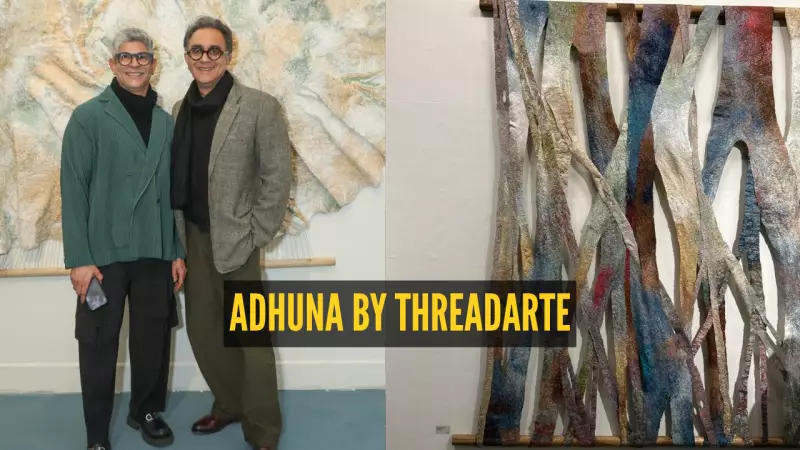
Art Centrix Space at Bikaner House currently hosts a remarkable exhibition titled Adhuna. Presented by Monica Jain, this showcase features the latest work from the artistic collective Threadarte. The exhibition centers around seven large-scale installations crafted from yarn. Artists used approximately 350 to 400 kilograms of waste threads gathered from various locations across India. Three sculptural pieces accompany these textile works.
Stepping Into the Present Moment
Together, the artworks trace the complex, layered textures of contemporary life. The exhibition posits that philosophy often begins as physical form before it becomes abstract theory. The forms are dense yet porous. They feel cyclical but remain open-ended. "We wanted the viewer to encounter the present physically before engaging with it conceptually," explains artist Gunjan Arora. "Each installation and sculpture is a moment you step into, rather than observe from a distance."
One standout piece is called Metaphors in the Wind. Its evocative imagery resembles a dense forest with intentional gaps. This work reflects the 'now' as a time thick with lived experience. The openings within the structure gesture toward future possibilities. "The present is never sealed," Arora clarifies. "Even in its density, there are spaces—quiet openings where choices, opportunities, and new directions exist."

Exploring Movement and Cyclical Nature
Another significant installation draws inspiration from the dynamic relationship between land and river. It explores how context shapes movement. Simultaneously, it shows how movement continually reshapes its own context. "The land may define the river's form, but as it flows through the moment, the river still finds its own way," notes Arora.
The installation I Am Where I Began uses materials like cotton, silk, viscose, and cast brass. It reflects on life's cyclical returns. Another work, titled Continuum, is created with cotton, silk, and linen. This piece meditates on the subtle shifts that mark the passage of time. Each moment may mirror the next, yet the beginning and end remain profoundly different. Its wing-like form powerfully suggests motion, possibility, and flight.
Sculptures Cast in Brass Offer Deep Reflection
The exhibition extends its exploration with three distinct sculptures. Artists formed these by casting yarn in brass. They offer a profound meditation on existence itself.
- The first sculpture signifies birth or becoming. It represents the very emergence of form.
- The second sculpture acknowledges the act of embracing both light and shadow. It recognizes contrast as an intrinsic part of life.
- The final sculpture returns to the origin. It suggests a quiet, reflective coming back to the start.
"The cycle doesn't move in a straight line," Arora reflects. "It keeps folding into itself. Endings and beginnings coexist."
The Meaning of 'Adhuna' and Collaborative Practice
After experiencing these works, the exhibition's title reveals its full meaning. Derived from Sanskrit, Adhuna translates to "now." Rahul Jain and Gunjan Arora approach this concept as neither fleeting nor passive. In a world driven by speed and constant anticipation, the exhibition invites viewers to recognize the present as layered and alive. It is shaped by memory, gesture, and decision, while subtly influencing what is yet to unfold.
"The present carries the weight of what has been lived," Arora says, "but it remains porous—open to redirection. Within it lies the agency to imagine futures differently."
This understanding of the present as both an archive and a proposition also informs Threadarte's collaborative practice. Jain and Arora allow their individual artistic voices to intersect and evolve. Together, they develop a shared language shaped by material, time, and exchange. "Threadarte exists within this ongoing unfolding," Arora concludes. "It's about letting processes, ideas, and materials speak to one another."