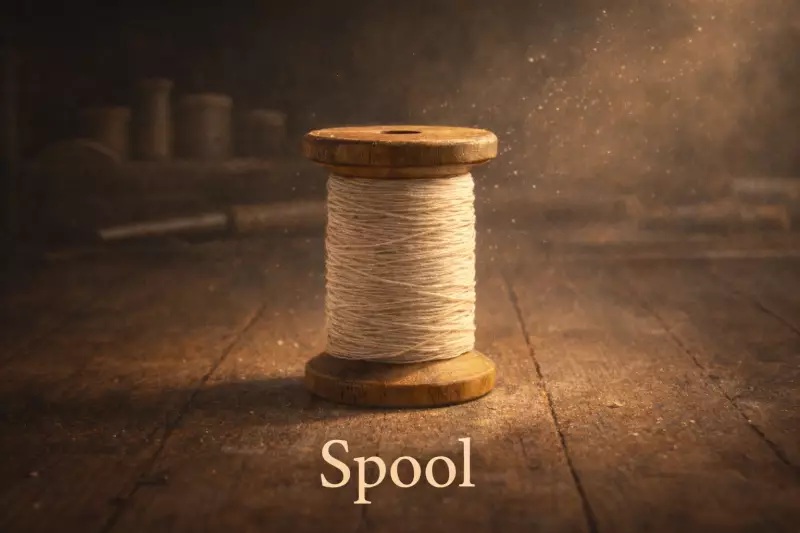
The Wordle puzzle on Christmas Eve, December 24, presented a seemingly humble answer: spool. In a season defined by sensory overload, glitter, and grand anticipation, this five-letter word stood out for its stark simplicity and lack of festive flair. It does not dazzle. Instead, it evokes an image of something cylindrical, patient, and functional. Yet, this understated term holds within it a profound history of human ingenuity, representing a fundamental technology upon which civilisation has silently depended.
From Tangled Threads to Ordered Continuity: The Spool's Practical Genesis
Long before the digital age of endless feeds, data clouds, and scrolling timelines, humanity faced a basic, physical problem: managing length. Thread would knot and snarl. Wire was prone to kinking. Film strips could tear. Human memory and recorded information were fragile, easily snapped if mishandled. The spool emerged as the elegant, mechanical solution to this universal challenge. The word itself is a quiet acknowledgment that continuity, to survive practical use, requires discipline and order.
The term spool entered the English language through the practical realms of labour and craft, not through lofty literature or philosophy. Its etymological roots are traced to Middle Low German 'spole' or Middle Dutch 'spoele', referring to a peg or cylinder used for winding yarn. This is a word forged in workshops, sewing rooms, and places of manual work. Language did not invent the concept of a spool abstractly; it observed an object performing essential, repetitive work and gave it a name. This resolutely practical origin explains why 'spool' never ascended to grandeur—it remained faithfully close to its function.

The Core Function: Preservation Through Discipline
At its heart, a spool is a deceptively simple device: a cylinder, often with flared ends, designed to hold something long, continuous, and vulnerable. This could be thread, wire, magnetic tape, or photographic film. These are materials whose entire utility vanishes the moment they become tangled, knotted, or broken.
The critical act performed by a spool is not compression or erasure, but organised preservation. It does not shorten what it holds; it makes its full length manageable and accessible. By winding material into consecutive, ordered loops, it imposes control on potential chaos. This act of disciplined winding protects continuity without destroying it, allowing for storage, transport, and controlled release.
The Spool's Silent Migration: From Textiles to the Digital Age
This fundamental principle allowed the spool to migrate seamlessly from the world of textiles into the heart of modern technology. As machines evolved, the spool adapted without changing its core nature. Film was spooled inside cameras and projectors. Magnetic tape, the backbone of audio, video, and early data storage, lived on spools. The very process of editing was once a physical act of cutting and splicing spooled tape—a tangible reminder that memory and narrative, like thread, could be irreparably damaged by carelessness.
Even today, in our digital vernacular, we invoke the spirit of the spool. When we say a computer printer or a system is "spooling" data, we are referencing that older, mechanical rhythm. It signifies not instant action, but a gradual, deliberate gathering—preparation before release. The word inherently carries a sense of patience within its structure.
Spool as a Verb: The Power of Accumulation in Language
In linguistic usage, 'spool' is most potent as a verb, suggesting a process rather than a static spectacle. Writers use it to describe slow, inevitable accumulation. Stories spool out. Memories spool through the mind. Tension spools quietly before a climax. When used effectively, the word conveys a sense of gathering momentum, of something being wound with care or obsession, creating a narrative or emotional thread that, once formed, cannot be easily undone.

Consider its use in a sentence: "The mystery spooled out slowly, each clue tightening the plot." Or, "He watched as the cable spooled onto the drum with a steady hum." The power lies in the word's refusal to hurry, its embodiment of controlled progression.
Why a Simple Word Like 'Spool' Still Matters Today
In an era of breakneck digital speed—where we stream, scroll, refresh, and discard—we often operate under the illusion that continuity is cheap, instant, and endlessly reversible. The ethic of the spool belongs to an older, perhaps wiser, understanding. It assumes that carelessness has a cost and that some things, once tangled or broken, cannot be fully restored. It reminds us that not all continuity can be cut, copied, and pasted without loss. Some forms of memory, narrative, and connection must be wound with care if they are to remain intact and usable.
For a Wordle answer on December 24, surrounded by the noise of celebration and the urgency of consumption, 'spool' offers a subversively quiet promise. It does not promise novelty or excitement. It promises preservation. It speaks of the disciplined, humble tools that hold the long threads of our stories, our data, and our history together, making civilisation itself possible. In its simple, cylindrical patience, it is a small monument to order in a chaotic world.