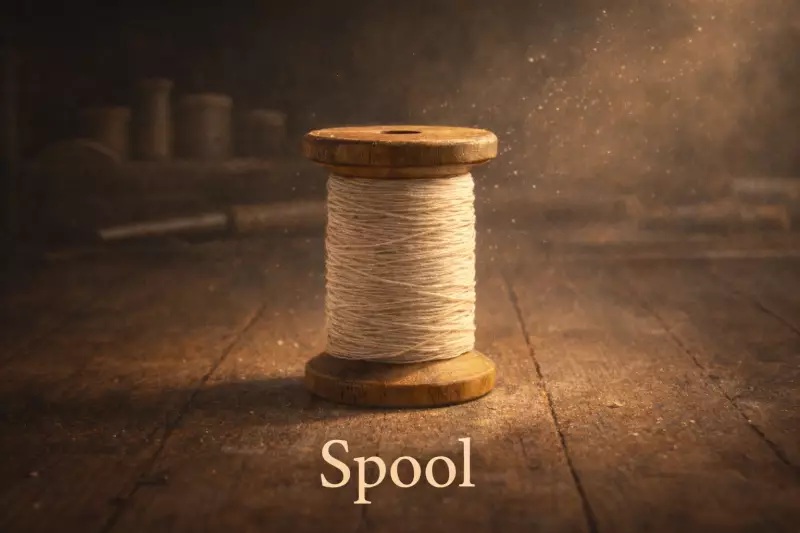
The Wordle puzzle for December 24 presented players with the word spool. On a date typically defined by sensory overload—excess, eager anticipation, and clamour—this answer felt like a deliberate understatement. It is not a festive word. It does not glitter. Instead, it sits, cylindrical and patient, demanding little. Yet, this humble term holds a silent, foundational role in human progress, one civilisation often overlooks.
From Workshop to Word: The Humble Origins of 'Spool'
Long before digital feeds and cloud storage, humanity faced a simple, physical problem: length. Thread tangled, wire kinked, film tore, and memory—when recorded physically—could snap if mishandled. The spool emerged as the elegant solution, a quiet testament that continuity, to survive practical use, requires discipline. The word spool entered the English language not through poetry or philosophy, but through the back door of manual labour.
Its etymology points to Middle Low German 'spole' or Middle Dutch 'spoele', referring to a peg or cylinder for winding thread. This was a term forged in workshops and sewing rooms, named for an object doing necessary work. Language did not imagine a spool; it observed one and labelled it. This resolutely practical origin explains why the word never became grand. It stayed faithfully close to its function, a workhorse of vocabulary.

The Silent Migration: From Textile Spools to Technological Memory
At its core, a spool is a cylinder with flared ends, designed to hold something long, continuous, and fragile—thread, wire, tape, film. These materials lose all value the moment they knot, twist, or break. Crucially, a spool does not shorten or compress what it holds. It preserves length by organising it. It disciplines chaos into ordered loops, making continuity manageable without destroying it.
This fundamental principle allowed the spool to migrate seamlessly from the realm of textiles to the heart of modern technology. As machines replaced hands, the spool adapted without changing its nature. Film was spooled. Magnetic tape for audio, video, and early data storage was spooled. The entire craft of editing was once the physical act of cutting and rejoining spooled material, a tangible reminder that memory, like thread, could be damaged beyond repair if handled carelessly.
Spooling in Language: A Verb of Patient Accumulation
In modern usage, spool works best as a verb, suggesting a process rather than a spectacle. It rarely seeks the spotlight in a sentence. Stories spool out. Memories spool through the mind. Tension spools quietly before it breaks. When used effectively, the word conveys a sense of gradual accumulation and inevitable unfurling, not sudden eruption. It implies something is being gathered carefully, even obsessively, and once gathered, it cannot easily be undone.
Consider its use: The narrative spooled out slowly, each detail tightening the plot. Or: The machine hummed as the cable spooled itself into place. The power lies in the word's inherent refusal to hurry. Even today, when we say a computer system is "spooling" data or a printer is "spooling," we invoke that older mechanical rhythm of gradual gathering and preparation before release.
A Subversive Reminder in an Age of Instantaneity
In a digital era built around speed—where we stream, scroll, refresh, and discard—the ethic of the spool feels almost radical. We often assume continuity is cheap and easily reversible. The concept of the spool belongs to an older wisdom, one that acknowledges carelessness has costs and some things, once tangled or snapped, cannot be fully restored. It reminds us that not everything can be cut, copied, and pasted without loss. Some forms of memory and material must be wound with care to remain usable.
As the Wordle of the day on December 24, surrounded by seasonal noise and urgency, spool offered a subversively quiet promise. It does not promise novelty or excitement. It promises preservation. It stands as a cylindrical, patient monument to the discipline required to maintain the long, continuous threads of our collective memory and technology—a foundational word that quietly organised the world long before algorithms tried to.