

Mamatha Tulluri's Personal Mission to Save a Dying Royal Craft
For Mamatha Tulluri, fashion transcends seasonal trends and commercial cycles. Her work represents a profound connection to memory, cultural heritage, and the solemn duty of preserving what modern society risks losing forever. Her relationship with Himroo—a centuries-old textile art—is intensely personal, describing it as a craft that "chose her before she chose it."
The Royal Origins of Himroo: From Mughal Courts to Near Extinction
Himroo originated in 14th century Aurangabad as an exclusive fabric for royalty. Created with a cotton foundation and intricate silk weaving, it served as a luxurious alternative to kum-khwab, the celebrated gold and silver brocade favored in Mughal courts. The name derives from the Persian term Hum-ruh, meaning 'similar,' reflecting its design to emulate royal textiles. Over centuries, it evolved into a distinctive Deccani craft renowned for complex motifs and subtle elegance.
Tragically, today fewer than a handful of artisans possess authentic knowledge of traditional Himroo techniques. The craft teeters on the brink of disappearing completely, which is precisely where Mamatha Tulluri's extraordinary journey commences—not as a trend-driven designer but as a dedicated custodian heeding a cultural call.

Hyderabad Roots and a Fateful Encounter
Born and raised in Hyderabad, Mamatha grew up immersed in the city's Ganga-Jamuni tehzeeb culture, where jewelry, textiles, rituals, and clothing formed lived experiences rather than curated aesthetics. Her path transformed when she met Suraiya Hassan Bose, affectionately known as Suraiya Aapa, widely respected as the grand matriarch of Indian handlooms.
"Meeting Suraiya Aapa felt like destiny," Mamatha recalls. "Through her guidance, I discovered Himroo, Mashru, Jamewar, and Paithani not merely as fabrics but as living historical narratives. They were voices speaking directly to me from the past."
Despite having no formal textile training or generational weaving legacy, Mamatha felt an instinctual pull toward Himroo. "I did not consciously select this craft," she explains. "It chose me. Once that connection formed, I understood there could be no turning back."
The Structural Revival: From Loom to Livelihood
In 2017, Mamatha established her own Himroo weaving unit, embarking on years of meticulous revival work. This was no superficial branding exercise but a structural, slow, and labor-intensive process. She assembled artisans, reconstructed forgotten techniques, studied archival patterns, and learned directly at the loom.
"Reviving a traditional weave constitutes emotional labor," Mamatha emphasizes. "You must unlearn modern expectations of speed. You must respect the inherent rhythm of the loom. Himroo cannot be rushed—it demands patience, humility, and complete surrender to the process."
She also launched a paid training program for young women, cultivating a new generation of Himroo weavers. "This transcends mere revival," she clarifies. "It's about creating sustainable livelihoods and restoring dignity. These women are becoming future custodians of heritage that was nearly erased."
Global Recognition and Celebrity Validation
Mamatha's work has gained national and international recognition, with presentations across the United States, Delhi, and at Parishkriti, IIC New Delhi, where she was personally selected by the Ministry of Textiles and Development Commissioner (Handlooms) to represent contemporary handlooms.
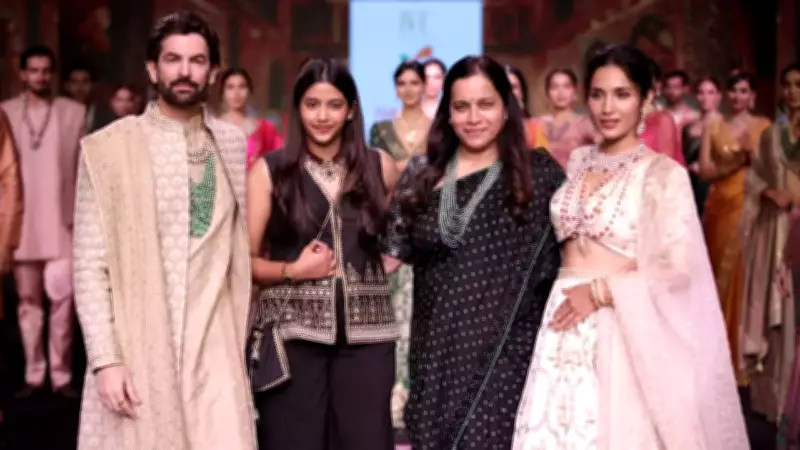
A defining moment occurred during her Times Fashion Week debut when Mamatha styled actor Neil Nitin Mukesh in authentic Himroo—marking the first celebrity to wear her designs. Coming from an artistic lineage himself, Neil connected deeply with the fabric's historical significance. Draped in Himroo, he described feeling like royalty and openly praised both the textile and Mamatha's interpretation.

"It felt like Himroo rediscovered its voice," Mamatha shares emotionally. "Neil comprehended the fabric's historical weight, not just its physical presence. He wore it with dignity, restraint, and reverence. I felt profound pride, gratitude, and quiet joy." Her Times Fashion Week presentation resembled less a conventional fashion show and more a moving Deccani narrative unfolding before the audience.
Preserving Legacy Through Limited, Ethical Production
Today, Mamatha Tulluri stands among the very few artisans producing authentic Himroo. Each piece emerges slowly, ethically, and in limited quantities—not as luxury merchandise but as living legacy.
"In preserving Himroo, we preserve history," she states. "But more importantly, we preserve knowledge, skilled hands, remembering eyes, and stories deserving survival."
For Mamatha, Project Himroo represents not a seasonal collection but a lifelong commitment—a tribute to the craft that discovered her, claimed her, and became inseparable from her identity. As Himroo transitions from royal courts to global runways, Mamatha continues sitting beside the loom, listening, learning, and weaving past into present—not to embalm history but to let it breathe and thrive anew.





