

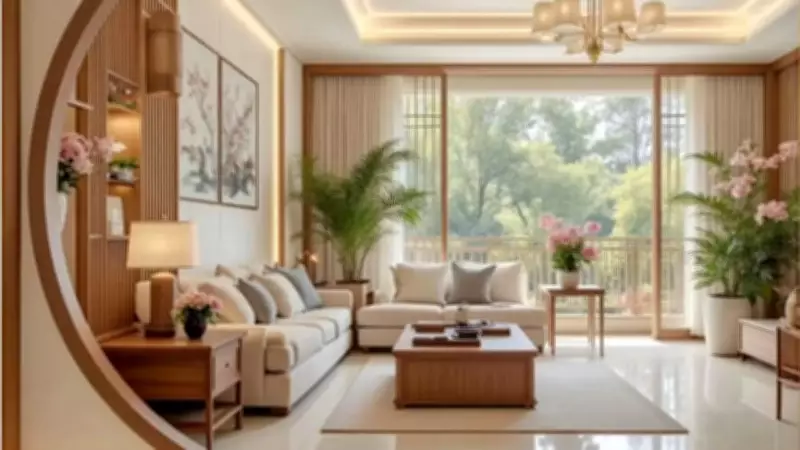
Transform Your Home into a Luxury Space Without Breaking the Bank
As spring arrives with its promise of renewal, homeowners across the country are seeking ways to refresh their living spaces. With economic pressures keeping budgets tight, the desire for affordable upgrades that deliver high-end results has never been stronger. The encouraging reality is that creating a luxurious-looking home doesn't require expensive renovations or designer price tags.
The Psychology of Premium Paint Colors
The most immediate transformation begins with your walls. While flat white and overly bright tones can make spaces feel cheap or unfinished, strategic color choices can completely change a room's perception. Warm neutrals, muted off-whites, deep greens, and navy tones consistently signal premium interiors to the human eye.
Scientific validation comes from a 2026 study published in the Journal of Environmental Psychology, which found that "Darker, saturated hues and warm neutral palettes were consistently associated with higher perceptions of luxury, intentionality and spatial comfort." This research confirms that color psychology plays a crucial role in how we perceive interior spaces.

Dr. Eleni Nicolaou, Art Therapist and Creative Wellness Expert at Davincified, explains this phenomenon: "Certain colors carry a psychological weight that our brains associate with quality and intention. Deeper, more saturated tones create a sense of intimacy, while warm neutrals reflect light in a way that feels considered rather than default."
Lighting Transformation Without Electrical Work
Lighting represents another powerful tool for creating luxury on a budget. The common mistake of relying on a single overhead light source creates harsh shadows and office-like atmospheres. The solution involves two simple changes: switching to warm-toned bulbs (around 2700K) and implementing layered lighting.
A 2026 study in Lighting Research & Technology provides compelling evidence, revealing that "Spaces using layered lighting systems were rated significantly higher in perceived warmth, depth, and overall quality compared to those relying on a single overhead light source."
Dr. Nicolaou emphasizes this point: "Lighting temperature and placement are two of the most underestimated tools in interior design. A room with layered, warm lighting feels curated and calm, which the brain reads as expensive."
The Decluttering Revolution
Visual clutter ranks among the top factors that diminish a room's perceived value. When surfaces become crowded, the eye struggles to find focus, creating a sense of chaos rather than calm. The solution involves strategic editing rather than complete minimalism.
"The spaces that feel most luxurious are the ones where every object looks like it was placed with purpose," notes Dr. Nicolaou. "When you edit ruthlessly, what remains automatically looks more valuable."
Research published in Environment and Behavior supports this approach, establishing that "Lower levels of visual clutter were associated with higher perceived property value and greater aesthetic appeal." This scientific backing confirms that removing excess items can significantly increase a space's perceived quality.
Texture Layering for Depth and Sophistication
Soft furnishings represent an often-overlooked opportunity for affordable luxury. Cushions, throws, rugs, and curtains contribute significantly to how a space feels both physically and visually. The key lies in material selection and strategic layering.
"Texture creates depth," explains Dr. Nicolaou. "When you layer different materials—a chunky knit next to a linen cushion, a jute rug under a velvet chair—the space starts to feel considered and rich, even if the individual pieces weren't expensive."
Simple tricks like hanging curtains higher than the window frame create the illusion of taller ceilings, a technique frequently employed in high-end interior design.
Strategic Statement Pieces
The final element involves selective focal points. A large mirror, oversized artwork, or one standout furniture item can anchor a room when given proper space to shine. The principle here is restraint and intentionality.

"One confident choice beats ten hesitant ones every time," advises Dr. Nicolaou. "Identify the one thing you want a room to be about, then edit everything else back so that piece can do its job."
Dr. Nicolaou concludes with practical guidance: "My biggest piece of advice is to focus on editing rather than adding. Most spaces would benefit more from removing three things than buying something new. When you strip back the noise and let a few well-chosen elements shine, the whole room lifts."
These five approaches demonstrate that creating a luxurious home environment depends more on intentional choices than unlimited budgets. By focusing on color psychology, lighting design, clutter management, texture layering, and selective statement pieces, homeowners can achieve premium results through thoughtful, affordable upgrades.
