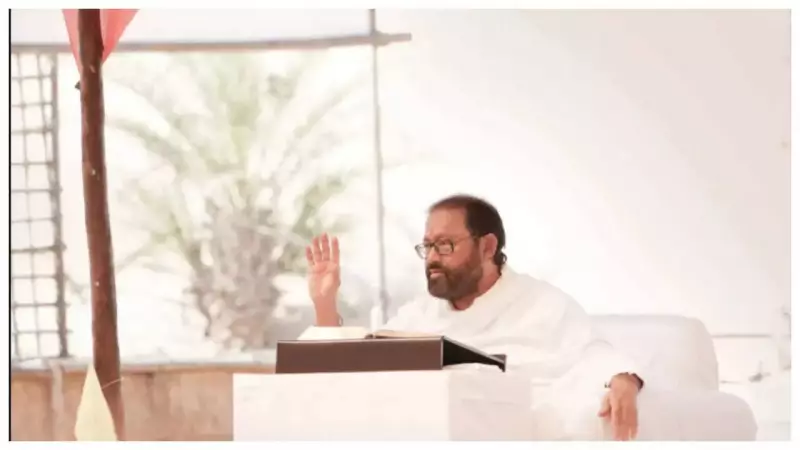
In a profound discourse, revered spiritual leader Pujya Gurudevshri has drawn attention to a fundamental yet overlooked truth: the reality of death. He posits that a conscious awakening to mortality is not morbid but transformative, capable of radically altering the quality of our present life. Despite the undeniable fact that death claims everyone—from the powerful like Alexander and Napoleon to the common person—humanity continues to live in a state of denial, believing "it will not happen to me." This avoidance, Gurudevshri explains, prevents the revolutionary change that spiritual seekers yearn for.
The Greatest Wonder: A Timeless Lesson from the Mahabharata
Gurudevshri illustrated this point with a powerful story from the Mahabharata. While wandering in a forest, the Pandavas encountered a yaksha (a nature spirit). Yudhishthira, the eldest, successfully answered the yaksha's five questions. The most crucial query was: 'What is the greatest wonder in the world?' Yudhishthira's profound reply was: 'The greatest wonder is that every day we see people dying but we don't believe that we will also die.'
This, Gurudevshri emphasizes, is the true wonder—far surpassing man-made marvels like the Taj Mahal or the Pyramids. The failure to internalize our own impermanence means we never prepare for it spiritually. We live under the illusion that we can somehow defeat death, a feat no one has accomplished. The only victory lies in awakening to it. For the enlightened, death loses its sting; it is like darkness dispelled by the flame of meditation and self-realization.

The Endless Run: Tolstoy's Parable and Our Modern Trap
The discourse delves into how this lack of awareness traps us in endless, futile striving. Gurudevshri cited a story by Russian writer Leo Tolstoy about a farmer lured by the promise of vast land in Siberia. Told he could claim all the land he could walk around in a day, the farmer ran greedily, forgoing rest, food, and water to maximize his gain. Overcome by exhaustion just as the finish line was in sight, he collapsed and died.
"This is not just the farmer's story," Gurudevshri stated. "Everyone runs thinking, 'Let me run a little more, then I shall rest.' But exhausted in life, everyone eventually dies." We waste our lives giving significance to petty matters, becoming old and tired without ever stopping the race. This cycle is fueled by the core mistake of not awakening to death's certainty.
Breaking the Cycle of Repeated Mistakes
A key symptom of this spiritual slumber is the repetition of the same core mistakes in different guises. Anger, lust, and desire manifest with different people or in varied situations, creating the illusion of new problems. Gurudevshri explained that if one introspects deeply, observing the events and their results, they will see the underlying pattern. He referenced how Lord Mahavir would enlighten seekers by showing them how they had repeated the same errors across different lifetimes.
The solution is not mere repentance but to find the root cause—the inner pain, dissatisfaction, or desire—and uproot it. Without this deep work, driven by the urgency that death awareness brings, the cycles of negative emotion continue unabated.
How Awareness of Death Transforms Existence
Those who truly awaken to death undergo a profound transformation. Their inner wandering stops; they find stillness. They develop acceptance for what they have and cease their relentless craving for more. Their focus shifts from the transient to the search for the eternal.
Gurudevshri gave the example of the Chinese mystic Zhuang Zhou, who kept a skull to remind himself and his disciples that their own skulls would one day be similarly discarded. This practice awakened them to death, dissolving ego and reactive anger. "In this period," Gurudevshri noted, "we need not carry a skull. Simply remembering this truth can change our way of thinking, standing, sitting, and walking."

This awareness also instills a precious urgency. He observed that Western societies, with a weaker belief in rebirth, often exhibit greater punctuality and purpose because they feel they have only one life. In contrast, the Eastern belief in reincarnation can lead to procrastination—"if not in this life, then the next." Awakening to death makes one understand the value of time, see life as fleeting, and hurry on the path of Dharma (righteousness).
Ultimately, with this awakening, the futility of passions and sense-gratification becomes clear. One ceases to suffer deeply in defeat or swell with excitement in victory, as both success and failure seem irrelevant. This leads to the birth of equanimity and the cherished state of witnessing consciousness.
By: Pujya Gurudevshri