Some travel memories fade with time, replaced by photographs, videos, and reels. Yet, there are moments that linger not because of their beauty, but due to the fear and unanswered questions they leave behind. My such moment occurred just outside the Kamakhya Temple in Assam, a few days before the famous annual Ambubachi Mela.
The Ambubachi Mela and Kamakhya Temple
For those unfamiliar, the Ambubachi Mela is one of the temple's grandest annual festivals, marking the symbolic menstruation of the presiding deity. This festival celebrates feminine power and fertility, during which the temple remains closed for three days. It also attracts ascetics, sadhus, and practitioners of various Tantric traditions from across India.
The Incident That Shocked Me
A few years ago, I traveled to Guwahati to explore the beauty of Northeast India, staying with my best friend. Kamakhya Temple had long been on my bucket list as one of India's most powerful Shakti Peethas, where Sati's yoni (reproductive organ) is believed to have fallen. The site is deeply associated with ancient Tantric traditions. My friend arranged for us to meet her family priest, who guided us through the rituals for a smooth darshan despite the crowds. Our visit fell on Amavasya, the new moon day, which added an aura of mystique to the experience.

As I entered the temple, the energy shifted dramatically. White pigeons fluttered, chants echoed through stone corridors, and the air carried a sweet incense fragrance. The crowd was manageable, and we completed our darshan peacefully.
The Market Outside
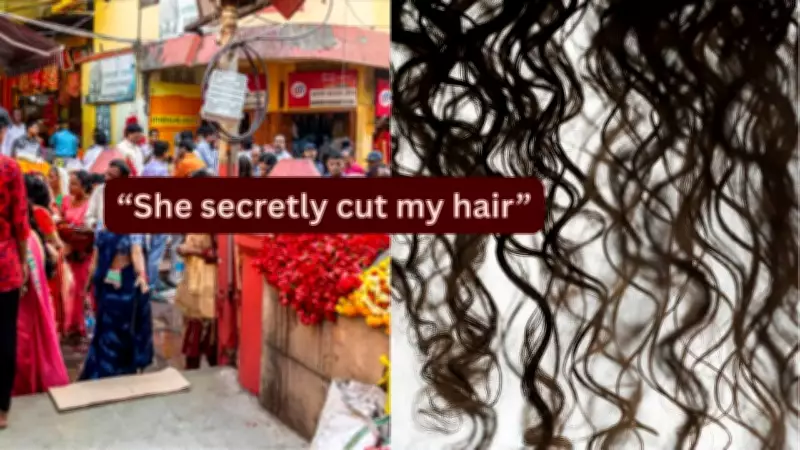
After thanking the priest, we stepped into the vibrant market surrounding the temple complex. Like many temple bazaars in India, it overflowed with religious artifacts—idols of goddesses and packets of famous vermilion associated with Kamakhya. At that time, I had thick, healthy, below-shoulder-length curly hair, which I wore loose. We stopped at an open shop selling colorful bangles, surrounded by a dense crowd of devotees.
Suddenly, a teenage boy sitting with the shopkeeper shouted angrily in Assamese at a woman standing beside me. My friend, who understood Assamese, turned around. A woman in a colorful saree stood incredibly close, with exceptionally long hair hanging loose below her waist. Her eyes looked disturbed and detached. In one hand, she held a small razor blade; in the other, a thick lock of curly hair—my hair! The memory still sends chills down my spine.
In the market chaos, she had silently cut a portion of my hair without my noticing. The boy was the only one who saw it. Before we could react, my friend struck the woman's hand hard, causing the lock to fall to the ground. The woman ran and disappeared into the crowd without uttering a word. I stood frozen, unable to comprehend what had happened.
The elderly shopkeeper urged us to tie our hair, explaining through my friend that such incidents—people trying to obtain hair or personal belongings—were not unheard of at crowded pilgrimage sites across India. Whether due to superstition or personal beliefs, he advised keeping hair tied in places with such powerful energy.
I never discovered who the woman was, and I don't want to know. Perhaps she was struggling with mental illness, or it was an isolated incident. There is no evidence to support assumptions about her intentions, but the experience felt deeply unsettling.
Lessons Learned
Travel often teaches lessons—sometimes about respecting local customs, sometimes about staying alert in crowded places. To this day, whenever I visit busy pilgrimage sites or crowded festivals, I ensure my hair is tied up. While some journeys leave you with souvenirs, this one left me with a lifetime mystery.
(Disclaimer: The views, observations, and experiences described in this article are solely those of the author and are based on a personal incident. The Times of India does not independently verify or endorse the personal opinions or experiences expressed by the author.)

About the Author
Priya Srivastava, from Lucknow, explores life through journeys to unexplored destinations and knitting travel stories. She believes in creating memories, eating like a local, talking to natives, understanding their way of living, and capturing their smiles in her camera. From quaint Himalayan villages to grand Rajasthan forts, serene Goa beaches to ancient Varanasi temples, she unfolds untold sagas. All her journeys are etched on her heart like beautiful paintings. She enjoys experimenting with new dishes and experiencing different cultures, drawing inspiration from travel. An ardent reader, cinema lover, and nascent photographer, she wishes to discover the myriad colors and sounds of nature.