After the glitter of gold fades in the dark when jewellery stores shut their shutters, Itwari's Sarafa Bazaar comes alive with the aroma and flavours of delicacies at food stalls lining the narrow streets of Nagpur.
Day and Night: A Tale of Two Markets
By day, the narrow lanes of Sarafa Bazaar in Itwari glimmer with gold, silver, and gemstones. Shop windows sparkle under white lights, jewellers display ornaments on velvet trays, and generations-old businesses hum with the rhythm of commerce. But as the clock inches past 8 pm and shutters begin rolling down, something magical happens in the old quarters of the city. This is when the gold sleeps, and the flavours awaken.
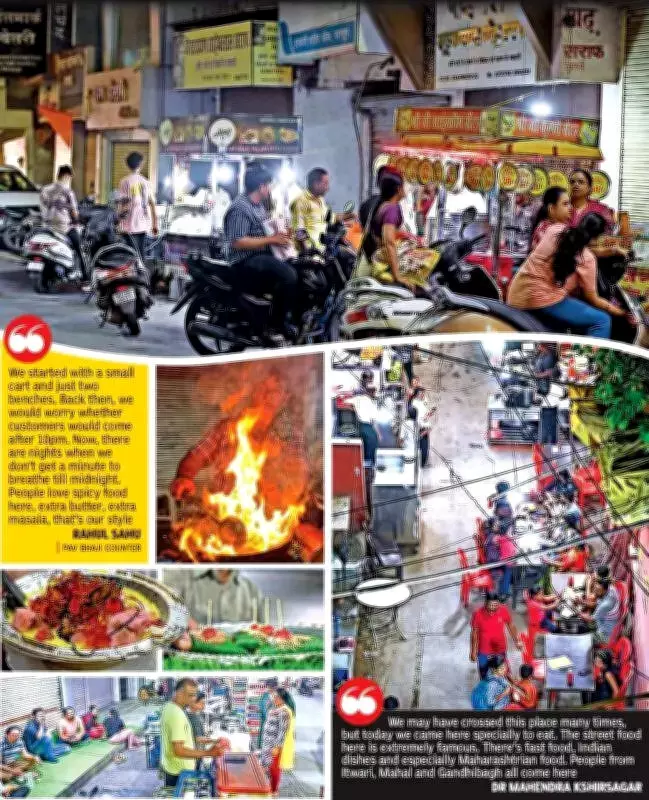
Under yellow streetlights and open skies, the Sarafa Bazaar comes alive in its second avatar — loud, smoky, colourful, and deliciously chaotic. Almost theatrically, the famed jewellery market transforms into a pulsating street food paradise. In minutes, the quiet trading lanes reinvent themselves into a carnival of flavours.

Outside the shops where necklaces glittered, giant tawas crackle with butter. The scent of polished ornaments gives way to the irresistible aroma of roasted spices, sizzling pav bhaji, smoky pulao, and syrupy desserts. Families arrive in groups. College students crowd around momo stalls. Couples walk slowly with kulfis in hand. Children tug their parents toward colourful icy pops and candy counters. Scooters line the roads while vendors shout out orders over the hiss of hot oil and the clang of steel ladles.
For more than a century, this transformation has unfolded almost like clockwork. Long before 'nightlife' became a buzzword, Sarafa had quietly built its own version of it.
A Quiet Charm Compared to Indore
While Sarafa Bazaar in Indore is nationally celebrated as a street food landmark, its counterpart here carries a quieter charm. Hidden inside the dense old city areas near Itwari and Mahal, it doesn't scream for attention. Yet every evening, it challenges the perception that Nagpur sleeps early.
'I am from Kamptee, but we often come here,' says Nadim Qureshi, balancing plates of noodles and sandwiches while navigating through the crowd. 'The pizza, sandwiches, noodles, and especially the ice cream here are amazing. Sundays are the best because families come out together. Also, because of the heat, people now prefer coming in the evening,' he says.
At one corner, giant pav bhaji pans bubble like molten lava. Nearby, vendors rapidly toss noodles in giant woks while clouds of steam rise dramatically into the air. Further down the lane, rows of kulfi counters glow brightly with flavours ranging from traditional malai and kesar pista to chocolate and now, the summer favourite, mango.
The Stories Behind the Stalls
One of the busiest stalls belongs to 34-year-old Rahul Sahu, whose pav bhaji counter has become a Sarafa favourite over the last 15 years. 'We started with a small cart and just two benches,' Rahul says while furiously mashing bhaji into butter. 'Back then, we would worry whether customers would come after 10 pm. Now, there are nights when we don't get a minute to breathe till midnight. People love spicy food here — extra butter, extra masala — that's our style,' he says with a chuckle while customers interrupt him with fresh orders.
Sahu points out that many customers who used to come here as students now come with their children. 'That is the biggest happiness for us,' he says.
A few steps away stands one of the oldest establishments in the lane — an 80-year-old paan shop run by four generations of the same family. The tiny stall, decorated with silver foil packets and colourful supari jars, remains surrounded by customers almost till closing time. 'My great-grandfather started this shop before Independence,' says the owner, Pankaj Kotambkar, while carefully folding a meetha paan. 'At that time, Sarafa was only jewellery shops. Slowly, food stalls started appearing at night,' he says while pointing at old black-and-white photographs in the shop.
'People finish dinner and then come here for paan, sweets, or kulfi. Earlier, our customers were mostly traders. Now, they comprise youngsters, tourists, and entire families.'

A Magnet for All Ages
Dr Mahendra Kshirsagar, visiting with family, said the market carries a charm that goes beyond food. 'We may have crossed this place many times, but today we came here specially to eat. The street food here is extremely famous. There's fast food, Indian dishes, and especially Maharashtrian food. People from Itwari, Mahal, and Gandhibagh all come here.'
At one stall, giant Maharashtrian thalis arrive loaded with spicy curries and bhakris. Nearby, plates of chole bhature disappear within seconds. Sweet counters tempt customers with rabdi, jalebi, and falooda, while teenagers line up for trendy fusion snacks and loaded sandwiches.
Swapnil and Durga, regular visitors to the market for years, said the variety is what keeps the place exciting. 'Every stall has its own unique taste,' says Swapnil, adding, 'Earlier we mostly came for sweets, but now there are so many new options.'
'We tried the Maharashtrian thali today and it was really very good,' says Durga, adding, 'Whether it's chola rice, chole bhature, or sweets, everything here tastes special.'
Perhaps the purest review, however, came from little Kushi, happily clutching an icy pop while standing beside her family. 'I like all the icy pop flavours, kulfi, and Maharashtrian food,' she says excitedly.