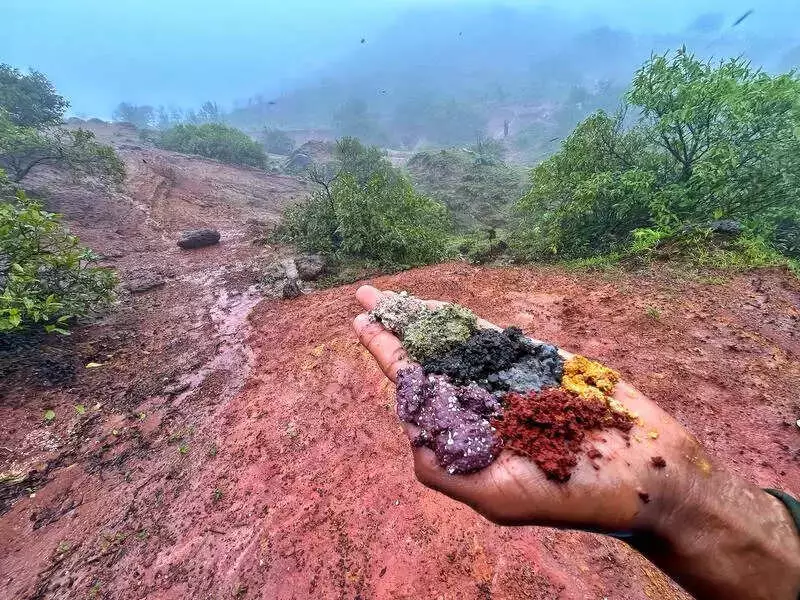
High in the Western Ghats near Pune, a plateau holds a secret painted in the earth itself. The Raireshwar plateau, situated at an elevation of 4,694 feet, is home to a stunning geological formation where soil shimmers in multiple hues. This spectacle tells a dual narrative, deeply rooted in both unwavering local faith and compelling scientific discovery.
A Sacred Tradition and a Warrior's Oath
For generations, residents of Raireshwar village, located roughly 80 kilometres from Pune, have held this coloured earth in deep reverence. They believe the soil is sacred bhasma (holy ash) possessing miraculous healing properties. Dattatray Jangam, president of the Raireshwar Villagers' Organisation, explains the longstanding tradition. "We apply this bhasma to Lord Shiva during festivals. If our cattle fall ill or get injured, we apply this soil to their skin. This practice has been handed down by our ancestors," he says.
The plateau is also historically significant for its ancient Shiva temple. Local legend states that it was here that the great Maratha ruler, Chhatrapati Shivaji Maharaj, took a solemn oath to challenge Mughal authority and establish Swarajya (self-rule). This blend of deep spirituality and historical legacy forms the bedrock of the local community's connection to the land.

The Science Behind the Spectrum
While villagers see divinity, curious trekkers and geologists see a natural marvel, often comparing the site to Peru's famous Rainbow Mountain. The scientific mystery was finally investigated in April 2022 by a team from Bhavatal, a Pune-based non-profit. Led by founder Abhijeet Ghorpade, the study aimed to demystify the colours.
Soil samples were analysed at Fergusson College's chemistry laboratory. "The results confirmed the different shades were due to the presence of laterite and specific metal contents," Ghorpade states. Initially, experts observed about ten colours, but closer scrutiny revealed some were blends. The team conclusively identified six primary shades: red, brown, yellow, purple, moss green, and bottle green.
Retired scientist Vidyadhar Borkar from the Agharkar Research Institute, who was part of the study, explains the geology. The colourful layer is laterite, which sits atop basalt (volcanic rock). "In tropical regions, intense heat and heavy rainfall erode rocks rich in iron and aluminium, forming laterite soil," he says. The vibrant colours come from metallic ions—oxides and hydroxides of iron, aluminium, and manganese, forming minerals like haematite and goethite.
A Tourist Hotspot Seeking Recognition
This natural wonder spans just about 1.5 acres on the 16-km-long plateau. Locals call the spot, located 2 km from the temple, 'vibhutichi khan' or a mine of divine power. In recent years, it has become a major draw for tourists, a trend amplified by social media. Sandip Jangam, a resident who arranges camping, notes, "The soil existed for ages, but national attention came only after people started sharing videos online."
Visitor numbers swell during the monsoon, says local trekker and tour organiser Sachin Deshmukh. He highlights that besides the soil, the plateau is home to unexplored floral variety, and on clear days, offers views of Panchgani's table land near Mahabaleshwar.
However, despite its popularity, many feel the site is neglected. Visitor Kedar Bidwai points out the lack of basic facilities, with people needing to walk up to 3 km to reach the base. "Even though the multi-coloured soil is widely shared on social media, the government has not cared to research or promote it properly," he laments.
Ghorpade adds a final scientific note, stating that while similar soil could exist elsewhere in the Western Ghats due to comparable topography, no other site has been officially documented. "Unless scientifically studied or brought to attention, it's wrong to make claims," he concludes, underscoring the unique status of Raireshwar's rainbow earth—a place where faith and science coexist in vibrant harmony.