

West Asia Conflict Cripples Summer Travel: Fares Soar, LPG Crisis Fuels Uncertainty
The ongoing war in West Asia has delivered a severe blow to the summer travel season, traditionally responsible for one-third of the annual travel trade business. A combination of skyrocketing air fares and profound uncertainty stemming from an acute commercial LPG crisis has resulted in a sharp and unexpected dip in demand.
Air Fares Skyrocket as Airlines Reroute Flights
In response to missile and drone threats in the Gulf region, airlines have been forced to reroute flights, avoiding potentially dangerous airspaces. This operational shift has led to exorbitant increases in air fares. Travel to Europe and the United States has become particularly costly, with fares surging by four to five times their usual rates. Even destinations in South-East Asia and Australia have seen significant price hikes.
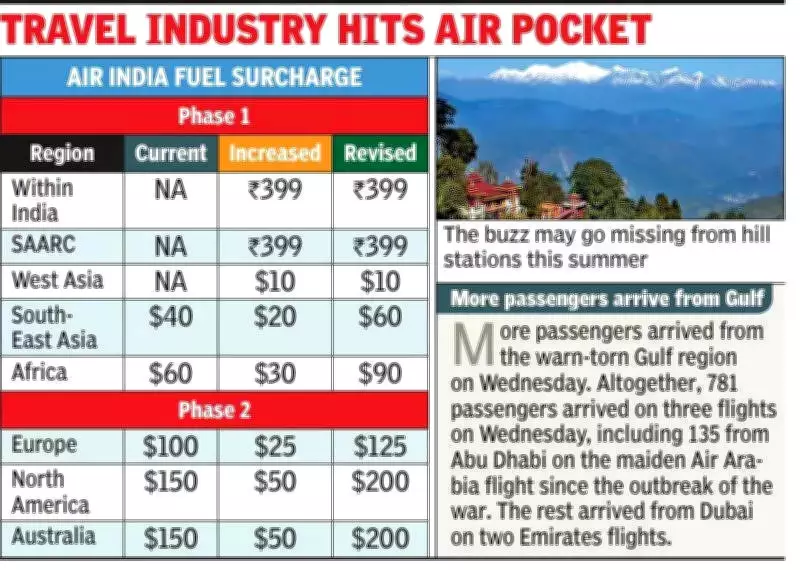
Air India has implemented new fuel surcharges in light of the crisis. For travel within India and SAARC countries, a surcharge of Rs 399 has been added. More substantially, for travel to South-East Asia, the surcharge per ticket has risen from $40 to $60, which translates to approximately Rs 5,500.

Uncertainty Over War Escalation and LPG Crisis Dampens Bookings
While fare increases are a major concern, travel industry experts report that the primary deterrent for travelers is the pervasive uncertainty. The fear of how the conflict might escalate and widen its geographic scope has made many potential tourists hesitant to commit to summer plans.
Compounding this issue is the severe commercial LPG crisis. Travel agents confirm that this shortage is significantly impacting consumer psychology, even affecting demand for domestic tourism. People are worried about traveling only to find hotels and restaurants unable to provide basic services like cooked food due to fuel shortages.
Industry Voices Express Grave Concern
Anjani Dhanuka of the Travel Agents Association of India stated, "Holiday is now the last thing on people's minds. They do not want to travel and then get stuck in a situation where hotels and restaurants are unable to provide food. For the industry, this is the most challenging time since the Covid-19 pandemic."
Anil Punjabi of the Travel Agents Federation of India described the situation as extremely bleak. "We always try to look at the positive picture. But for once, we are advising clients to exercise extreme caution and monitor the situation closely. While airfares may be refundable if flights are cancelled, the same cannot be said for hotel bookings and local travel arrangements," he explained.
The disruption has had professional consequences as well. Debjit Dutta, Chairman of the Indian Association of Tour Operators (IATO), was unable to attend the prestigious ITB Berlin 2026 travel show due to flight disruptions caused by the war's outbreak. He noted that domestic tourism, particularly to hill stations, had a golden opportunity this summer with European travel curtailed, but the LPG crisis has severely undermined that potential.
Ravi Gusain, President of IATO, issued a stark warning: "If the war does not end this month, the entire summer holiday season could be wiped out. This is a devastating scenario for tourism. Approximately 40% of Indians traveling abroad rely on Gulf carriers, which are among the worst affected. Both outbound and inbound tourism will suffer tremendously unless hostilities cease soon."
Personal Impact on Travelers
The crisis is hitting individual families hard. Soumya Mukherjee, a technology professional and resident of Entally, Kolkata, shared his predicament: "We are scheduled to fly to Jaipur next week for a family trip, with a subsequent family function in Bangalore. The trip was planned around my children's school reopening dates. I have not purchased the tickets yet because the sudden fare increase is going to put a significant strain on our finances." His story reflects the difficult choices many Indians are now facing.

The confluence of geopolitical conflict, logistical disruptions, and a domestic fuel crisis has created a perfect storm for the travel industry. With summer bookings plummeting, stakeholders are anxiously hoping for a rapid de-escalation to salvage what remains of the critical travel season.





