

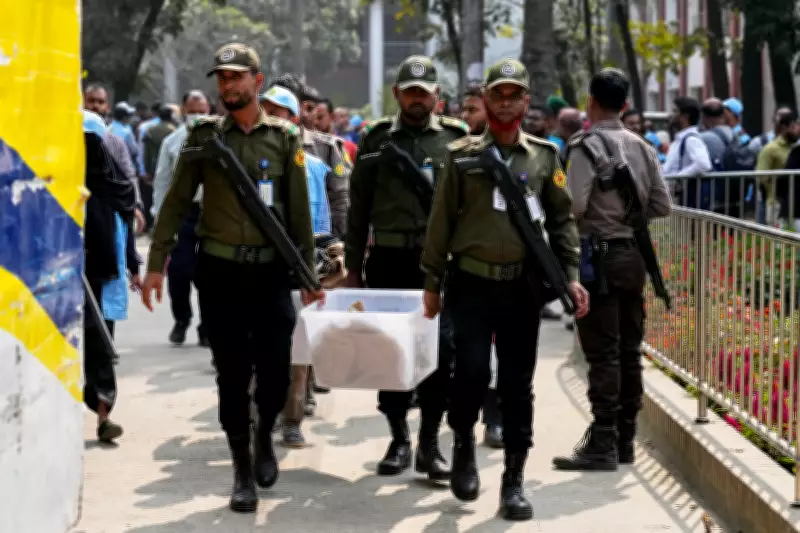
Bangladesh's 2026 Election: Unprecedented Security Deployment for Historic Polls
Bangladesh is preparing for its most technologically advanced and heavily secured general election in history on February 12, 2026, with authorities deploying a staggering 958,000 security personnel nationwide. This massive security operation comes as the country holds its first parliamentary elections since the 2024 mass uprising that toppled former Prime Minister Sheikh Hasina.
Record-Breaking Security Measures
Police Inspector General Baharul Alam revealed that nearly 24,000 out of approximately 43,000 polling centers across Bangladesh have been classified as "high" or "moderate" risk-prone. In the capital Dhaka alone, 1,614 of 2,131 polling stations have been flagged as potentially problematic.
Election Commissioner Abul Fazal Mohammad Sanaullah emphasized that security arrangements are based on detailed local sensitivity assessments. "Security deployment is being made based on local sensitivity assessments," he stated during a media briefing, adding that the Election Commission expects law enforcement agencies to ensure a peaceful atmosphere for voters.

Technological Surveillance Firsts
For the first time in Bangladesh's electoral history, authorities are deploying:
- Unmanned Aerial Vehicles (UAVs) and drones for aerial monitoring
- 25,000 body-worn cameras for police personnel, particularly in Dhaka
- CCTV surveillance covering nearly 90% of polling stations
Sanaullah explained that some body cameras are IP-based for live feeds, while others record locally. The comprehensive surveillance network represents a significant technological upgrade from previous elections.
Election Details and Context
The elections are being overseen by an interim administration led by Nobel laureate Muhammad Yunus and coincide with a referendum on an 84-point reform package. Key election details include:
- Voting in 299 constituencies (Sherpur-3 postponed due to candidate death)
- Polling hours from 7:30 am to 4:30 pm
- 42,659 polling centers nationwide
- 127.7 million registered voters, including 3.58% first-time voters
- 1,981 candidates contesting parliamentary seats
The national legislature comprises 350 members, with 300 directly elected from single-member constituencies and 50 reserved seats for women.
Political Landscape and International Scrutiny
Following the disbanding of Hasina's Awami League and its exclusion from the polls, the contest is primarily between the Bangladesh Nationalist Party (BNP) and its former ally, Jamaat-e-Islami. Pre-election surveys suggest the BNP, led by Tarique Rahman, is the frontrunner.
Approximately 500 foreign observers, including representatives from the European Union and Commonwealth, are expected to monitor the electoral process. The election represents a crucial test for Bangladesh's democratic recovery after years of disputed polls and shrinking civic space.
Minority Concerns and Democratic Stakes
Rights groups have expressed concerns about increased intimidation and violence against minority communities, particularly Hindus who constitute about 8% of Bangladesh's predominantly Muslim population of 170 million.
Catherine Cooper, staff attorney at the Robert & Ethel Kennedy Human Rights Centre, emphasized the importance of protecting civic space. "It is critical that the newly elected government prioritize and protect civic space, allowing civil society, the press, political opposition, and all citizens to speak without fear of repression," she stated.
For nearly five million first-time voters and the broader electorate, Thursday's vote represents more than a political contest—it's seen as a referendum on whether the momentum of the 2024 uprising can translate into lasting democratic reform.
With unprecedented security measures including record personnel deployment, comprehensive camera surveillance, and aerial monitoring, authorities assert that the security architecture is fully prepared. Whether this massive operation reassures voters and facilitates a peaceful transfer of power remains to be seen, with domestic and international observers watching closely.






