Union Budget 2026: Beyond Policy Poetry to Tangible Education Delivery
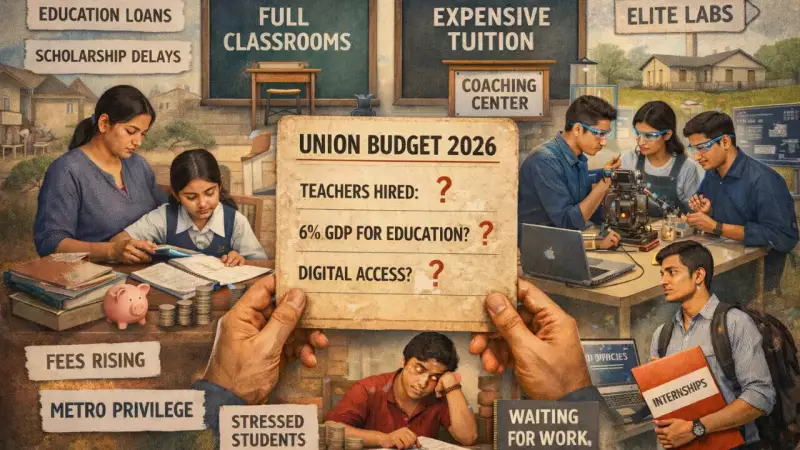
The upcoming Union Budget 2026 will be interpreted not as a conventional policy document but as a comprehensive report card—evaluated by two critical stakeholders who seldom align perfectly yet consistently bear the consequences: the parents who finance the educational journey and the students who shoulder its academic weight. For India's youth, this budget transcends political speechmaking; it represents a concrete commitment to their everyday reality. The distinction lies between classrooms where qualified educators consistently appear versus environments where learning defaults to external coaching centers. It separates "digital learning" as mere political slogan from digital learning as functional reality—comprising usable devices, reliable connectivity, and pedagogically equipped teachers.
Equity as the Central Examination
This budget also serves as a crucial fairness assessment: Will advanced laboratories, AI-enabled educational tools, and skill development programs extend beyond elite private institutions and metropolitan campuses, or will they perpetuate as another postal-code privilege masquerading as reform? Parents will analyze the identical budget through their household financial ledgers. They will search for genuine affordability indicators—timely scholarship disbursements and education loans that facilitate upward mobility rather than becoming slow-burning debt traps.
Families will additionally seek provisions for an element rarely highlighted in budget headlines yet dominating student existence: comprehensive well-being support. Within an education ecosystem where stress has evolved into an unofficial parallel curriculum, counseling and mental health services can no longer be dismissed as "soft" additions. Increasingly, families regard these as fundamental infrastructure—as essential as physical classrooms and library resources.

Core Expectations from Budget 2026
Budget 2026 will ultimately be judged not by the quantity of announced schemes but by its effectiveness in making schooling and higher education less reliant on private coping mechanisms—and more dependably public, aligning with the foundational assumptions of a functioning republic. Here are the principal areas where students and parents seek substantive progress, mapped directly to their lived pressures rather than governmental program listings.
Funding Learning Outcomes Over Scheme Expansion
Parents experience education not through policy announcements but through observable outcomes: whether their child can independently read paragraphs and execute basic arithmetic without requiring expensive private tuition. Consequently, Budget 2026 anticipations emphasize visible foundational improvements rather than novel program nomenclature. The authentic examination lies in what budgetary allocations support within school premises.
When expenditures target activities between morning assembly and afternoon dispersal, results become palpable:
- Increased instructional time dedicated to literacy and numeracy within regular timetables
- Classroom libraries with graded reading materials enabling daily practice
- Simple mathematics kits helping children comprehend concepts like subtraction rather than fearing them
Parents additionally seek sensible assessment mechanisms: frequent, brief skill evaluations demonstrating genuine progress rather than memory-intensive examinations, coupled with teacher support that reaches actual classrooms beyond one-time training certifications. India's NIPUN Bharat mission establishes the ambitious target of universal foundational literacy and numeracy by 2026–27; Budget 2026 represents the moment when this objective either receives substantial backing or subtly postpones into the future.

Teacher Recruitment and Continuous Training as Primary Expenditure
For students, no alternative replaces a competent, regularly-present teacher. For parents, teacher availability secretly determines whether private coaching transforms from optional supplement to "mandatory" requirement. Official data already highlights capacity limitations: The government's UDISE+ report indicates single-teacher schools remain distressingly numerous at 104,125 during 2024–25. Simultaneously, established policy frameworks position training as essential infrastructure—Samagra Shiksha's implementation framework explicitly supports induction and in-service teacher training through SCERTs and associated institutions.
In Budget 2026, families anticipate one unambiguous shift: elevating teacher hiring and ongoing professional development to primary expenditure status rather than marginal add-ons.
Credible Roadmap Toward 6% GDP Allocation for Education
This longstanding commitment resurfaces periodically precisely because it remains unfulfilled. The National Education Policy 2020 explicitly states that central and state governments will collaborate to increase public education investment to 6% of GDP "at the earliest." Families may not dissect fiscal federalism complexities, but they will scrutinize Budget 2026 for a believable implementation pathway: clear timelines, logical sequencing, and transparent visibility.
A Parliament response dated December 4, 2024, cites official estimates indicating combined central and state/UT education expenditure reached merely 4.12% of GDP during 2021–22 (based on "Analysis of Budgeted Expenditure on Education" data). The numerical gap is now evident, and public expectations will correspondingly intensify.
Comprehensive Digital Access: Devices, Connectivity, and Teacher Readiness
Students interpret "digital learning" through practical requirements: functional devices, affordable data access, and instructors proficient in utilizing both. Absent this triad, digital initiatives cease being solutions and become inequality amplifiers. Previous budget messaging emphasized connectivity, targeting broadband provision for all government secondary schools via BharatNet within three years.
A Lok Sabha reply from December 3, 2025, documented 67,955 operational FTTH connections in government schools under this program. UDISE+ infrastructure updates indicate school-level progress too: computer access availability increased from 57.2% in 2023–24 to 64.7% in 2024–25. Budget 2026 will consequently be evaluated on whether "digital" signifies the complete stack—devices, dependable connectivity, and teacher preparedness—rather than mere fiber-optic cables.
AI and Advanced Laboratories Beyond Elite Institutions
When artificial intelligence and "future skills" initiatives remain confined to privileged campuses, students correctly perceive this as performative reform. Families seek more fundamental evidence: confirmation that advanced learning resources will disseminate beyond handfuls of metropolitan centers, particularly reaching government schools where opportunity should inherently be public.
The government's own Budget 2025–26 proposal emphasized innovation, pledging 50,000 Atal Tinkering Labs in government schools over five years. However, by Budget 2026, the measurement standard evolves. Laboratories cannot persist as ribbon-cutting infrastructure—photogenic yet pedagogically shallow. Parents and students will monitor signals that transform these spaces into genuine learning environments:
- Timetabled laboratory sessions integrated into curricula
- Functional mentor networks that consistently engage
- Consumables and maintenance budgets that don't deplete mid-academic term
- Teachers adequately trained to conduct hands-on sessions beyond annual "activity" events
The fundamental principle remains equity. A student in a district headquarters—or a modest town slightly beyond—should not receive future-skills education secondhand while flagship urban institutions obtain priority access.
Skills Embedded Within Curricula, Not Add-On Certificates
Students weary of being instructed to "complete an additional course" after finishing their degrees. The expectation shifts toward institutional integration: skills and experiential learning as credit-bearing components within formal schooling and higher education. Policy architecture already exists for this transformation: The National Credit Framework (NCrF) operates as a unified meta-framework merging academics, skilling, and experiential learning, implemented through the Academic Bank of Credits.
UGC's internship guidelines similarly permit credit allocation for internships within undergraduate programs. Budget 2026 expectations will concentrate on whether this framework becomes routine practice rather than PDF-file promises.
Authentic Education-to-Employment Bridges Via Apprenticeships
The present moment demands fewer motivational addresses and more paid, structured workplace exposure. The scaffolding, theoretically, already exists. UGC's Apprenticeship Embedded Degree Programme Guidelines 2025 position apprenticeships as connectors between classroom learning and employer requirements, mandating formal tripartite agreements among higher-education institutions, employers, and students.
Regarding skilling, the National Apprenticeship Promotion Scheme outlines government support mechanisms, including stipend-sharing up to notified limits. Budget 2026 will therefore be examined with intensely practical questions: Does this remain a framework benefiting the well-connected, or does it become scalable pathways? Students and parents will seek indicators of expanded reach—increased apprenticeship seats, clearer employer incentives, predictable stipend flows, and access not restricted to specific sectors, cities, or "top-tier" colleges.
Essentially, not another employability slogan but a pipeline genuinely accessible to ordinary students.
Education Affordability: Reliable Scholarships and Safer Student Loans
For parents, affordability isn't theoretical debate but monthly financial calculation. In Budget 2026, families will search for signals that educational costs aren't being stealthily transferred to households—through elevated out-of-pocket expenses, coaching dependency, or unsustainable debt. Consequently, scholarships remain frontline expectations: not merely additional schemes on paper but clearer targeting and predictable, timely disbursements.
Student loans occupy similar territory. Under the Centre's CSIS interest-subsidy scheme, eligible borrowers receive interest subsidies during moratorium periods—the study years when students aren't earning. For learners, this moratorium isn't technical jargon but the difference between graduating with breathing space versus confronting immediate EMI obligations. Budget 2026 will thus generate expectations for affordability support that's simple to access, clearly communicated, and dependable.
Student Well-Being as Core Institutional Infrastructure
Students rarely request "mental health policy." They seek something simpler: at least one responsible adult within the system who takes their concerns seriously before distress escalates into headlines. Parents increasingly treat well-being as institutional capability—not burdens families must manage independently.
The Ministry of Education's MANODARPAN operates as an official platform for student psychosocial support, positioned as assistance "during COVID and beyond." NCERT similarly describes it as a mechanism enabling students to seek help from mental-health experts and counselors. Budget 2026 expectations will therefore focus on whether counseling transitions from helpline-style safety nets to authentic institutional layers—trained campus counselors, clear referral pathways, and sustained support beyond crisis-intervention advice.
Delivery Versus Another Draft Document
Union Budget 2026 won't be remembered for speechwriting elegance but for implementation physics: what it financially supports, what it reiterates, and what it tacitly leaves for households to "manage." This constitutes the lived economics of Indian education—where state intentions often appear noble, yet family coping mechanisms demonstrate superior organization.
When public spending inadequately nourishes learning outcomes, parents don't convene pedagogical roundtables; they simply pay for tuition. When teachers are insufficient or inadequately supported, coaching doesn't remain market choice; it becomes the market itself. When "digital" signifies fiber without devices, or devices without teacher readiness, technology stops being reform and starts functioning as sorting machinery—dividing those who can convert connectivity into learning from those merely watching buffering icons.
This pattern replicates wherever systems falter. Laboratories and AI programs cluster within few postal codes while being labeled "future-ready." Beyond those zones, the future arrives as hearsay. Skills are announced like banners, then sold back to students as certificates. Work exposure gets promised yet frequently delivered through networks—internships for the connected, webinars for the remainder.
Within the chasm between policy and practice, a parallel education economy flourishes: coaching centers, crash courses, paid projects, private counseling—each representing private invoices for public shortfalls. What families bring into Budget 2026 isn't wish-lists but sharpened impatience born from experience. They desire affordability with dignity: scholarships arriving punctually, loans not secretly hardening into lifelong anxieties, and counseling existing inside institutions.
What remains uncertain is whether the system will behave less like trial subscriptions—free until fine-print scrutiny—and more like public guarantees.