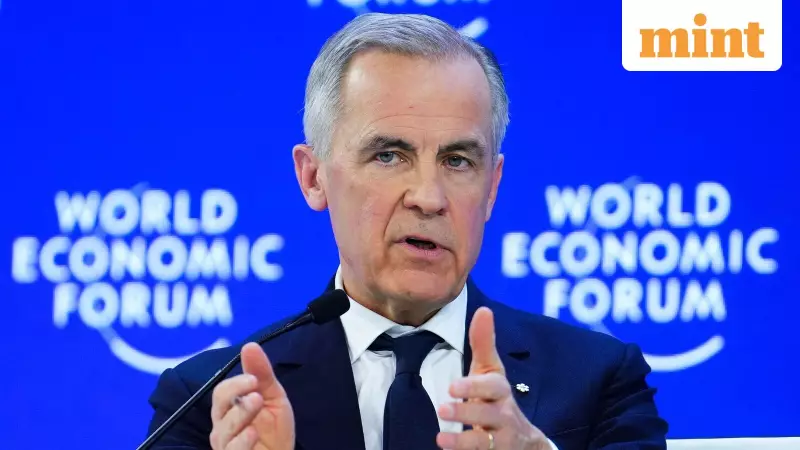
US-Canada Diplomatic Spat Intensifies Over Carney's Call for Small Power Unity
Washington and Ottawa are embroiled in a heated diplomatic confrontation following Canadian Prime Minister Mark Carney's bold advocacy for smaller nations to collectively resist what he characterizes as American economic and military bullying. The dispute marks a significant deterioration in bilateral relations, with the Trump administration expressing open fury at Carney's recent international maneuvers.
Carney's Provocative Moves at Davos and Beyond
In a series of calculated actions over the past week, Prime Minister Carney has:
- Resolved a longstanding trade dispute with China, America's primary strategic competitor
- Delivered a landmark speech at the World Economic Forum in Davos explicitly urging smaller powers to unite against economic coercion from global superpowers
- Positioned Canada as a potential leader for middle powers seeking alternatives to traditional great power dominance
These developments have been interpreted internationally as a direct challenge to the Trump administration's foreign policy approach, particularly as President Trump simultaneously threatened European nations over Arctic territories.

Trump Administration's Angry Response
The reaction from Washington has been swift and severe. President Trump personally confronted Carney during his own Davos appearance, declaring "Canada lives because of the United States" and demanding greater gratitude from the Canadian leader. Subsequent actions included:
- Revoking Canada's invitation to join the Board of Peace via Truth Social
- Commerce Secretary Howard Lutnick accusing Carney of "an arrogant kind of thought" and comparing his speech to whining
- Treasury Secretary Scott Bessent dismissing the speech as mere "value-signaling" rather than substantive policy
Administration officials have suggested Carney's China trade agreement could undermine ongoing USMCA renegotiations, adding economic dimensions to the diplomatic conflict.
Carney's Defiant Counter-Response
Upon returning to Canada, Prime Minister Carney delivered a forceful rebuttal before a domestic audience. He emphasized Canada's historical foundations in "partnership over domination, and collaboration over division" while directly addressing Trump's comments: "Canada doesn't live because of the United States. Canada thrives because we are Canadian."
Carney called for renewed efforts to rebuild Canada's economy while reducing dependence on the United States, framing this as a central policy priority for his administration.
Broader Implications for US-Canada Relations
This confrontation represents the latest rupture in a relationship that has deteriorated significantly since Trump took office. Historical context reveals:
- Immediate imposition of tariffs on Canada after decades of duty-free trade
- Previous Trump administration musings about economic coercion to potentially annex Canada
- Ongoing uncertainty about USMCA's future as formal renegotiations approach
According to Fen Hampson, professor of international affairs at Carleton University, Carney's actions signal a fundamental belief that "the decades-old economic and security bargain with the U.S. is over." This represents a strategic pivot toward diversification and coalition-building among rules-based trading partners.
Economic Vulnerabilities and Strategic Calculations
Canada faces significant economic challenges in this confrontation:
- Approximately 80% of Canadian exports to the US currently arrive duty-free under USMCA
- The Canadian economy remains highly exposed to US trade relationships
- Business investment and hiring remain tepid pending USMCA's resolution
- Military capabilities remain dependent on US support for adequate defense
Despite these vulnerabilities, Carney's Davos speech articulated a clear vision for middle powers, warning that "if we're not at the table, we're on the menu" when dealing with global hegemons. He advocated for issue-specific coalitions rather than bilateral negotiations from positions of weakness.

International Reactions and Parallel Developments
Carney's stance has resonated beyond North America:
- European powers have increased pushback against Trump administration policies
- UK Prime Minister Keir Starmer expressed outrage over Trump's NATO comments
- Davos attendees reportedly responded positively to Carney's framing of global challenges
However, Carney faces domestic criticism for engaging China despite concerns about foreign interference and human rights records. His response that China represents "a more reliable trading partner than the U.S." reflects pragmatic calculations about global economic realities.
Expert Perspectives on Risks and Opportunities
Analysts offer mixed assessments of Carney's strategy. Bill Bishop notes potential Chinese leverage over Canada through increased trade dependence, while former diplomat Louise Blais acknowledges the speech's resonance but warns about Canada's limited capacity to withstand economic retaliation given deep integration with the US economy.
Blais particularly emphasizes that "statements of shared values still matter, but only when they are backed by the ability to say no without inflicting debilitating harm on oneself" – a capability she believes Canada currently lacks.
As USMCA renegotiations approach this summer, this diplomatic confrontation sets the stage for potentially transformative changes in North American economic and political relationships, with implications extending far beyond bilateral ties to affect global middle power dynamics in an increasingly polarized world order.