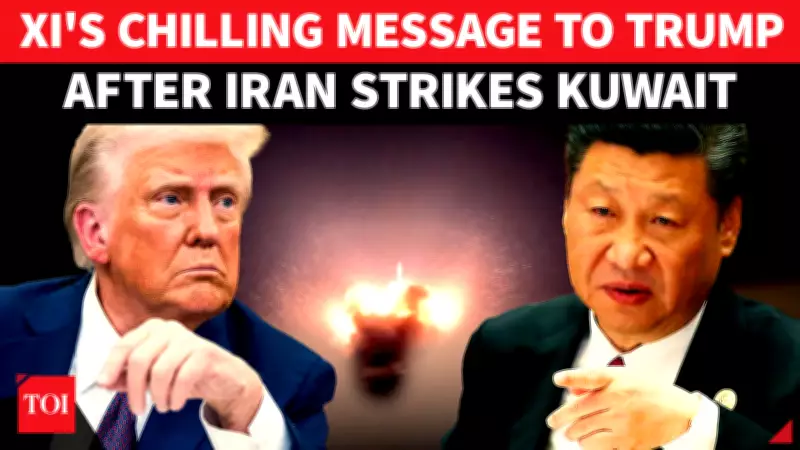
China has issued a strong warning to the United States and Iran, urging both nations to exercise restraint after a fresh wave of military exchanges threatened to unravel the fragile ceasefire in the Gulf. Chinese Foreign Ministry spokesperson Mao Ning expressed Beijing's deep concern over the escalating tensions and called on all sides to honor their ceasefire commitments and pursue diplomatic solutions.
The remarks came after a reported Iranian drone and missile strike on Kuwait International Airport resulted in one fatality and several injuries. The attack marks a significant escalation in the ongoing conflict, raising fears of a broader regional war.
China's Call for Restraint
In a press briefing, Mao Ning stated, 'Stop playing with fire. The situation in the Gulf is already volatile. We urge the United States and Iran to de-escalate immediately and return to the negotiating table.' She emphasized that Beijing supports all efforts to maintain peace and stability in the region.

Impact on Ceasefire
The strike on Kuwait comes just weeks after a tenuous ceasefire was brokered between the US and Iran. Analysts warn that the incident could derail diplomatic progress and lead to a full-scale conflict. The international community has reacted with alarm, with several nations calling for an emergency UN Security Council meeting.
Regional Reactions
Kuwaiti authorities have condemned the attack, calling it a 'blatant violation of international law.' Meanwhile, Iran has not officially claimed responsibility, but sources indicate the strike was in retaliation for recent US airstrikes on Iranian positions in Syria.
Broader Implications
The escalation has also drawn attention to the role of other regional players. Israel, which has been involved in covert operations against Iranian assets, faces growing domestic unrest. Ultra-Orthodox Jews stormed a police compound in Jerusalem, and protests against Prime Minister Netanyahu's policies have intensified.
In Europe, tensions remain high as the conflict threatens global oil supplies. The UK and France have urged both sides to exercise maximum restraint.
Analysis
Experts believe that China's warning reflects its strategic interest in maintaining stability in the Gulf, a key source of its energy imports. Beijing has positioned itself as a neutral mediator, but its influence is limited compared to the US and Russia.
As the situation develops, the world watches anxiously for any further escalation that could tip the region into chaos.