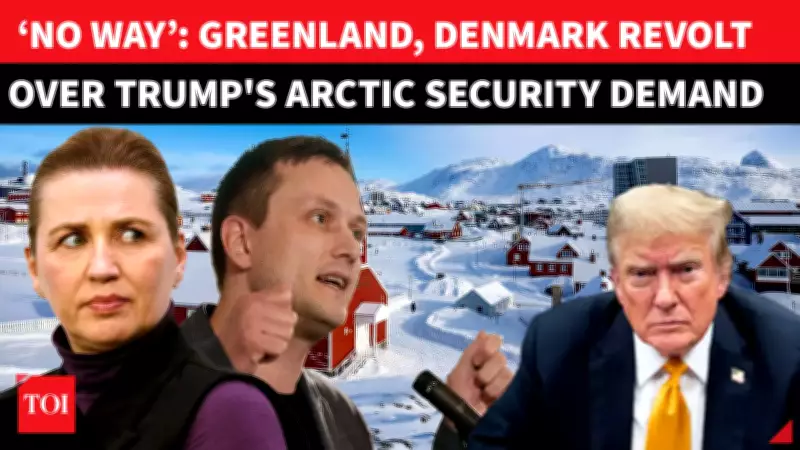
Danish Prime Minister Delivers Strong Rebuke Over Trump's Greenland Ambitions
Danish Prime Minister Mette Frederiksen has issued a forceful condemnation of former U.S. President Donald Trump's persistent threats to acquire Greenland, labeling the pressure as "unacceptable" during her address at the prestigious Munich Security Conference. The diplomatic confrontation unfolded following a brief 15-minute closed-door meeting with U.S. Senator Marco Rubio, highlighting escalating tensions over the strategic Arctic territory.
A Firm Stance on Sovereignty
Frederiksen's remarks represent a significant escalation in Denmark's response to what she characterized as inappropriate geopolitical maneuvering. "The pressure being exerted on Greenland is completely unacceptable," the Prime Minister declared unequivocally during her conference appearance. Her statement comes amid renewed attention to Trump's longstanding interest in purchasing Greenland, an autonomous territory within the Kingdom of Denmark that holds substantial strategic importance due to its Arctic location and natural resources.
Closed-Door Diplomacy Precedes Public Rebuke
The diplomatic exchange occurred after Frederiksen engaged in a 15-minute private discussion with Senator Marco Rubio, a prominent Republican figure known for his foreign policy expertise. While the exact content of their conversation remains confidential, observers note that the timing suggests the Greenland issue was likely a central topic. This private diplomatic engagement immediately preceded Frederiksen's public criticism, indicating coordinated messaging from the Danish government.

Strategic Implications of the Arctic Territory
Greenland's geopolitical significance cannot be overstated, with several key factors contributing to international interest:
- Strategic Location: Positioned in the Arctic region with growing importance for global shipping routes
- Resource Wealth: Substantial deposits of rare earth minerals and potential oil reserves
- Climate Significance: Central to climate change research and environmental monitoring
- Military Value: Strategic positioning for defense and surveillance capabilities
Frederiksen's strong language reflects Denmark's determination to protect its sovereignty over the territory while navigating complex international relationships.
Broader Context of Munich Security Conference
The Munich Security Conference serves as a critical platform for global leaders to address pressing international security concerns. Frederiksen's comments emerged alongside numerous other significant diplomatic exchanges at the event, including:
- Chinese Foreign Minister challenging Japan regarding Taiwan
- Czech Deputy Prime Minister confronting Hillary Clinton on multiple issues
- German officials promising closer ties with India while acknowledging BRICS relationships
- Iran and Russia coordinating positions against European interests
This context underscores how the Greenland dispute represents one facet of broader geopolitical realignments and tensions being negotiated at the highest levels of international diplomacy.
Historical Context of Trump's Greenland Interest
Donald Trump's fascination with acquiring Greenland dates back to his presidency, when he publicly floated the idea of purchasing the territory. The proposal was immediately rejected by Danish officials, with then-Prime Minister Mette Frederiksen calling the notion "absurd" in 2019. The renewed attention to this issue suggests ongoing interest from Trump-aligned political figures, potentially signaling future foreign policy directions should Trump return to political prominence.
The Danish government's firm stance demonstrates their commitment to territorial integrity while navigating the complex dynamics of transatlantic relationships. As Arctic competition intensifies, Greenland's status will likely remain a point of diplomatic contention between Denmark, the United States, and other global powers with interests in the region.