

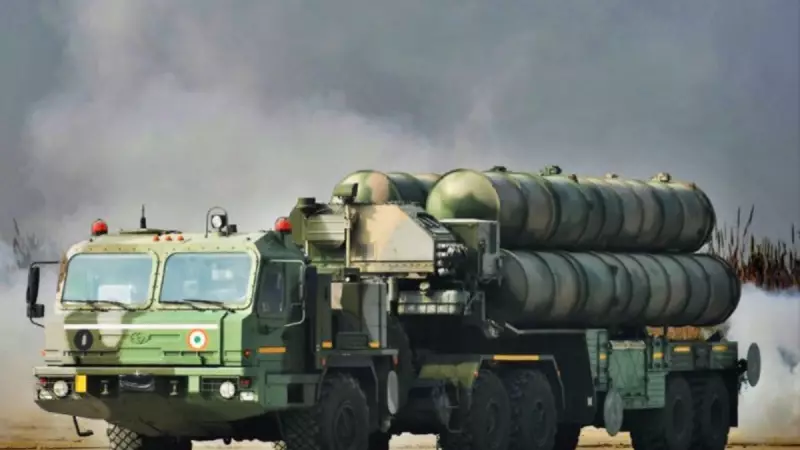
In a significant strategic reveal, the Indian Air Force (IAF) has publicly shared the first official image of its formidable S-400 Triumf air defence missile system. This visual confirmation, released on December 28, 2024, marks a pivotal moment for India's national security apparatus, showcasing the operational deployment of one of the world's most advanced long-range surface-to-air missile (SAM) systems.
Unveiling India's Aerial Shield: The S-400 System in Focus
The released image provides a clear look at the mobile launcher vehicles of the S-400 system, highlighting its readiness and integration into the IAF's inventory. Acquired from Russia under a multi-billion dollar deal signed in October 2018, the S-400 Triumf is a game-changer for India's air defence capabilities. The system is designed to engage and destroy a wide spectrum of aerial threats, including:
- Stealth aircraft
- Strategic bombers
- Ballistic and cruise missiles
- Unmanned aerial vehicles (UAVs)
- High-performance fighter jets
The S-400 can simultaneously track up to 300 targets and engage 36 of them at ranges of up to 400 kilometres. Its ability to launch different types of interceptor missiles creates a layered defence, making it exceptionally difficult for adversaries to penetrate Indian airspace.

Strategic Deployment and Operational Readiness
The deployment of the S-400 systems is a carefully calibrated strategic move. Reports indicate that the first squadron has been operational in the Punjab sector, enhancing surveillance and defensive coverage along India's western frontiers. This placement is crucial for monitoring air activity from potential threat vectors.
India is set to receive a total of five regiments (squadrons) of the S-400 system. The delivery schedule, though delayed by global events, has seen steady progress. The revelation of the image underscores that the systems are not just delivered but are actively being deployed and integrated into the IAF's broader Integrated Air Command and Control System (IACCS).
Implications for Regional Security and Defence Posture
The induction of the S-400 Triumf profoundly alters the regional military balance. It provides India with a potent deterrent capability, significantly raising the cost of any aggressive air action by adversaries. The system's long-range engagement capability allows the IAF to establish air dominance deep inside hostile territory without crossing borders.
This acquisition also demonstrates India's strategic autonomy in defence procurement, navigating complex geopolitical pressures. While the deal attracted potential sanctions under the now-defunct US CAATSA law, India proceeded, prioritizing its national security imperatives. The system's compatibility with existing and future Indian defence assets is a key focus, ensuring a seamless network-centric warfare capability.
For the Indian Air Force, the S-400 fills a critical gap in its long-range air defence, complementing other systems like the indigenous MR-SAM and Akash missile systems. It acts as a force multiplier, freeing up fighter jets for offensive roles rather than point defence. Military analysts assert that the S-400, combined with India's growing fleet of Rafale and Sukhoi Su-30MKI fighters, creates a formidable defensive-offensive matrix.
The public release of the image serves multiple purposes: it acts as a transparent update to the citizenry, a signal of operational readiness to the nation, and a clear message of deterrence to potential adversaries. As India continues to bolster its multi-layered air defence shield, the S-400 Triumf stands as a cornerstone of its strategy to secure its skies against evolving and complex threats in the 21st century.






