

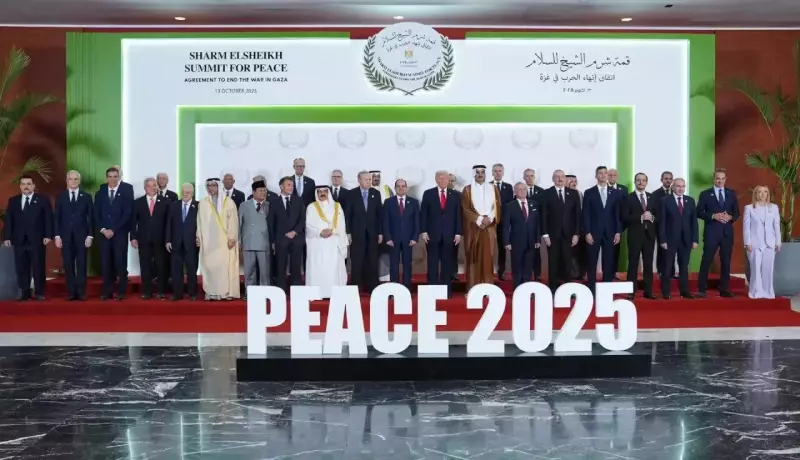
In a significant diplomatic breakthrough, US President Donald Trump alongside regional leaders signed a major peace agreement for Gaza on Monday. The summit, held in Sharm el-Sheikh, Egypt, also witnessed a crucial hostage-prisoner exchange between the warring parties.
The Deal and Immediate Aftermath
The developments, which form key parts of President Trump's 20-point peace plan, unfolded just three days after a ceasefire took effect. Following the truce, Israeli forces withdrew to a pre-determined line. Mediated by the United States, Egypt, and Qatar, this deal comes after months of conflict that began in October 2023 and several failed indirect negotiations in Doha.
By Monday evening, all living hostages held by Hamas were back in Israel. However, the remains of many slain captives were still in Gaza. In return, Israel released hundreds of Palestinian prisoners. The initial phase also mandated a surge of humanitarian aid into Gaza and a partial Israeli pullback from the territory's main cities.

Egypt's foreign minister emphasised that full implementation of this first phase is critical before negotiations on the next stage can begin. The situation, however, remains fragile with deep-seated mistrust between Israel and Hamas.
Thorny Challenges Ahead
The later phases of the Trump-brokered plan will confront far more difficult issues. These include determining Gaza's postwar governance, Israel's firm demand for Hamas to disarm—a condition the group rejects—and Palestinian demands for statehood, which the current Israeli government opposes.
Israeli Prime Minister Benjamin Netanyahu issued a stark warning, stating, "Hamas will disarm and Gaza will be demilitarised. If this can be achieved the easy way, all the better; if not, it will be achieved the hard way." Israel has hinted it may resume military operations if its core demands are not met.
On governance, the U.S. plan proposes an international body to oversee the territory, managed by Palestinian technocrats, explicitly excluding Hamas. It envisions a future, reformed role for Mahmoud Abbas's Palestinian Authority, though no timeline is set. Hamas, conversely, insists any government must be decided by Palestinians alone.
Rebuilding Gaza and Security Concerns
Reconstruction poses a monumental challenge. Estimates from the World Bank and an Egyptian postwar plan suggest at least $53 billion will be needed to rebuild the shattered territory. Egypt plans to host a future reconstruction conference.
The peace plan also stipulates that regional and international partners will help develop a new Palestinian security force. On the ground, while Israeli troops have withdrawn from Gaza City and Khan Younis, they still control about 53% of the enclave, including areas in Rafah and along the border with Israel.
While the deal recognises an independent Palestinian state as an aspiration, Prime Minister Netanyahu has repeatedly rejected its creation. The path forward is fraught, and the success of this fragile truce hinges on navigating these deeply contentious issues in the days to come.






