

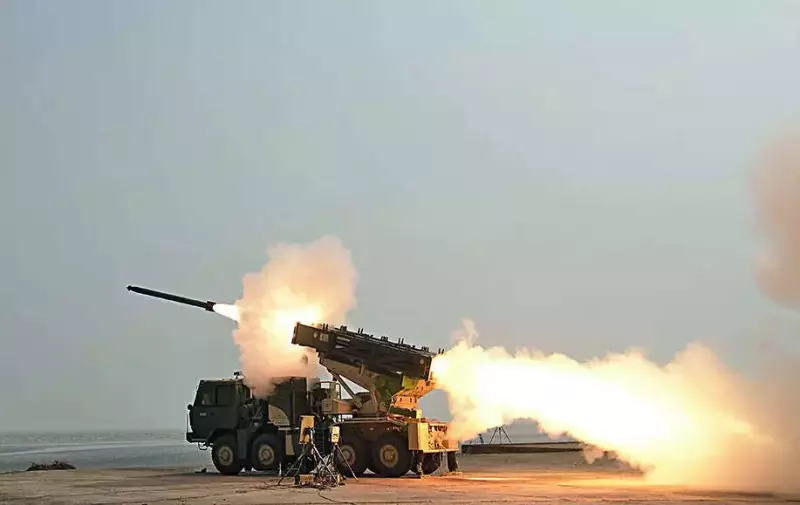
In a significant push to bolster its military capabilities, the Indian defence ministry on Monday granted initial approval for a series of modernisation projects with a combined value of a staggering Rs 79,000 crore. The Defence Acquisition Council (DAC), chaired by Minister Rajnath Singh, accorded the Acceptance of Necessity (AoN) for a wide array of systems ranging from long-range missiles to indigenous drone technology.
Major Acquisitions: Missiles, Drones, and Tankers
The most substantial project to receive the green light is the Rs 30,000 crore procurement of a large number of missiles for the Barak-8 medium-range surface-to-air missile (MRSAM) system. This system, developed jointly with Israel, is operational with the Indian Air Force and Navy. These missiles, with an interception range exceeding 70 km, proved their mettle during the May cross-border hostilities, where they were part of the multi-layered air defence that countered threats including Turkish drones and Chinese-origin missiles.
Further enhancing surveillance, the DAC approved the Rs 1,600 crore lease of two additional MQ-9B 'Predator' high-altitude long endurance (HALE) drones. These will supplement the two already operated by the Navy for long-range missions over a three-year period, bridging a capability gap until India receives 31 armed MQ-9B drones from the US around 2029-30.

Addressing a long-standing need of the Air Force, the council also cleared the over Rs 9,000 crore acquisition of six mid-air refuelling aircraft. Under this project, Israel Aerospace Industries (IAI) will modify six pre-owned Boeing 767 commercial planes into aerial tankers, significantly extending the operational reach of India's fighter jets.
Boosting Indigenous Firepower: Range Extensions and Kamikaze Drones
A key focus of the approvals was on enhancing the reach and lethality of home-grown weapon systems. Two crucial design and development projects received the AoN: range extensions for the Astra Mark-2 air-to-air missiles and the Pinaka guided rocket ammunition.
The Pinaka rocket system, which currently strikes targets up to 75 km away, is set for a major upgrade. Its deep-strike capability is being increased to 120 km, a enhancement successfully tested just a day before the DAC meeting. Future plans aim to extend this range to an impressive 300 km.
Similarly, the Defence Research and Development Organisation (DRDO) is working on doubling the range of the Astra air-to-air missiles from 100 km to 200 km. The IAF is expected to place an initial order for 600-700 Astra-2 missiles, with a future Astra-3 variant envisioned with a 350 km range.
In a move towards self-reliance in precision strikes, the DAC approved the procurement of 850 'Make in India' kamikaze drones or loitering munitions for the Army's new artillery units, 'Shaktibaan' and 'Divyastra', at an estimated cost of Rs 2,000 crore. These will be produced domestically, either by Indian companies or through foreign collaboration.
Counter-Drone Tech and Other Critical Approvals
Recognising the growing threat from unmanned aerial systems, the council also cleared the indigenous Integrated Drone Detection & Interdiction System Mark-2 (IDD&IS). This system employs 30-kilowatt lasers to disable or destroy small drones and swarms at distances of up to 3.5 km.
Other notable approvals included:
- Additional French Meteor air-to-air missiles (120-150 km range) for the Rafale fighter jets.
- Israeli guidance kits for Spice-1000 precision-guided bombs.
- Overhauls of Mi-17 helicopters in Russia and T-90S main battle tanks in India.
- Acquisition of low-level lightweight radars, naval tugs, simulators for Tejas jets, and secure communication radios.
This massive infusion of funds and technological focus underscores India's commitment to rapidly modernising its armed forces with a strategic mix of imported capability and indigenously developed, cutting-edge firepower.






