

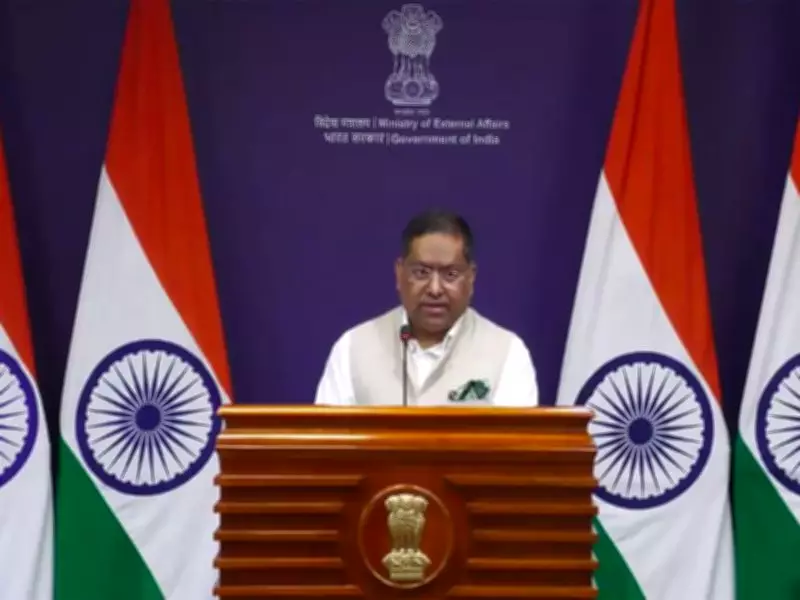
On Tuesday, the Ministry of External Affairs (MEA) reiterated that India's pursuit of energy security for its 1.4 billion citizens is guided strictly by national interest, while also reaffirming its longstanding commitment to Palestine.
Energy Security Based on National Interest
At a press briefing in New Delhi, MEA Spokesperson Randhir Jaiswal stated that India's strategy involves diversifying energy sources to ensure affordability. His comments came amid evolving geopolitical developments in West Asia and questions regarding India's procurement of oil from sanctioned nations and Russian waivers.
"As far as our energy sourcing is concerned, you're well aware that our policy is based on national interest. Our policy is to provide energy at affordable rates and from diverse sources to the 1.4 billion people of India. I have said this on several occasions, and that continues to be the case," Jaiswal told the media.

Strait of Hormuz Traffic Update
With the Strait of Hormuz remaining a global concern, Jaiswal provided a reassuring update on maritime traffic. Since the signing of a Memorandum of Understanding (MOU) on June 17, at least 11 India-bound vessels, including three Indian-flagged crude oil tankers, have successfully transited the critical chokepoint.
"Traffic is going back and forth," Jaiswal noted, confirming that 10 Indian-flagged vessels previously stranded in the region have begun moving, with an expectation that they will clear the passage soon.
"The vessels include three Indian-flagged crude oil tankers, each carrying 285,000 metric tons of crude oil; one foreign-flagged LPG carrier; one foreign-flagged crude oil tanker; and six foreign-flagged bulk carriers carrying fertiliser cargo. It is our expectation and hope that the remaining Indian-flagged vessels would also be able to cross the Hormuz soon," Jaiswal informed.
BRICS NSA Meeting and Iran Talks
New Delhi is currently hosting the BRICS National Security Advisor (NSA) meeting, providing a platform for critical bilateral discussions. Jaiswal confirmed that India's NSA met with his Iranian counterpart to review the volatile situation in West Asia. The talks covered the full spectrum of India-Iran bilateral relations, including ongoing cooperation at the strategically vital Chabahar Port.
"Our National Security Advisor had a meeting with his Iranian counterpart, who is here to attend the BRICS NSA meeting. Both sides reviewed the ongoing situation in West Asia. They discussed various aspects of the developments happening there. They also discussed cooperation under the BRICS platform, as well as various aspects of India-Iran bilateral ties," he said.
Commitment to Palestine
Responding to an urgent appeal from the Palestinian Ambassador regarding the collapse of Gaza's medical infrastructure, the MEA spokesperson highlighted India's enduring commitment to the region. Jaiswal underscored that India has maintained deep ties with Palestine for decades, providing consistent support through bilateral development projects and the United Nations Relief and Works Agency (UNRWA).
"For years and decades, we have had good relations with Palestine. Under the development partnership, we have provided them with several projects. We have provided these projects both bilaterally and through UNRWA. We have also provided them with assistance on humanitarian grounds, and this work will continue in the future," he said.
USD 2.5 Million Contribution to UNRWA
His remarks follow India's announcement in June that it will soon hand over USD 2.5 million to UNRWA as part of its annual contribution. India's Permanent Representative to the UN, Ambassador Harish Parvathaneni, highlighted at the UNSC high table the longstanding development partnership with Palestine.
"We will be handing over in a few days, USD 2.5 million to UNRWA, the first tranche of our annual USD 5 million contribution," he said.
The MEA underscored a delicate balancing act: maintaining its own economic and energy needs while upholding its long-standing role as a partner in humanitarian development for nations facing crisis.






