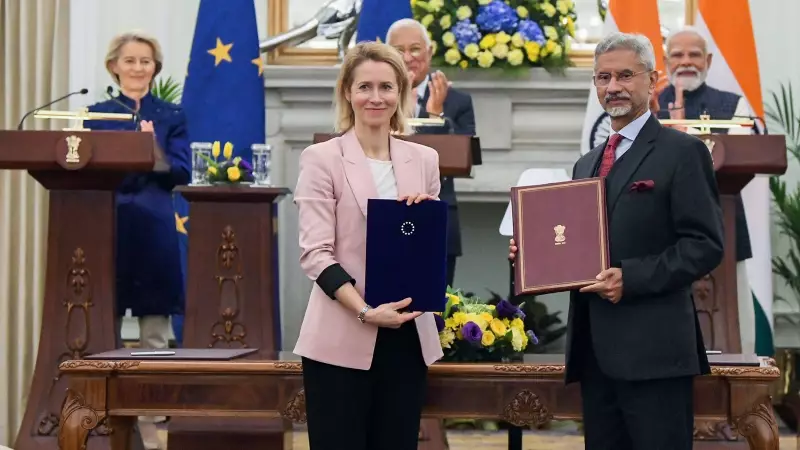
In a notable diplomatic development, India and the European Union have found common ground on critical global issues, particularly regarding Ukraine and Gaza, marking a subtle yet significant shift in their bilateral discourse. This alignment comes after years of diverging views on Russian actions in Ukraine, which have long dominated discussions between Delhi and Brussels.
A Departure from Past Differences
For the past four years, India and the EU have held differing positions on Russia's invasion of Ukraine, with India refraining from explicitly condemning the aggression. However, in a joint statement issued during a high-level meeting in New Delhi, both sides expressed concern over the ongoing war in Ukraine, emphasizing its immense human suffering and global consequences. The statement commits to supporting efforts for a comprehensive, just, and lasting peace based on the principles of the UN Charter and international law, including independence, sovereignty, and territorial integrity.
Key Statements from Leaders
Prime Minister Narendra Modi highlighted the partnership's role in strengthening global stability amid profound turbulence. He noted that respect for multilateralism and international norms remains a shared priority, with both sides united on the need for reforming global institutions to address contemporary challenges.

European Council President Antonio Costa reinforced this sentiment, stating that as the world's largest democracies, the EU and India share the responsibility of upholding international law, with the UN Charter at its core. He referenced Mahatma Gandhi's words on peace through justice and expressed confidence in India's support for creating conditions for peace in Ukraine through dialogue and diplomacy.
Focus on Gaza and Regional Issues
The joint statement also addressed the Gaza conflict, noting the adoption of UN Security Council Resolution 2803, which welcomes the establishment of the Board of Peace and authorizes an International Stabilisation Force. Both sides encouraged full implementation of the resolution in line with international law and reiterated their readiness to support efforts for a just and durable peace, stressing the need for unhindered humanitarian access and a two-State solution through dialogue.
This indicates a cautious approach, with both parties hinting at keeping the Board of Peace limited to Gaza and not extending it beyond. Additionally, the statement discussed recent developments in Iran, underscoring the importance of peaceful resolution through dialogue and diplomacy, sending a signal against military escalation.
Indo-Pacific Cooperation and China
With an eye on China's assertive behavior, the joint statement reiterated a shared commitment to promoting a free, open, peaceful, and prosperous Indo-Pacific in accordance with international law, including UNCLOS. The leaders welcomed closer engagement in the region, such as the inaugural India-EU Consultations on the Indo-Pacific in New Delhi, and looked forward to joint activities under the Indo-Pacific Oceans Initiative and strengthened cooperation in the Indian Ocean Rim Association under India's Chairship.
This comprehensive alignment on multiple fronts reflects a significant evolution in India's foreign policy, moving towards greater convergence with European partners on global security and stability issues.