India and European Union Forge Historic Security and Defence Partnership
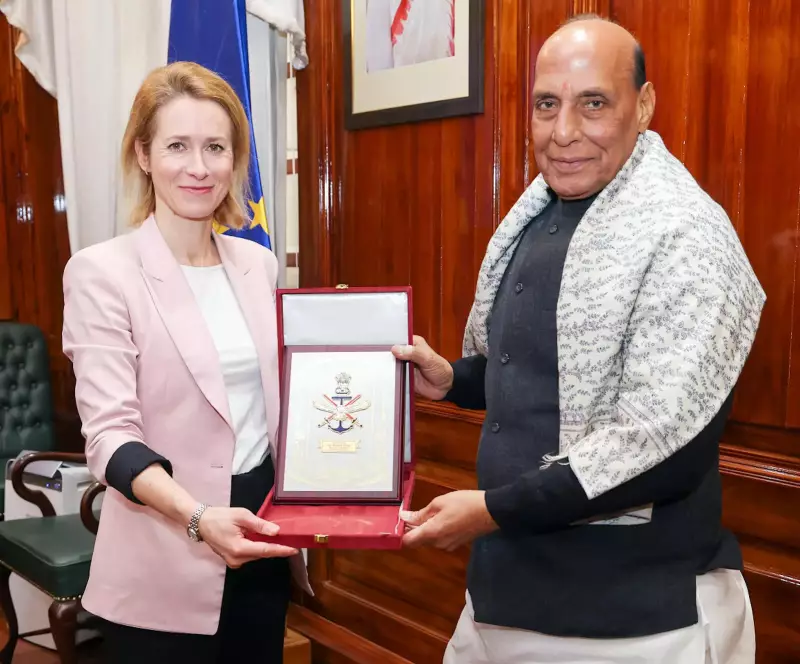
In a significant development for international security cooperation, Defence Minister Rajnath Singh on Tuesday signed a comprehensive security and defence partnership agreement with European Commission Vice-President and EU High Representative for Foreign Affairs and Security Policy Kaja Kallas in New Delhi.
The landmark agreement positions India as the third Asian country to establish such a formal defence partnership with the European Union, following similar arrangements with Japan and South Korea. This strategic move underscores India's growing importance in global security architecture and its deepening ties with European nations.
High-Level Discussions and Strategic Alignment
During the signing ceremony, Rajnath Singh, accompanied by the three service chiefs of the Indian armed forces, held extensive delegation-level talks with the EU delegation led by Kallas. The discussions covered a wide spectrum of bilateral security and defence issues, with particular emphasis on creating opportunities for integrating defence supply chains.

In a post on social media platform X, Rajnath Singh expressed his enthusiasm about the meeting, stating: "Delighted to meet Vice President (HRVP) of the European Union Ms. Kaja Kallas in New Delhi today. Discussed a range of bilateral security and defence issues including opportunities for integrating supply chains for building trusted defence ecosystems and future-ready capabilities. Looking forward to greater cooperation between India and the EU countries."
Comprehensive Cooperation Framework
The newly established partnership creates a robust framework for enhanced collaboration across multiple security domains. According to a European Commission statement, the agreement enables closer cooperation and joint initiatives on shared priorities including:
- Maritime security operations and coordination
- Non-proliferation and disarmament initiatives
- Space security and cooperation
- Countering cyber and hybrid threats
- Joint counterterrorism efforts
The partnership also facilitates strengthened defence industrial cooperation and advances alignment on various defence initiatives between India and EU member states. While tailored to India's specific strategic priorities, the partnership covers a broad spectrum of cooperation areas including peacebuilding, conflict prevention, crisis management, and defence capability development.
Multilateral Engagement and Future Prospects
Kaja Kallas emphasized the importance of deepening ties across multilateral forums during the discussions. She described the signing as "a milestone" and expressed optimism about building upon this foundation for future cooperation.
"There is so much more we can work together on in the multilateral fora, as well as bilaterally, to further develop defence cooperation. I really look forward to our discussions today and further cooperation in the future," Kallas stated during the meeting.
The EU representative also appreciated India's Republic Day celebrations, noting that seeing EU operations represented in the parade demonstrated the growing partnership between the two entities. "It was a proud moment to see that our operations were also a part of this parade. It shows how we have been able to work together," she remarked.
Strategic Significance and Global Context
According to European Union officials, Security and Defence Partnerships represent a key pillar of the EU's efforts to promote peace and security both within Europe and globally. These partnerships serve as a new framework to deepen bilateral relations with non-EU countries in a mutually beneficial manner.
The partnerships form a cornerstone of the EU's Strategic Compass, which was adopted in March 2022 and outlines the bloc's approach to security and defence in a rapidly evolving global environment. Through this strategic framework, the EU has committed to engaging more consistently and comprehensively with its bilateral partners, developing tailored partnerships based on shared values and interests.

This agreement marks a significant step forward in India-EU relations, potentially opening new avenues for technological collaboration, intelligence sharing, and joint security initiatives that could reshape regional security dynamics and contribute to global stability.