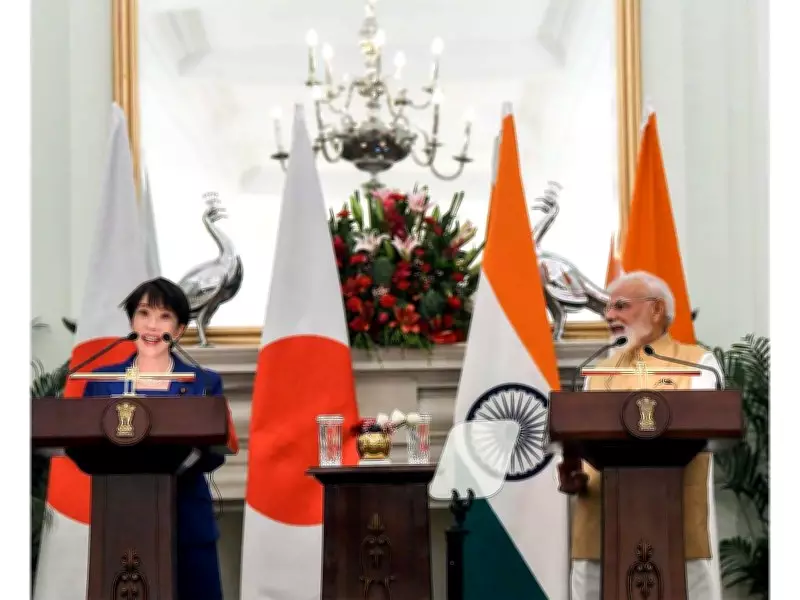
India and Japan on Thursday issued a sharp condemnation of cross-border terrorism originating from Pakistan, demanding immediate global action to dismantle state-supported safe havens and financing channels. The joint statement followed bilateral talks between Prime Minister Narendra Modi and Japanese Prime Minister Sanae Takaichi.
Condemnation of Specific Terrorist Attacks
The two nations condemned in the strongest terms the April 22, 2025 terrorist attack on tourists in Pahalgam, Jammu and Kashmir, noting the United Nations Security Council Monitoring Team Report that implicated The Resistance Front (TRF). They also explicitly condemned the November 10, 2025 car bombing near the Red Fort in Delhi, demanding that perpetrators, organisers, and financiers be brought to justice.
Call for Global Action Against Terror Entities
The prime ministers called for urgent global action against all UN-listed terrorist entities and their proxies, specifically naming Lashkar-e-Tayyiba (LeT), Jaish-e-Mohammad (JeM), Al Qaeda, and ISIS. They emphasised that the international community must root out terrorist safe havens, disrupt the nexus between terror financing and transnational crime, and halt cross-border movement of terrorists.

Concerns Over Maritime Security
The leaders expressed serious concern over the volatile situations in the East China Sea and the South China Sea. They opposed unilateral actions that endanger freedom of navigation and overflight, attempts to change the status quo by force, and militarisation of disputed features. They reaffirmed that all maritime disputes must be resolved peacefully under international law, specifically the United Nations Convention on the Law of the Sea (UNCLOS).
Push for UNSC Reform
The prime ministers reiterated commitment to working with G4 nations to accelerate UN Security Council reform by expanding both permanent and non-permanent member categories. They pledged to push for text-based negotiations under the Inter-Governmental Negotiations framework to secure concrete outcomes within a fixed timeframe. India and Japan endorsed each other's candidatures for permanent seats on a reformed council and confirmed mutual support for upcoming non-permanent seat bids.
Regional Security Flashpoints
The leaders addressed acute security flashpoints across Asia and the Middle East. They expressed grave concerns over North Korea's nuclear and missile programs, demanding complete denuclearisation and urging strict enforcement of sanctions against arms transfers. Regarding the Middle East, they highlighted the need to secure free navigation through the Strait of Hormuz to maintain stable energy supply chains, called for rebuilding Gaza alongside a guaranteed two-state solution, and voiced support for a lasting peace in Ukraine rooted in the UN Charter.
Bilateral Summit and Business Forum
The joint statement came during Takaichi's three-day official visit to India from July 1 to July 3, at the invitation of Prime Minister Modi. She participated in the 16th India-Japan Annual Summit, where both leaders reviewed the full spectrum of bilateral cooperation and discussed regional and global issues. Takaichi also took part in the India-Japan Business Forum alongside PM Modi.