

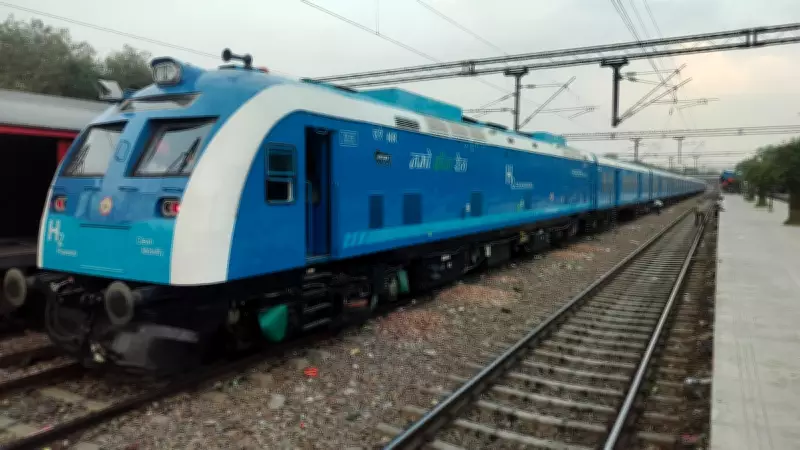
India's first hydrogen fuel cell-based train successfully completed its trial run between Delhi and Jind, reaching a top speed of 120 kmph, according to Indian Railways officials. The trial, conducted on June 26, 2026, marks a significant step towards introducing zero-emission trains on the country's rail network.
Trial Run Details
The hydrogen train, developed by Indian Railways in collaboration with the Ministry of New and Renewable Energy, covered a distance of approximately 120 kilometers from Delhi to Jind in Haryana. The train achieved a speed of 120 kmph during the trial, demonstrating its capability for mainstream operations. Officials stated that the train performed flawlessly, with all systems functioning as expected.
The train is powered by hydrogen fuel cells that generate electricity through a chemical reaction between hydrogen and oxygen, with water vapor as the only byproduct. This technology eliminates direct carbon emissions, aligning with India's goal of achieving net-zero carbon emissions by 2070.

Impact and Future Plans
Indian Railways plans to deploy hydrogen trains on heritage and hilly routes, where electrification is challenging. The success of this trial run paves the way for commercial operations, with the first hydrogen train expected to enter service by late 2026. According to a senior railway official, "This trial validates our hydrogen propulsion technology and brings us closer to sustainable rail transport."
The project is part of Indian Railways' broader strategy to become a net-zero carbon emitter by 2030. Currently, the railways consumes about 2.5 billion liters of diesel annually, contributing significantly to carbon emissions. Hydrogen trains could replace diesel locomotives on non-electrified routes, reducing both pollution and fuel costs.
Technical Specifications
The hydrogen train is equipped with a 500-kW fuel cell system and a battery for energy storage. It can run for up to 1,000 kilometers on a single refueling, with a maximum speed of 140 kmph. The train uses compressed hydrogen stored in cylinders on the roof, and refueling takes about 15 minutes.
Indian Railways has also established a hydrogen production and refueling facility at the Jind station, using electrolysis powered by solar energy. This ensures the entire lifecycle of the train's energy is green.
Environmental Benefits
Each hydrogen train is expected to save approximately 10,000 tonnes of CO2 emissions per year compared to diesel trains. With plans to introduce 50 hydrogen trains by 2030, the cumulative reduction in emissions could be substantial. The initiative also supports India's commitment to the Paris Agreement and its goal of 500 GW of renewable energy capacity by 2030.
Railway Minister Ashwini Vaishnaw said, "The hydrogen train is a testament to India's engineering capabilities and our commitment to green mobility. We are proud to be among the first countries to develop and test such technology."
The trial run has been widely praised by environmentalists and industry experts. However, challenges remain, including the high cost of hydrogen production and the need for extensive refueling infrastructure. Indian Railways is working on scaling up production and reducing costs through partnerships with private companies.






