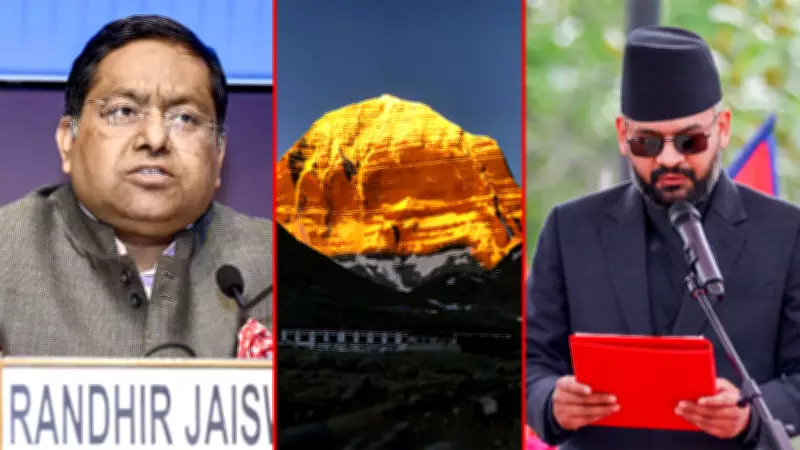
A fresh diplomatic row has erupted between India and Nepal over the Kailash Mansarovar Yatra route via Lipulekh Pass. Nepal has objected to the pilgrimage route, claiming the region falls within its territory, while India has rejected the claim as unjustified and historically inaccurate.
Background of the Dispute
The dispute is rooted in differing interpretations of the 1816 Sugauli Treaty, which was signed between the British East India Company and Nepal. The treaty defined the boundaries between Nepal and British India. However, the exact demarcation of the Lipulekh, Kalapani, and Limpiyadhura areas has remained a point of contention. These strategically significant regions are located at the tri-junction of India, Nepal, and China.
Nepal's Objection
Kathmandu has raised the issue with both India and China, asserting that the Lipulekh Pass falls within Nepalese territory. Nepal's new government has taken a firm stance, arguing that the pilgrimage route violates its sovereignty. The objection has the potential to test bilateral ties under the current administration in Nepal.

India's Response
India has categorically rejected Nepal's claim, stating that the territory is historically a part of India. The Indian government maintains that the route via Lipulekh Pass has been used for the Kailash Mansarovar Yatra for centuries without any dispute. New Delhi has emphasized that the claim is not supported by historical evidence or the provisions of the Sugauli Treaty.
Strategic Importance
The Lipulekh, Kalapani, and Limpiyadhura areas are of strategic importance due to their proximity to the China border. The region is also crucial for India's defense and infrastructure projects. The ongoing dispute underscores the complexities of border management in the Himalayan region.
Willingness for Dialogue
Despite the differences, both countries have indicated a willingness to resolve the matter through dialogue. Diplomatic channels remain open, and there is hope that the issue can be settled amicably. The development comes at a time when India and Nepal are seeking to strengthen their bilateral relationship.
The Kailash Mansarovar Yatra is a significant pilgrimage for Hindus, and any disruption to the route could affect thousands of devotees. Both nations are aware of the cultural and religious importance of the yatra and are expected to approach the issue with sensitivity.