

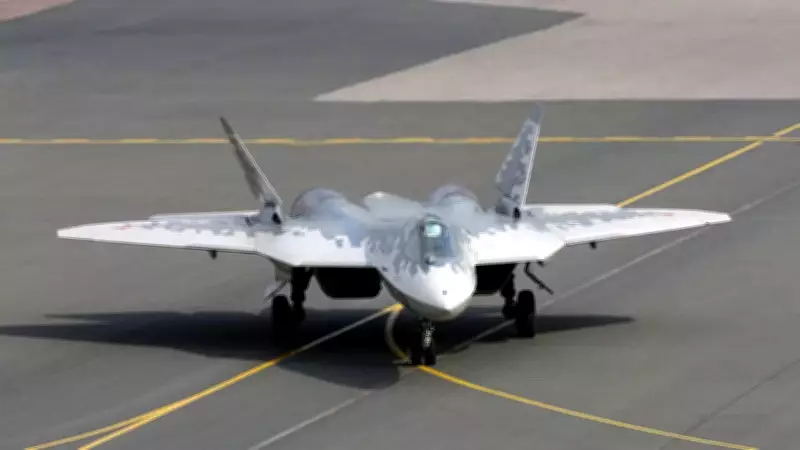
India and Russia Explore Joint Production of Fifth-Generation Su-57 Fighter Jets
India and Russia are currently holding advanced technical discussions to explore the possibility of jointly producing the fifth-generation Sukhoi Su-57 fighter jet in India, according to senior Russian aerospace officials. While there has been no official response from the Indian side, these comments signal Moscow's renewed push to re-enter India's fighter ecosystem at a time when New Delhi is weighing multiple paths for its future air combat fleet.
Advanced Stage of Technical Consultations
The discussions, described by United Aircraft Corporation (UAC) CEO Vadim Badekha as being at an "advanced stage of technical consultations", include the possibility of licensed production of the export variant Su-57E at facilities currently manufacturing the Su-30MKI, with extensive involvement of Indian industry and systems. This claim revives a long-dormant conversation around Indo-Russian fifth-generation cooperation, years after India exited the earlier FGFA programme.
"Today, we are in the advanced stage of technical negotiations on this contract. Such contracts, given our experience, determine the trajectory of our cooperation for several decades to come," CEO of Russia's United Aircraft Corporation (UAC) Vadim Badekha told Russian reporters on the sidelines of the Wings India air show at Begumpet airport in Hyderabad.

Production Facilities and Industry Involvement
Badekha claimed that the parties are also discussing "the licensed production of the Su-57 fighters in India at the facilities currently used to produce the Su-30 aircraft, and the maximum use of Indian industry and Indian systems in this aircraft." He emphasized that "the contract requires extensive, in-depth study. It is currently in the advanced stage of technical consultations," as quoted by the state-run TASS news agency.
Broader Defense Cooperation Offers
Earlier, the CEO of the state-arms exporter Rosoboronexport, Alexander Mikheev, announced that the company was offering New Delhi the supply of the latest fifth-generation Su-57E fighter jets, as well as the organisation of their production in India and assistance in developing its own indigenous AMCA stealth fighter, according to state-run RIA Novosti.
Meanwhile, the private Interfax agency reported about the signing of an agreement between UAC and Hindustan Aeronautics Limited (HAL) for the production of Superjet-100 regional jets in India. "The document formalises the agreement that HAL will assist UAC in the Superjet type certification/validation process in India. HAL will also be granted a license to manufacture and sell the SJ-100, including components, parts, and spare parts necessary for the repair and maintenance of this aircraft," Interfax reported.
Understanding the Sukhoi Su-57 Fighter Jet
The Sukhoi Su-57 is Russia's first operational fifth-generation combat aircraft, developed under the PAK FA programme to replace legacy MiG-29 and Su-27 variants. Designed as a multirole platform, it is intended to perform air-superiority, strike, suppression of enemy air defences and network-centric operations in contested environments.
Key Design and Performance Features
Design Philosophy: Unlike Western fifth-generation fighters such as the F-22 and F-35, the Su-57 prioritizes extreme agility alongside reduced observability rather than pursuing minimum radar cross-section at all costs. The airframe features blended shaping, internal weapons bays and extensive use of composite materials to lower radar, infrared and visual signatures.
Performance Capabilities:
- Maximum speed exceeding Mach 2
- Sustained supercruise in the Mach 1.3–1.6 range
- Combat radius of around 1,500 km
- Service ceiling close to 20,000 metres
Current Status and Operational Experience
The aircraft made its maiden flight in January 2010, entered limited service with the Russian Aerospace Forces in 2020, and remains in low-rate serial production. The Su-57 has reportedly been used during the Ukraine conflict, primarily in stand-off roles such as missile launches and sensor operations from within Russian-controlled airspace.

Strategic Implications for India
For New Delhi, any discussion on Su-57 joint production sits at the intersection of immediate capability gaps, long-term self-reliance goals and the indigenous AMCA programme. Russia has explicitly linked its Su-57 offer with assistance on India's own fifth-generation ambitions — a proposition that may appeal to planners looking for technology absorption rather than outright imports.
At the same time, India's past experience with the FGFA programme, cost concerns, and evolving strategic alignments will weigh heavily on decision-making. The potential joint production agreement represents a significant development in Indo-Russian defense cooperation that could shape both countries' aerospace industries for decades to come.





