

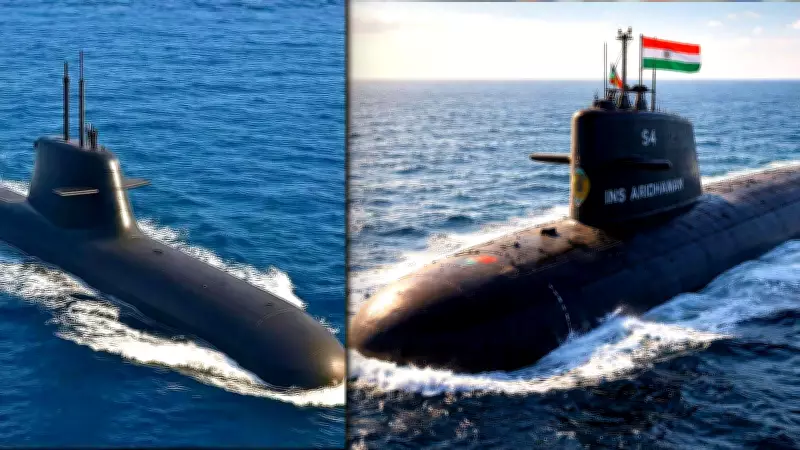
India's Nuclear Submarine Trio: A Formidable Deterrent Against China and Pakistan
The most potent weapon in a nuclear arsenal is not necessarily the one that inflicts maximum destruction, but rather the one that remains invulnerable to a first strike. This principle underpins the concept of credible nuclear deterrence, and India has meticulously built this capability over five decades through its highly secretive Advanced Technology Vessel project.
The Operational Trio: Arihant, Arighaat, and Aridhaman
India now boasts two Arihant-class nuclear-powered ballistic missile submarines conducting active deep-sea deterrence patrols. This marks a significant shift from ceremonial capability to a continuous, operational sea-based nuclear force.
INS Arihant, commissioned in August 2016, holds the historic distinction of being the first ballistic missile submarine constructed by a nation outside the five permanent members of the United Nations Security Council. Its induction was a monumental achievement for India's indigenous defense program.

INS Arighaat, commissioned in August 2024 with an impressive 70 percent indigenous content, demonstrated a critical capability by executing the first-ever submerged launch of the K-4 intermediate-range ballistic missile. This successful test confirmed India's ability to target locations on China's eastern seaboard from concealed, submerged positions within the vast expanse of the Indian Ocean.
The program's most advanced vessel, INS Aridhaman, is slated for induction in 2026. It represents a fundamental leap in capability. While Arihant and Arighaat are equipped with four missile tubes each, Aridhaman doubles that firepower with eight tubes. This enhanced platform can carry a formidable payload, including:
- Up to 24 K-15 missiles
- Eight K-4 missiles
- A combination of both missile types
Furthermore, Aridhaman is designed with future compatibility in mind, ready to integrate the upcoming K-5 missile system.
Expanding the Fleet and the Strategic Imperative
A fourth submarine, tentatively named INS Arisudan, embarked on sea trials in late 2025 and is anticipated to be commissioned by 2027. This progression will position India among an elite group of nations capable of simultaneously operating four SSBNs (Ship Submersible Ballistic Nuclear) in various phases of deployment and readiness.
The strategic context for this rapid naval expansion is clear and pressing. China's submarine fleet is projected to swell to approximately 80 vessels by 2035, representing a massive underwater force. Simultaneously, Pakistan is in the final stages of acquiring eight Chinese Yuan-class submarines. India's development of a robust sea-based deterrent is a direct and calculated response to this accelerating two-front underwater threat, a challenge not seen since the height of the Cold War.
The Foundation of Credible Deterrence
A nuclear-powered ballistic missile submarine, operating silently in the depths of the ocean, possesses a unique survivability. It can endure a potential first strike and guarantee a devastating retaliatory response. This guarantee is the very bedrock of credible nuclear deterrence.
The names chosen for these submarines—Arihant, Arighaat, Aridhaman—are not modest. They reflect the core attributes India intends for its nuclear deterrent: to be invisible to adversaries, survivable against attacks, and certain in its capacity to respond if necessary. Together, this growing fleet of indigenous nuclear submarines ensures that India's strategic posture in the Indian Ocean remains formidable and resilient against evolving regional threats.






