

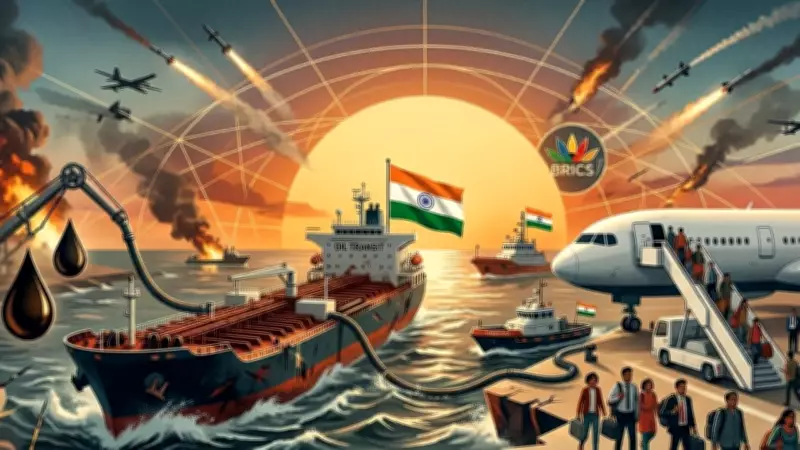
India's Three-Front Crisis: Managing Evacuations, Energy, and Diplomacy in Middle East Conflict
What began as a routine end to February quickly transformed into a geopolitical maelstrom when the United States and Israel launched coordinated strikes on Iran, an operation dubbed Operation Epic Fury. The conflict escalated dramatically with the reported killing of Iran's Supreme Leader, Ayatollah Ali Khamenei, marking an unprecedented shift. Iran retaliated by targeting US and Israeli military assets across the Middle East, widening the theater of tension and drawing global repercussions.
For India, the stakes are immediate and multi-layered, requiring a delicate balance of security, economics, and diplomacy. Three weeks into the crisis, India is navigating a complex web of challenges as the situation continues to evolve rapidly.
Bringing Lakhs of Indians Back: A Massive Repatriation Effort
The first signs of strain emerged from the ground, with the Ministry of External Affairs (MEA) confirming that five Indian nationals have been killed and one remains missing in the conflict zone. Since February 28, over 2.2 lakh Indian nationals have returned to India as the Gulf crisis intensified, highlighting the direct impact on citizens.

Indian missions in Iran, Israel, and across West Asia are operating round the clock, maintaining contact with nationals and coordinating with local authorities. Dedicated control rooms have been established in New Delhi and regional embassies to respond to distress calls. While a full-scale evacuation has not been announced, the government is facilitating case-by-case movements through available commercial routes, hindered by airspace restrictions and security conditions.
Key developments in the repatriation process include:
- Flight Coordination: Approximately 2,20,000 Indians have returned via 45 flights from Gulf hubs like the UAE, Saudi Arabia, Oman, and Qatar, with airlines adjusting schedules due to airspace disruptions.
- Land Routes: From Iran, 550 Indians crossed into Armenia via land, and 90 entered Azerbaijan this week, assisted by the Indian embassy in Tehran.
- Student Evacuations: Nearly 70 Indian students, primarily from Jammu and Kashmir studying medicine in Iran, landed in Delhi after a multi-stage journey, with fares spiking due to emergency demand.
- Ongoing Challenges: Repatriation continues amid closures, such as Kuwait's airspace, and selective evacuations, like moving 15 crew members after a vessel was hit near Iraq.
Officials stress that broader evacuation depends on feasibility and security conditions, with an estimated 8–9 million Indians in the Gulf region, making the approach cautious and preparedness-focused.
The Energy and Oil Crisis: Straining Supply Chains
India's energy supply chains have been under intense pressure, with the Strait of Hormuz emerging as a critical risk point. This narrow passage, only 33 kilometers wide, handles about 20% of the world's seaborne oil trade. For India, it is vital, as the country imports over 50% of its crude oil and significant LPG through this route from Gulf nations like the UAE, Saudi Arabia, and Qatar.
Despite geopolitical tensions, imports have continued, albeit strained. The Indian crude oil tanker Jag Laadki arrived at Mundra Port in Gujarat after loading at UAE's Fujairah port, which came under attack. This marked the third vessel to successfully transit the Strait of Hormuz recently. Earlier, two Indian-flagged LPG carriers, Shivalik and Nanda Devi, delivered nearly 92,700 tonnes of LPG to Gujarat, providing relief to the domestic market.
However, challenges persist:

- Stranded Shipments: Around three lakh tonnes of LPG across six Indian-flagged ships remain delayed in the Strait of Hormuz due to security bottlenecks.
- Diplomatic Efforts: New Delhi is engaging in case-by-case permissions with Tehran, as there is no blanket arrangement for automatic passage, according to External Affairs Minister S Jaishankar.
- Economic Strain: Surging freight and insurance costs are impacting refiners, with 28 Indian-flagged vessels initially in the strait and many shipping firms reluctant to quote rates amid uncertainties.
India's strategy focuses on keeping supplies moving while managing risk, rather than abrupt rerouting, resulting in a mixed outcome with key cargos arriving but broader pressures mounting.
Walking the Diplomatic Tightrope: Balancing Competing Interests
As the conflict rages into its third week, India's diplomatic posture is shaped by a careful effort to balance competing interests in a divided geopolitical landscape. The MEA has repeatedly emphasized calls for de-escalation, restraint, and dialogue, while urging protection of civilian lives, avoiding explicit sides to reflect India's engagement-based foreign policy.
Prime Minister Narendra Modi has been actively engaging world leaders:
- He spoke with the UAE President to condemn attacks on UAE territory, stressing India's solidarity.
- He communicated with Iranian President Masoud Pezeshkian, expressing concern over escalations and urging de-escalation, while thanking Iran for cooperation in repatriating Indians.
These engagements reflect India's multi-alignment strategy, calibrating ties with the US, Israel, Iran, and Gulf partners to protect energy imports, expatriate welfare, and strategic interests. The diplomatic challenge extends to India's role as chair of BRICS in 2026, with divergent positions among member countries hindering a unified statement on the crisis.
Political opposition, including Congress leader Shashi Tharoor, has called for a more assertive role, urging New Delhi to take a proactive lead in demanding a ceasefire. This highlights the tension in India's foreign policy as it navigates peace advocacy while protecting its interests in a shifting landscape.
A Three-Front Crisis, Still Unfolding
Three weeks into the conflict, India is managing a layered crisis with confirmed casualties, fragile energy flows, and a polarizing diplomatic environment. Each strand is being addressed, but none is fully under control. As long as the Strait of Hormuz remains unstable, challenges in evacuations, energy security, and diplomacy will continue to evolve, shaping India's response in real time.





