

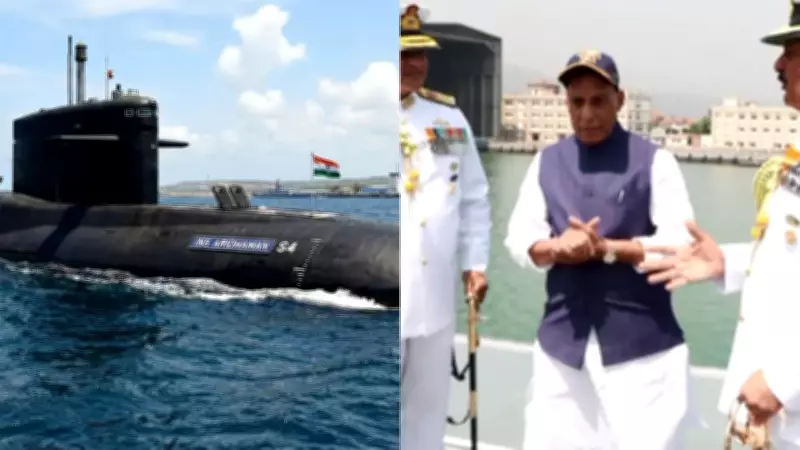
India Commissions INS Aridhaman, Its Third Indigenous Nuclear-Powered Submarine
In a significant stride for India's maritime defense capabilities, Defence Minister Rajnath Singh officially commissioned the indigenous nuclear-powered ballistic missile submarine INS Aridhaman into the Indian Navy on Friday. This event marks a pivotal moment as India continues to bolster its underwater nuclear prowess, complementing its established air and land-based nuclear capabilities.
INS Aridhaman: A Closer Look at India's Third Nuclear Submarine
INS Aridhaman represents the third vessel in the Arihant-class of nuclear submarines, constructed under the highly classified Project ATV at Vishakhapatnam. The induction of this advanced submarine is set to substantially enhance the operational strength and strategic reach of the Indian Navy.
India's nuclear-powered ballistic missile submarine (SSBN) program remains one of the nation's most closely guarded defense initiatives. The SSBN designation stands for Ship Submersible Ballistic Nuclear, referring to submarines capable of launching nuclear missiles while submerged.

The journey of India's indigenous SSBN program began with INS Arihant, the country's first domestically built nuclear submarine, which was launched in 2009 and quietly commissioned in 2016. This was followed by INS Arighaat, commissioned in August 2024, establishing India's growing expertise in this sophisticated domain.
Commissioning Ceremony and Strategic Significance
INS Aridhaman's commissioning followed extensive months of rigorous sea trials to ensure operational readiness. Defence Minister Rajnath Singh presided over the formal ceremony at a naval base in Kerala, emphasizing the vessel's importance through a cryptic social media post in Hindi that stated, "It's not words but power, 'Aridman'."
With this commissioning, India solidifies its position among an elite group of nations possessing nuclear-powered submarines, joining the ranks of the United States, Russia, the United Kingdom, France, and China. This advancement underscores India's commitment to maintaining a credible nuclear triad and enhancing its strategic deterrence capabilities.
Simultaneous Induction of Stealth Frigate INS Taragiri
In a parallel development highlighting the Navy's comprehensive modernization efforts, Defence Minister Singh also commissioned the advanced stealth frigate INS Taragiri. This induction occurs against the backdrop of growing strategic and maritime importance along India's eastern seaboard, driven by evolving regional security dynamics and India's deepening engagement in the Indo-Pacific region.
As the fourth vessel in the Project 17A class, INS Taragiri represents a 6,670-tonne embodiment of India's indigenous shipbuilding capabilities and the 'Make in India' initiative. Constructed by Mazagon Dock Shipbuilders Limited (MDL) in Mumbai, the frigate features a sleeker design with significantly reduced Radar Cross-Section, enabling enhanced stealth operations.
The vessel boasts indigenous content exceeding 75 percent, demonstrating the maturity of India's domestic industrial ecosystem. This achievement involves contributions from over 200 Micro, Small, and Medium Enterprises (MSMEs), supporting thousands of jobs and advancing the government's Aatmanirbharta (self-reliance) objectives.
Advanced Capabilities of INS Taragiri
Powered by a Combined Diesel or Gas (CODOG) propulsion system, INS Taragiri is engineered for high-speed, high-endurance versatility across multi-dimensional maritime operations. Its sophisticated weapon suite includes:
- Supersonic Surface-to-Surface Missiles
- Medium Range Surface-to-Air Missiles
- A specialized Anti-Submarine Warfare suite
These systems are seamlessly integrated through a state-of-the-art Combat Management System, enabling rapid and precise threat response. Beyond its combat roles, INS Taragiri is designed for flexible mission profiles, including Humanitarian Assistance and Disaster Relief (HADR) operations, reflecting the Navy's comprehensive approach to maritime security.

Strengthening India's Naval Power
The simultaneous commissioning of INS Aridhaman and INS Taragiri exemplifies the Indian Navy's sustained focus on enhancing combat readiness and operational capabilities through an ambitious fleet augmentation program. These developments contribute to building a combat-ready, cohesive, and credible naval force that safeguards India's maritime interests.
As India continues to advance its indigenous defense manufacturing capabilities, these vessels stand as testaments to the nation's growing technological prowess and strategic autonomy in the global maritime domain.





