

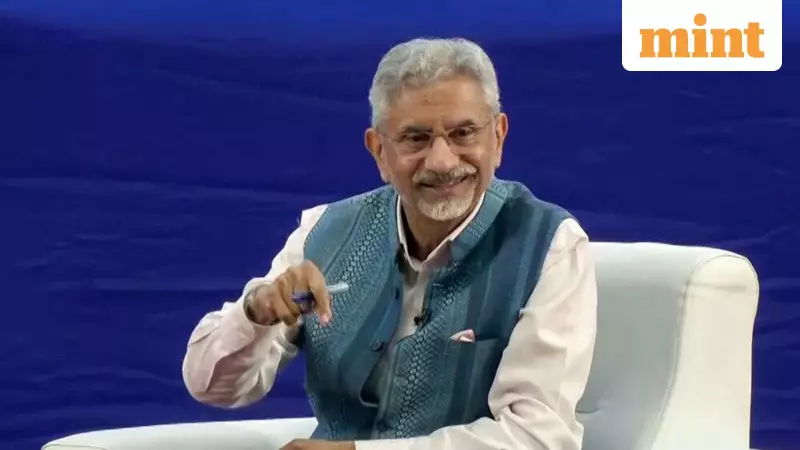
External Affairs Minister Dr. S. Jaishankar delivered a strong message on India's foreign policy approach, drawing a clear distinction between cooperation with friendly neighbours and a firm stance against those supporting terrorism. Speaking at the Indian Institute of Technology (IIT) Madras on January 2, the minister outlined a pragmatic vision guided by national security and regional growth.
A Firm Stance on Security and Terrorism
Without explicitly naming Pakistan, Dr. Jaishankar left little room for ambiguity regarding nations that harbour terrorism. He asserted India's unequivocal right to defend its citizens from threats emanating across its borders. "When it comes to bad neighbours who persist with terrorism, India has every right to defend its people and will do whatever is necessary," he stated firmly during his interaction with students.
The minister linked the issue of cross-border terrorism directly to bilateral cooperation, making a compelling argument. "You cannot request us to share our water with you and also spread terrorism in our country," he said, highlighting the inherent contradiction in expecting normalised relations while supporting activities that threaten India's security.

The 'Good Neighbour' Policy: Sharing and Assistance
In stark contrast, Dr. Jaishankar elaborated on India's generous and supportive approach towards constructive partners in the region. He positioned India's economic growth as a "lifting tide" for South Asia, benefiting neighbours who engage positively.
He cited multiple recent examples of this goodwill: the provision of COVID-19 vaccines during the pandemic, extending fuel and food support amid the Ukraine conflict's global disruptions, and the substantial financial assistance of USD 4 billion to Sri Lanka during its severe economic crisis. "With good neighbours, India invests, helps and shares," he summarised, framing this as a policy guided by "common sense."
Communication, Heritage, and Global Positioning
Dr. Jaishankar emphasised the critical role of clear diplomacy in preventing misunderstandings on the world stage. "How to prevent people from misreading you is to communicate. If you communicate well, clearly and honestly, other countries and other people respect it and accept it," he advised.
He also took pride in India's civilisational continuity and its democratic choice. He pointed out that India is among the "very few" ancient civilizations to evolve into a major modern nation-state. "It was our decision to opt for a democratic political model, which made the very idea of democracy as a universal political concept," he noted, adding that this choice gave global heft to the democratic ideal.
The minister also touched upon the philosophy of 'Vasudhaiva Kutumbakam' (the world is one family), explaining that it reflects an outlook where the world is not seen as hostile. The challenge, he said, is to achieve maximum impact with limited resources through smart foreign policy that leverages competitiveness and international partnerships.
Launch of the IITM Global Research Foundation
During his visit, Dr. Jaishankar also inaugurated the 'IITM Global Research Foundation', a major international initiative by IIT Madras. This foundation aims to transform the institute into a globally-connected centre for education, cutting-edge research, innovation, and entrepreneurial ventures.
The minister's address reinforced a dual-track foreign policy: uncompromising on security threats while being a reliable and generous partner for peace and prosperity in the region. His remarks underscore the direct link between a neighbour's actions and the nature of its relationship with New Delhi.






