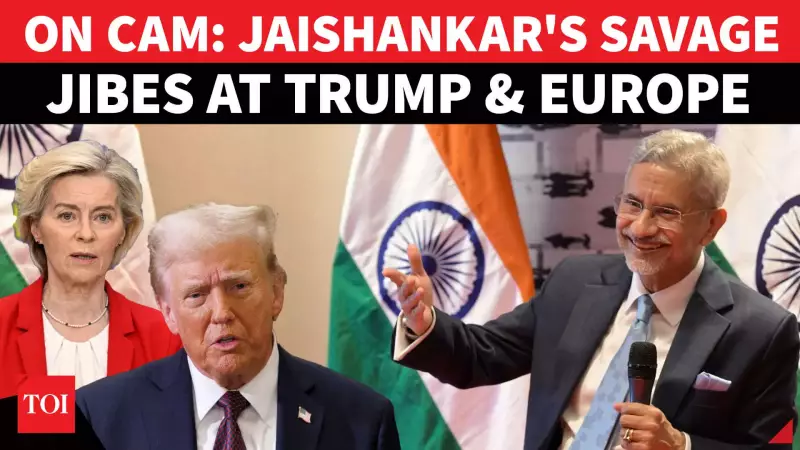
India's External Affairs Minister, Dr. S Jaishankar, provided a candid assessment of the significant challenges shaping the nation's international engagements in a rapidly changing global order. Speaking in Pune on December 20, 2025, Jaishankar outlined the intricate balancing act required to manage relationships with major powers while addressing pressing regional demands.
The Great Power Tightrope: US, China, and Russia
Dr. Jaishankar explicitly acknowledged that dealing with the United States, managing China, and maintaining a stable relationship with Russia have all grown more complex. He described the current geopolitical landscape as a web of competing interests where India must make clear strategic choices. This complexity stems from a world in flux, where traditional alliances are being tested and new economic and security realities are emerging.
The minister's remarks underscore India's unique position, where it engages deeply with competing blocs. This involves fostering a strategic partnership with the US, managing a contentious border and economic rivalry with China, and sustaining a longstanding, defense-focused relationship with Russia, all simultaneously.

India as the Global First Responder
Jaishankar highlighted concrete examples where India stepped up as a reliable global actor during crises. He pointed to India's role as a 'first responder' in Sri Lanka during its economic collapse and its provision of vaccines as a 'lifeline' for numerous countries throughout the COVID-19 pandemic.
Furthermore, he emphasized India's crucial interventions in ensuring energy and food security during the Ukraine conflict, demonstrating how the nation delivers essential support when established global systems falter. These actions, according to Jaishankar, have bolstered India's reputation and solidified its claim to global leadership.
Expanding Horizons and a Civilisational Imprint
The External Affairs Minister broadened the scope beyond great power politics. He stated that Europe and India's immediate neighbourhood now command even greater diplomatic attention. Jaishankar also detailed India's deepening engagements across the Gulf, Southeast Asia, and Central Asia.
He stressed India's profound civilisational impact abroad as a foundation for these relationships. A key part of this influence is the global demand for Indian talent, which Jaishankar termed a powerful 'brand.' He urged young Indians to adopt a global mindset and view the entire world as their potential workplace.
Clarity, Vision, and Leadership
In navigating this complicated terrain, Jaishankar emphasized the non-negotiable need for clarity in thought, deliberate strategic choices, and a long-term vision. He credited the defining force behind India's current global posture to Prime Minister Narendra Modi's leadership and strategic vision.
The minister's comprehensive address in Pune paints a picture of an India confidently yet cautiously carving its path in a multipolar world. It is a path defined by principled pragmatism, a willingness to assume global responsibilities, and an unwavering focus on national interest amid intersecting international pressures.