

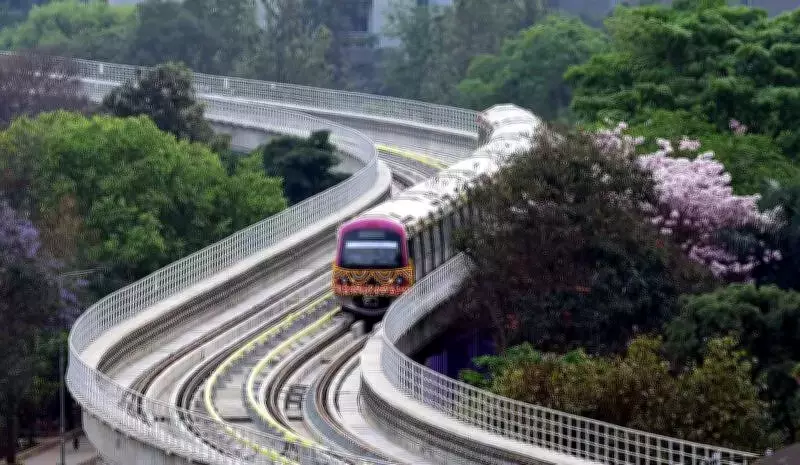
Japan-India High-Speed Rail Initiative Set to Revolutionize Bengaluru's Connectivity and Economy
In a significant development for India's infrastructure landscape, Japanese officials have emphasized that the planned high-speed rail projects linking Bengaluru with Chennai and Hyderabad will not only transform travel but also catalyze business and economic activity across the region. The initiative, discussed at the Japan–India Mobility Summit 2026, is poised to bring about a paradigm shift in mobility and urban development.
Drawing Parallels to Japan's Bullet Train Success
Watanabe Ikko, director for India at Japan's Ministry of Economy, Trade and Industry (METI), drew a compelling comparison to the Tokyo–Nagoya bullet train, which drastically reduced travel time from seven hours to just one and a half hours. "This reduction significantly boosted business transactions, allowing companies like Toyota to access Tokyo markets with ease," he stated. Similarly, Bengaluru-based businesses are expected to reap substantial benefits from enhanced connectivity, facilitating faster movement of goods, services, and people.
Japan's Continued Support and Focus on Transit-Oriented Development
Japan has already been a key partner in Bengaluru's urban development, providing JICA loans for Namma Metro Phase 2. Takayama Naritoshi, deputy director-general for Trade at METI, underscored the importance of transit-oriented development (TOD) and multimodal connectivity to reduce reliance on private vehicles. He highlighted India's digital strengths, such as integrated journey planning, unified ticketing, and data-driven management, as crucial elements that can enhance TOD and improve reliability across various transport modes.

Karnataka's Potential for Mobility Innovation
S Selvakumar, principal secretary for Karnataka's commerce and industries department, pointed to the state's robust ecosystem for mobility innovation. With over 800 R&D centres, global capability hubs, and progressive policies like the Clean Mobility Policy 2025–2030, Karnataka is well-positioned to lead in next-generation solutions. "Karnataka can deepen engagement with Japanese industry to accelerate the development of advanced mobility technologies," he remarked, signaling a strong commitment to collaborative growth.
Call for Broader Collaboration in Sustainable Mobility
NITI Aayog member VK Saraswat advocated for expanding collaboration beyond mere infrastructure to include technology co-creation. He urged joint efforts in areas such as hydrogen mobility, smart transport systems, next-generation vehicles, and integrated mobility platforms. Noting the shared goals of sustainability and decarbonization, Saraswat emphasized that India and Japan can jointly advance innovative, eco-friendly mobility solutions to address global challenges.
The high-speed rail projects represent a transformative step towards modernizing India's transport network, with Bengaluru at the forefront of this mobility revolution. By leveraging Japanese expertise and India's digital prowess, the initiative promises to boost economic productivity, reduce congestion, and foster sustainable urban development, setting a new benchmark for international cooperation in infrastructure and technology.






