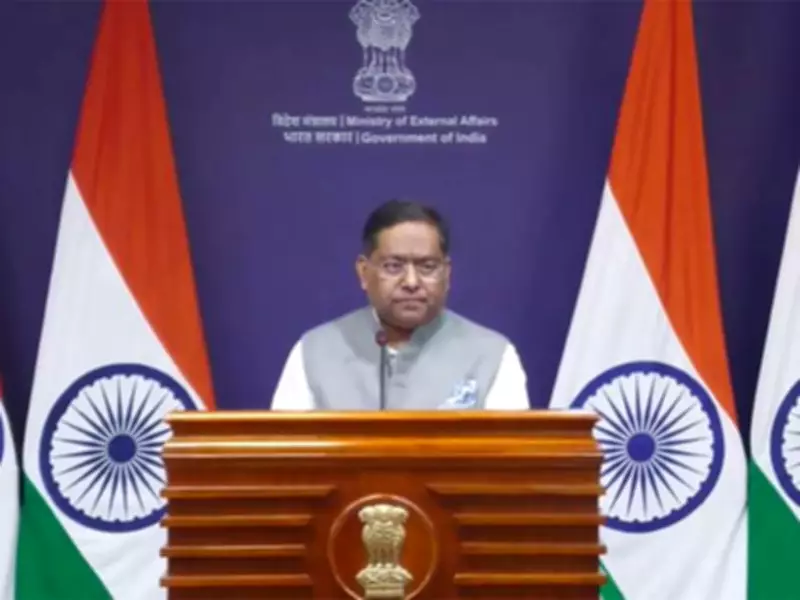
India on Friday reiterated that the Indus Waters Treaty (IWT) remains in abeyance as long as Pakistan continues its support for cross-border terrorism. Ministry of External Affairs (MEA) Spokesperson Randhir Jaiswal stated that Pakistan must credibly and irrevocably abjure its backing of such terrorism for any reconsideration of the treaty.
India's Stance on Indus Waters Treaty
Responding to a query during a press conference in New Delhi, Jaiswal said, "India's position on the Indus Waters Treaty is consistent. IWT stands in abeyance in response to Pakistan's continued sponsorship of cross-border terrorism. Pakistan must credibly and irrevocably abjure its support for cross-border terrorism." This marks a firm reiteration of India's long-standing demand.
Condemnation of Pakistan's Airstrikes in Afghanistan
Jaiswal also strongly condemned the Pakistani airstrikes that hit eastern Afghanistan, resulting in significant civilian casualties. "We had strongly condemned the airstrikes that happened from Pakistan into Afghanistan, in which several civilian lives, including women and children, were lost. We had offered our condolences on the passing away of precious lives, and we had also, at the same time, reiterated our strong support for the territorial integrity and sovereignty of Afghanistan," he said.

According to the deputy spokesperson of the Taliban-led Afghan government, Hamdullah Fitrat, the attacks resulted in the martyrdom of 36 civilians, including women and children, while 163 others sustained injuries. Three residential houses were completely destroyed. Pakistan conducted cross-border military strikes in the eastern provinces of Paktia, Paktika, and Kunar, causing widespread devastation.
India's Humanitarian Assistance to Afghanistan
Jaiswal highlighted India's ongoing humanitarian cooperation with Afghanistan, stating, "We have an ongoing humanitarian assistance cooperation. We have been sending them medicines... and also been offering development projects which can bring benefit to the lives of people there." India continues to support Afghanistan's territorial integrity and sovereignty.
India-Japan Joint Condemnation of Terrorism
On Thursday, India and Japan issued a sharp, unequivocal condemnation of cross-border terrorism originating from Pakistan. The joint statement followed bilateral talks between Prime Minister Narendra Modi and Japanese Prime Minister Sanae Takaichi. The two nations demanded immediate global action to dismantle state-supported safe havens and financing channels for terrorist groups.
The joint statement called for urgent, concerted global actions against all UN-listed terrorist entities and their proxies, specifically naming Lashkar-e-Tayyiba (LeT), Jaish-e-Mohammad (JeM), Al Qaeda, and ISIS. The prime ministers emphasized that the international community must take resolute measures to completely root out terrorist safe havens, disrupt the nexus between terror financing and transnational crime, and halt the cross-border movement of terrorists.
Implications for Regional Security
India's consistent position on the IWT and its strong condemnation of Pakistan's actions in Afghanistan underscore the heightened tensions in the region. The abeyance of the treaty, a water-sharing mechanism between the two nations, reflects India's insistence on Pakistan ending its sponsorship of cross-border terrorism as a prerequisite for any bilateral engagement. The joint India-Japan stance adds international pressure on Pakistan to comply with global counter-terrorism norms.