

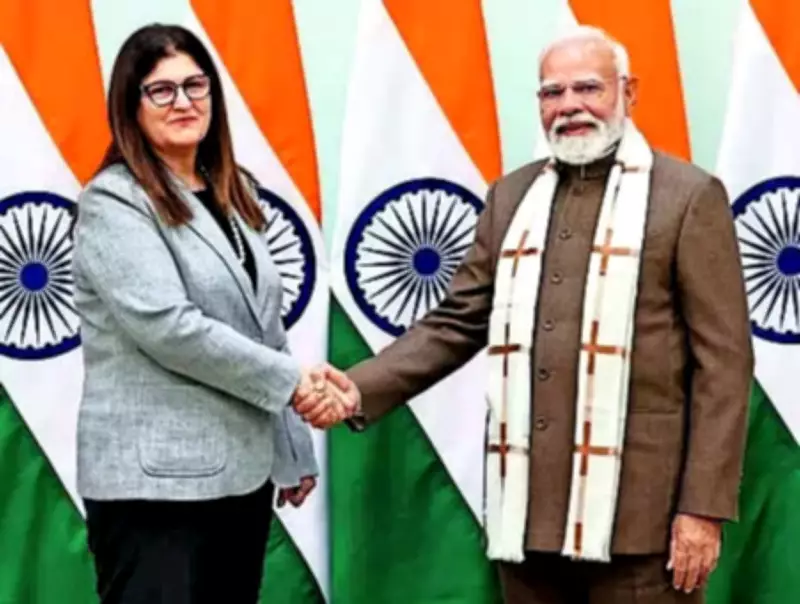
PM Modi Reaffirms India's Support for Palestine During Arab Ministers Meeting
Prime Minister Narendra Modi held a significant meeting with Palestinian Foreign Minister Varsen Aghabekian in New Delhi, where he reiterated India's continued support for the people of Palestine and welcomed ongoing peace efforts, including the Gaza peace plan. The meeting took place as part of the second India-Arab Foreign Ministers' Meeting, which brought together foreign ministers from Arab countries to discuss regional cooperation and challenges.
Strengthening India-Arab Partnership
During the discussions, Prime Minister Modi emphasized the deep civilizational bonds between India and the Arab world, describing the region as part of India's extended neighborhood. In a post on X, Modi highlighted the vibrant people-to-people connections and enduring brotherly ties that unite the two regions, along with a shared commitment to peace, progress, and stability.
The Prime Minister expressed confidence that enhanced cooperation in technology, energy, trade, and innovation would unlock new opportunities and elevate the partnership to unprecedented heights. According to the Ministry of External Affairs, Modi outlined his vision for the India-Arab partnership in the coming years and reaffirmed India's commitment to deepening cooperation in trade and investment, energy, technology, healthcare, and other priority areas for mutual benefit.

Palestinian Minister Acknowledges India's Support
Foreign Minister Varsen Aghabekian highlighted the humanitarian catastrophe in Gaza during her meeting with Prime Minister Modi and expressed Palestine's appreciation for India's principled support for Palestinian rights under international law. The Palestinian minister's participation as part of the Arab delegation underscored the importance of multilateral engagement in addressing regional conflicts.
External Affairs Minister S. Jaishankar, who also participated in the meeting, asserted that countries targeted by terrorism have the right to defend themselves. He emphasized that this right is particularly crucial in the context of cross-border terrorism, which violates fundamental principles of international relations and diplomacy.
India's Development Assistance to Palestine
A source familiar with the discussions revealed that India has been a long-standing development partner for Palestine, providing assistance both bilaterally and through United Nations agencies. To date, India has provided assistance worth approximately USD 170 million to Palestine, with projects valued at USD 40 million currently under implementation. This development partnership reflects India's consistent approach to supporting Palestinian aspirations through concrete economic and humanitarian measures.
Addressing Terrorism and Regional Stability
During the foreign ministers' meeting, Jaishankar strongly raised the issue of cross-border terrorism, describing it as particularly unacceptable due to its violation of basic international relations principles. He told the Arab foreign ministers that societies targeted by terrorism not only have the right to defend themselves but will understandably exercise this right in the face of threats.
"It is essential that we strengthen international cooperation to combat what is a global scourge," Jaishankar stated. "Zero-tolerance for terrorism must be an uncompromising universal norm that guides our collective response to security challenges."
Gaza Peace Plan and Regional Implications
The minister also noted that the changing landscape in West Asia has significant implications for India's relations with the Arab world. He identified advancing the comprehensive plan to end the Gaza conflict as a widely shared priority among participating nations.
"Various countries have made policy declarations on the peace plan, individually or collectively," Jaishankar explained. "This broader context informs our deliberations on the region's challenges and prospects, as we work toward sustainable solutions that address both immediate humanitarian concerns and long-term stability."

Prime Minister Modi conveyed his appreciation for the important role played by the Arab League in supporting efforts toward regional peace and stability. The discussions reflected India's balanced approach to Middle East diplomacy, combining principled support for Palestinian rights with practical cooperation on counter-terrorism and regional security issues.





