

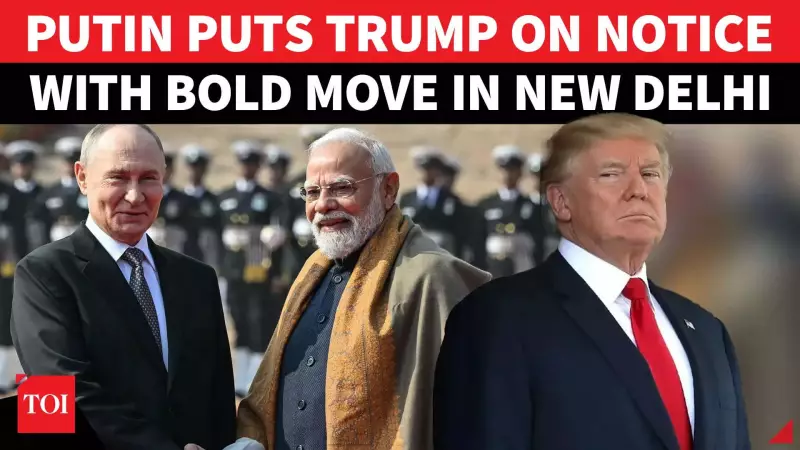
Russian President Vladimir Putin has delivered a sharp geopolitical challenge to the United States from the heart of India's capital, sending shockwaves towards Washington. During his visit to New Delhi, Putin directly confronted U.S. criticism of India's ongoing purchases of Russian crude oil, framing it as a matter of sovereign privilege and highlighting perceived American hypocrisy.
The Core of Putin's Challenge in New Delhi
At the centre of the confrontation is the energy trade between Russia and India, which has surged since the onset of the Ukraine conflict. The United States has repeatedly pressured allies and partners, including India, to reduce their dependency on Russian energy. However, Putin turned this argument on its head during his statements in Delhi on December 5, 2025.
He pointedly questioned Washington's stance by revealing that the United States itself continues to import Russian nuclear fuel for its domestic power plants. "If America can maintain such critical energy ties with Moscow," Putin argued, "then India is fully entitled to the same privilege." This comparison was a calculated move to expose a double standard and shield India from Western pressure.

A Signal in the Shared Ride: Modi and Putin's Symbolic Gesture
The diplomatic messaging was amplified by a powerful visual symbol. Upon arrival, Indian Prime Minister Narendra Modi and President Putin travelled together in the same car from Delhi airport. This gesture, shared publicly by the Indian PM, was widely interpreted as a signal of the enduring and special strategic partnership between New Delhi and Moscow, despite intense scrutiny from the West.
Wider Ripples and Global Tensions
Putin's bold stance from Delhi sharpens the global spotlight on the complex U.S.–India–Russia triangle. It places India in a delicate position, balancing its historic defence and energy ties with Russia against its growing strategic and economic convergence with the United States and its allies. The challenge also arrives amidst a volatile international climate, with references in related reports to tensions over Ukraine and debates within the U.S. political establishment about future foreign policy directions.
The Russian leader's remarks are seen as an attempt to drive a wedge into the Washington-New Delhi partnership and assert that national interest, not external pressure, should guide India's energy security decisions. The incident underscores how energy trade has become a primary battleground in the new era of global geopolitics, with major powers vying for influence.
Ultimately, Putin's challenge from New Delhi is more than a defence of oil sales. It is a strategic manoeuvre to validate Russia's international partnerships and question the consistency of American foreign policy. The world now watches how Washington will respond to this direct provocation issued from Indian soil, and how India will navigate the ensuing diplomatic currents.






