

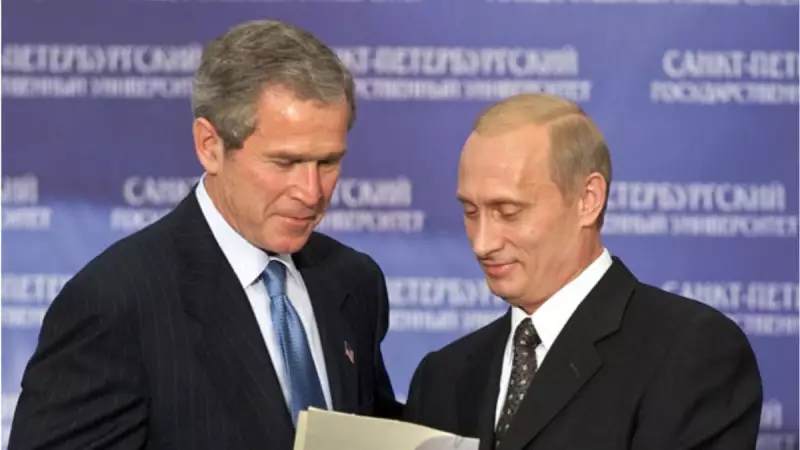
Declassified diplomatic records have unveiled a startling moment of geopolitical candor between two world leaders, highlighting deep-seated anxieties about nuclear security in South Asia. The conversation, which took place over sixteen years ago, shows former Russian President Vladimir Putin expressing significant concerns to then-U.S. President George W. Bush about the safety of Pakistan's atomic weapons.
A Candid Warning in the Black Sea Resort
The pivotal exchange occurred on April 6, 2008, during a meeting at the Bocharov Ruchei residence in Sochi, a Black Sea resort. This was part of President Bush's final official visit to Russia before the end of his term. The talks, meant to cover a broad agenda, took a serious turn when President Putin shifted the focus to Pakistan's political instability.
According to the declassified memorandum of conversation, Putin pointedly questioned the stability of the Pakistani leadership. He raised a scenario that has long haunted global security experts: what would happen if Pakistan's nuclear arsenal fell into the hands of extremists? Putin specifically warned Bush about the risks of "some kind of extremist regime coming to power" in Islamabad. This concern was rooted in the volatile political climate of the time, marked by the assassination of former Prime Minister Benazir Bhutto in late 2007 and ongoing militant threats.

The Context of the 2008 Geopolitical Landscape
The discussion was not happening in a vacuum. In 2008, Pakistan was a key U.S. ally in the war on terror but was internally grappling with severe challenges. The country's nuclear program, developed in response to India's, had always been a subject of international scrutiny. Putin's warning to Bush underscored a shared, though rarely stated so bluntly, apprehension between Moscow and Washington.
President Bush, in his response, acknowledged the gravity of the concern. The American leader assured Putin that the United States was closely monitoring the situation. Bush emphasized that his administration was in constant touch with the Pakistani military, which was considered the primary guardian of the country's nuclear assets. He conveyed a belief that the Pakistani army was professional and could be relied upon to prevent the weapons from being compromised, even in a crisis.
Enduring Implications for Global Nuclear Security
The revelation of this 2008 dialogue is more than a historical footnote; it casts a long shadow on contemporary security debates. The conversation proves that fears of Pakistan's nuclear weapons falling into the wrong hands were a top-tier concern at the highest levels of global power, long before they became a frequent topic in public discourse.
This declassified memo adds a crucial layer to our understanding of India's security environment. For decades, India has lived with the reality of a nuclear-armed neighbor with a history of political instability and militant threats. Putin's explicit warning to Bush validates the strategic concerns that have shaped India's foreign and defense policies.
The dialogue also highlights the complex role of the Pakistani military. While often criticized for its political influence, it was viewed by the U.S. President in 2008 as the essential firewall protecting the nuclear arsenal from extremist takeover. This perception has influenced international engagement with Pakistan's security establishment for years.
The declassification of this memo serves as a stark reminder that nuclear proliferation and security remain the most critical challenges in international relations. The fact that such a warning was exchanged privately between the leaders of Russia and America shows that the stability of Pakistan has been, and continues to be, a global security imperative. The concerns voiced in Sochi in 2008 continue to resonate today, informing diplomatic strategies and defense calculations worldwide.






