

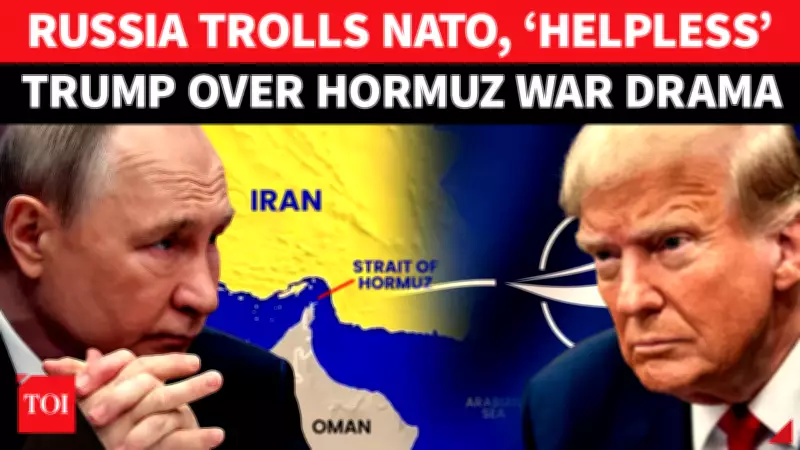
Russia Launches Scathing Critique of NATO Amid Trump's Iran War Ultimatum
In a sharp escalation of geopolitical tensions, Russia has delivered a blistering assessment of the North Atlantic Treaty Organization (NATO), labeling it as a "broken" and "hostile" entity. This verbal assault comes directly in response to former U.S. President Donald Trump's recent threats to withdraw from the military alliance over the ongoing conflict in Iran.
Kremlin's Direct Condemnation of the Western Alliance
Kremlin spokesperson Dmitry Peskov articulated Moscow's position with unequivocal clarity, stating that Russia perceives NATO as an openly antagonistic bloc that consistently treats Russia as an adversary. Peskov emphasized that this perspective is deeply entrenched within Russian foreign policy, reflecting years of strained relations and mutual distrust.
"We consider NATO to be a hostile bloc which views Russia as an enemy," Peskov declared, underscoring the fundamental rift between Moscow and the Western defense coalition. His remarks were delivered with a tone of firm conviction, highlighting the Kremlin's unwavering stance on the matter.

Trump's Provocative Exit Threat Ignites Fresh Controversy
The catalyst for this latest diplomatic flare-up was Donald Trump's provocative assertion that he would consider pulling the United States out of NATO if the alliance fails to align with his approach to the Iran war. Trump's comments have exposed and exacerbated existing fractures within the bloc, prompting concerns about its cohesion and future effectiveness.
Analysts suggest that Trump's rhetoric has provided Russia with a prime opportunity to highlight and exploit these internal divisions. By publicly questioning NATO's unity and purpose, Moscow aims to undermine the alliance's credibility on the global stage, particularly in the context of the volatile Iran conflict.
Putin's Offer to Mediate in the Iran Crisis
Amid the heated exchanges, Peskov reiterated President Vladimir Putin's readiness to play a constructive role in resolving the Iran war. He affirmed that Moscow is prepared to contribute actively to efforts aimed at halting the hostilities and restoring normalcy in the region.
"President Putin is ready to contribute to ensuring that the fighting in Iran stops and the situation returns to normalcy," Peskov stated, positioning Russia as a potential mediator in the conflict. This offer contrasts sharply with the confrontational tone directed at NATO, suggesting a strategic duality in Russia's foreign policy approach.
Broader Implications for Global Security and Alliances
The unfolding scenario raises critical questions about the stability of international alliances and the future of collective security mechanisms. NATO, long regarded as a cornerstone of Western defense, now faces unprecedented scrutiny both from within and from external adversaries like Russia.
The Iran war continues to serve as a flashpoint, amplifying geopolitical rivalries and testing the resilience of multilateral institutions. As Trump's threats reverberate through diplomatic channels, and Russia seizes the moment to criticize NATO, the global community watches closely, aware that the outcomes could reshape international relations for years to come.
In summary, Russia's pointed criticism of NATO, triggered by Trump's exit threats over the Iran war, underscores a period of significant turmoil within the alliance. With Moscow branding NATO as broken and hostile, and Putin offering mediation in Iran, the dynamics of global power are in a state of flux, with profound implications for peace and security worldwide.






