

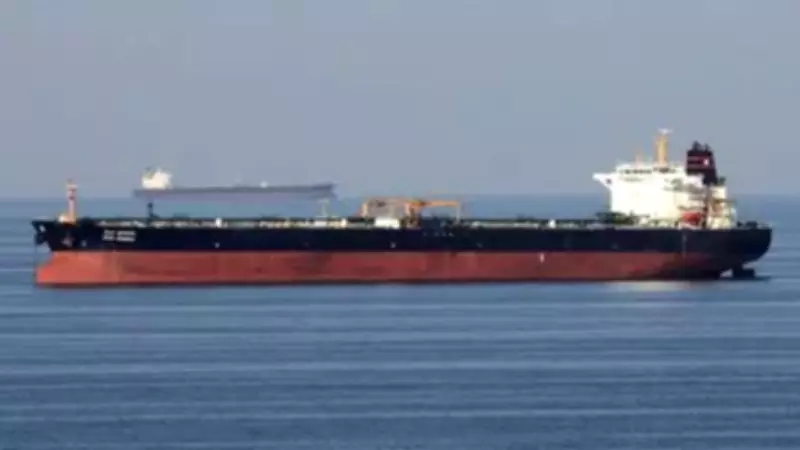
Tankers Reverse Course Near Iran's Larak Island as Diplomatic Efforts Falter
In a development highlighting escalating tensions in a critical global chokepoint, two empty crude tankers attempted to enter the Strait of Hormuz on Sunday but abruptly turned back after reaching the approach area near Iran's Larak Island. This movement, captured by detailed ship-tracking data, unfolded concurrently with reports that negotiators in Islamabad had failed to reach an agreement in ongoing high-stakes talks.
Detailed Movements of Vessels in the Gulf
According to comprehensive maritime tracking information, two very large crude carriers (VLCCs) and one Aframax-class vessel, all with no direct operational links to Iran, initiated a movement towards the Strait of Hormuz from the Gulf of Oman late on Saturday. These vessels proceeded to waters adjacent to Larak Island in the early hours of Sunday before decisively altering their course away from the strait.
Among the vessels that executed this retreat were the Iraq-bound Agios Fanourios I and the Pakistan-flagged Shalamar, which was en route to Das Island in the United Arab Emirates. Shipping registry data indicates that the Agios Fanourios I is managed by Greece-based Eastern Mediterranean Maritime, while the Shalamar is owned by the state-run Pakistan National Shipping Corporation.

Contrasting Passage and Unclear Motivations
In a contrasting maneuver, the very large crude carrier Mombasa B continued its transit through the Strait of Hormuz. It navigated between Larak and Qeshm islands via an Iran-approved route into the Persian Gulf, though its final destination remains unconfirmed in shipping logs.
Simultaneously, the Pakistani oil product tanker Khairpur exhibited erratic movement through Iranian-controlled waters. The vessel altered its course twice on Sunday, first executing a U-turn near the Larak and Qeshm islands, then reversing again to resume its inbound transit toward the Gulf.
The precise reasons for these sudden about-turns remain shrouded in uncertainty, particularly given that both Iraq and Pakistan had reportedly received prior approval from Iranian authorities for transit through the strait. This ambiguity points to complex, unstated factors influencing maritime decisions in the region.
A Pattern of Aborted Transits and Elevated Risk
This incident is not isolated. In recent weeks, multiple commercial vessels have attempted to transit the Strait of Hormuz only to later abort their passages, reflecting perceptibly shifting security conditions and demonstrably elevated risks in this strategically vital area.
- Most affected ships were seeking to exit the Persian Gulf, though empty tankers also move inward to load cargo.
- Two Chinese container vessels turned back in late April before eventually completing their exit.
- A liquefied natural gas (LNG) carrier reversed course last week before abandoning its initial transit attempt entirely.
A successful passage by all three crude tankers on Sunday would have contributed to a noted recent increase in traffic through the strait. This waterway has been under intense scrutiny since late February, coinciding with heightened movement by vessels linked to Iran. Just a day prior, on Saturday, two Chinese supertankers and a Greek-flagged vessel successfully exited the Persian Gulf through the strait while carrying full crude cargoes.
Diplomatic Collapse in Islamabad
This maritime activity unfolds against a stark diplomatic backdrop. The development follows the collapse of negotiations between the United States and Iran in Islamabad, Pakistan, which ended without any agreement.
According to US Vice President JD Vance, the central point of contention was Iran's nuclear programme. He described it as a "red line" for the administration, stating that Iran was explicitly told to terminate its programme and halt all uranium enrichment activities.
Iranian officials, for their part, labeled the US demands as "unreasonable" and placed the blame for the talks' failure squarely on Washington. This diplomatic impasse appears to cast a long shadow over the security calculus in the adjacent maritime domain, potentially influencing the cautious movements observed in the Strait of Hormuz.






