

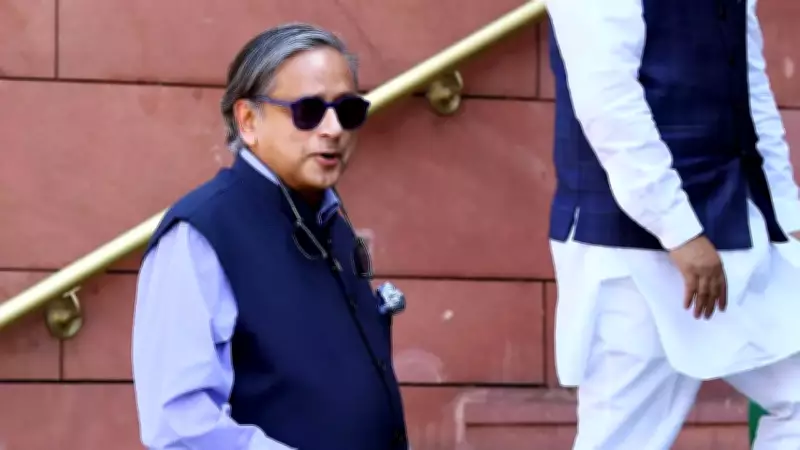
Shashi Tharoor Breaks with Opposition, Endorses Government's Cautious Stance on Middle East Conflict
In a notable departure from his party and the broader opposition, Congress MP Shashi Tharoor on Thursday expressed support for the Centre's cautious position regarding the escalating conflict between the US-Israel alliance and Iran in the Middle East. Speaking to PTI, Tharoor acknowledged the government's prudent approach while highlighting areas where India could have acted more diplomatically.
Tharoor's Call for Condolences and Diplomatic Engagement
Tharoor emphasized that India should have publicly condoled the assassination of Ayatollah Khamenei in a US-Israel strike, even if not condemning it outright. "I don't know about condemning it, but we should certainly have condoled it. After all, he was the spiritual leader of a country with which we have friendly relations," he stated. He pointed to India's swift response to President Raisi's death two years ago as a precedent, suggesting that offering condolences would have been a courteous and appropriate gesture.
He noted that Foreign Secretary Vikram Misri signing the condolence book at the Iranian embassy was a positive step, but argued for more proactive diplomacy. "It is simply the courteous thing to do for any country," Tharoor added, underscoring the importance of maintaining diplomatic decorum.

Understanding Government's Cautious Stand and Advocating for Peace
Despite his critique, Tharoor expressed understanding of the government's cautious stance, describing it as necessary given the complex geopolitical landscape. He proposed that India, given its significant stakes in the region, should lead a neutral group of countries in urging both sides to end the conflict swiftly. "A good group of countries not party to the conflict on either side could go to both sides and ask them to call off the conflict, and India should be at the forefront of this," he asserted.
Tharoor outlined India's critical interests in the Middle East, including:
- Energy security reliant on Gulf stability, particularly for LPG and LNG imports.
- Approximately 9 million Indian citizens residing in the region, whose safety and remittances are vital.
- Substantial investments from nations like the UAE and Saudi Arabia.
- Extensive trade relations and security cooperation.
"You don't want to see that jeopardised. So for us, peace and stability in the Middle East-West Asia is extremely important," he concluded, highlighting the economic and strategic imperatives driving India's position.
Opposition Criticism and Parliamentary Context
Tharoor's comments come amid sharp criticism from the opposition, which has accused Prime Minister Narendra Modi's government of maintaining a "silence" on Khamenei's assassination, alleging it aims to avoid upsetting American and Israeli allies. The opposition has contrasted India's condemnation of Iran's attacks on Gulf states with its quiet response to the initial US-Israeli assault on Iran.
Earlier this month, Congress staged walkouts in both the Rajya Sabha and Lok Sabha, protesting External Affairs Minister S. Jaishankar's statement on the West Asia situation. The party labeled his remarks "vapid" and criticized Modi's foreign policy as pushing India toward "vassalage." In Parliament, Jaishankar defended India's stance, affirming support for sovereignty and territorial integrity in the region and justifying humanitarian decisions like allowing an Iranian ship to dock.
Tharoor's nuanced position underscores the delicate balance India must strike in navigating international conflicts while safeguarding its national interests and diplomatic relationships.






