

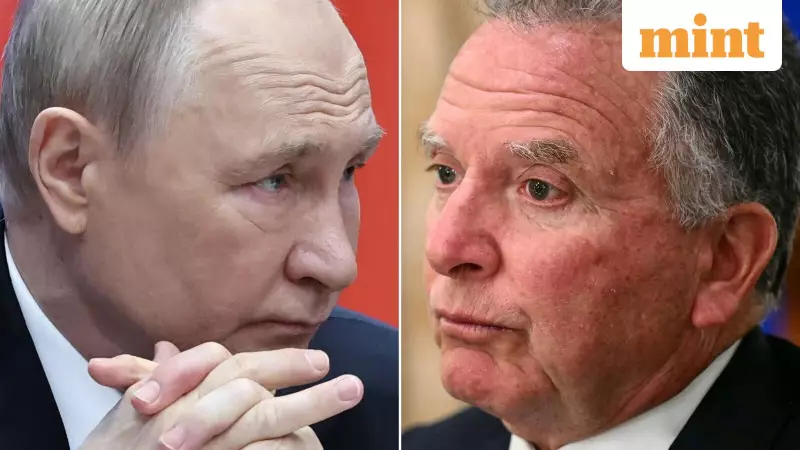
In a significant diplomatic move, US President Donald Trump's special envoy, Steve Witkoff, along with the President's son-in-law Jared Kushner, landed in Moscow on Tuesday, December 2. Their mission is to hold direct discussions with Russian President Vladimir Putin, aiming to find a potential end to the devastating war in Ukraine. This high-stakes visit represents the latest push by the Trump administration to broker peace in Europe's most deadly conflict since the Second World War.
Background of US Mediation Efforts
This is not the first attempt by President Trump to mediate a resolution. Previous efforts included a summit with President Putin in Alaska during August and separate meetings with Ukrainian leader Volodymyr Zelenskiy. However, these talks have yet to yield a concrete peace agreement. The diplomatic landscape grew more tense last week when a leaked US draft outlining 28 potential peace proposals surfaced. This document alarmed officials in Ukraine and across Europe, as critics argued its terms heavily favoured Moscow's long-standing demands.
Ukrainian and European leaders expressed deep concern that the proposals could restrict Ukraine's military capabilities and formally recognise Russian control over approximately a fifth of Ukrainian territory. In response, key European powers have prepared and presented their own counter-proposals to ensure Ukraine's sovereignty is not compromised.

Emphasising his country's stance, President Zelensky stated on social media, "Ukraine approaches all diplomatic efforts with utmost seriousness – we are committed to achieving a real peace and guaranteed security. This is exactly the level of commitment that must be compelled from the Russian side."
The Moscow Meetings and Kremlin's Stance
Confirming the schedule, Kremlin spokesman Dmitry Peskov told Reuters that President Putin would indeed meet with the American envoys, Witkoff and Kushner. Peskov avoided commenting on Russia's specific "red lines," suggesting that public negotiations through the media are not helpful. The US delegation arrived at the talks accompanied only by an interpreter, indicating the sensitive and direct nature of the discussions.
President Putin has signalled openness to dialogue but coupled it with a stark warning. He indicated that if Ukraine rejects a potential agreement, Russian military forces are prepared to advance further into Ukrainian territory. The Russian leader described the current talks as a preliminary review of ideas rather than negotiations for a final, formal treaty.
Reports from Reuters noted that a convoy carrying the US officials arrived in central Moscow from Vnukovo airport. Prior to this Moscow leg, the envoys had met with Rustem Umerov, the Secretary of Ukraine's National Security and Defence Council, in Miami to discuss peace proposals. In Moscow, Witkoff is also scheduled to meet Kirill Dmitriev, who serves as Putin's investment envoy.
Core Russian Demands and International Apprehension
The central demands from Russia, which have been a major point of contention, include:
- A permanent guarantee that Ukraine will never join the NATO alliance.
- Strict caps on the size and capability of the Ukrainian army.
- International recognition of Russian control over the regions of Crimea, Donbas, Zaporizhzhia, and Kherson.
- Legal protections for Russian-speaking populations and Orthodox Christian believers within Ukraine.
Ukraine has firmly rejected these conditions, viewing them as a demand for national capitulation that would leave the country defenceless and open to future Russian aggression. European powers are deeply worried that a peace deal skewed in Moscow's favour could not only shatter Ukrainian sovereignty but also provide Russia with significant economic and strategic advantages, altering the European security order.
Currently, Russian forces control more than 19% of Ukraine's internationally recognised territory, which amounts to roughly 115,600 square kilometres. They have made notable territorial gains throughout 2025. Ukraine and its Western allies characterise the war as a modern imperial land grab and caution that a Russian victory could pose a direct threat to neighbouring NATO member states in the future.






