

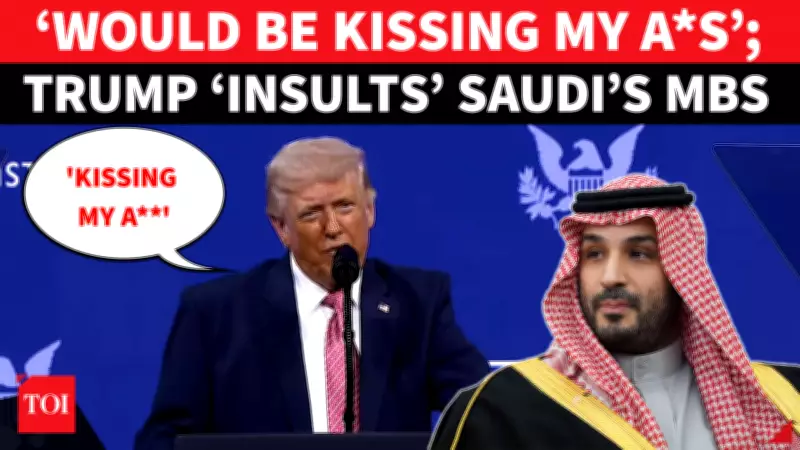
Trump's Vulgar Remark About Saudi Crown Prince Sparks Global Outrage
In a stunning moment that has reverberated across international diplomatic circles, former United States President Donald Trump delivered a crude and highly controversial insult directed at Saudi Crown Prince Mohammed bin Salman. The explosive comment was made during a public speech where Trump was addressing the escalating tensions and complex geopolitical situation involving Iran.
A Shocking Statement Goes Viral
The incident occurred as Trump was praising the leadership of Saudi Arabia, a key ally in the Middle East. Without warning, he abruptly shifted tone and uttered a vulgar phrase that has since gone viral on social media platforms and news outlets worldwide. The remark, which explicitly referenced the Crown Prince in a demeaning manner, was captured on video and quickly spread, drawing immediate condemnation and sparking intense debate.
This controversial statement comes at a particularly sensitive time, as regional alliances are being tested and the threat of conflict with Iran looms larger. The Middle East is currently grappling with heightened instability, making Trump's comments especially provocative and potentially damaging to diplomatic relations.

Geopolitical Context and Rising Tensions
The speech was delivered against a backdrop of increasing hostilities involving Iran and its proxies. Recent developments have included:
- Missile and drone attacks targeting Abu Dhabi, resulting in injuries and fires.
- Houthi forces joining the conflict by launching a missile at an Israeli nuclear site.
- Iranian strikes on Saudi Arabia's Prince Sultan Air Base, causing injuries to US personnel and damaging aircraft.
- Cluster bomb barrages hitting Tel Aviv, leading to widespread panic and destruction.
Trump used the platform to assert that Iran is "begging" for a deal as military strikes intensify. He also made bold claims about the regime's vulnerability, suggesting it could be "blown up" amidst the ongoing warfare. These assertions were part of a broader narrative where Trump positioned himself as a decisive leader in confronting Iranian aggression.
Political Reactions and Broader Implications
The vulgar insult has not occurred in isolation. It follows a pattern of Trump's unconventional diplomatic style, which often prioritizes blunt rhetoric over traditional statecraft. However, this particular instance has raised alarms due to its potential to undermine critical alliances.
Political figures have responded with a mix of criticism and concern. Senator Peter Welch has lambasted Trump over a proposed $200 billion push for war with Iran, accusing him of having "no strategy." Meanwhile, Senator Marco Rubio has claimed that the conflict with Iran is nearing its end without the need for an immediate ground invasion, suggesting a complex and evolving military assessment.
Additionally, the US has confirmed that approximately 300 American soldiers have been injured in Iran-linked attacks across the Middle East since the war began, highlighting the human cost of the ongoing hostilities. The Islamic Revolutionary Guard Corps has further expanded the war zone, threatening US infrastructure after Israeli bombings targeted nuclear sites.
Analysis of Diplomatic Fallout
Experts are analyzing the potential consequences of Trump's remark on US-Saudi relations. Saudi Arabia has long been a strategic partner in countering Iranian influence, and such public disrespect toward its leadership could strain this crucial alliance. The comment may also impact broader diplomatic efforts in the region, where maintaining coalition unity is essential for addressing shared security threats.
Furthermore, the incident underscores the volatile nature of current Middle Eastern politics, where verbal provocations can quickly escalate tensions. As the situation with Iran remains fluid, with continued strikes and counter-strikes, the need for measured and respectful dialogue is more pressing than ever.

In summary, Donald Trump's vulgar insult against Saudi Crown Prince Mohammed bin Salman has ignited a firestorm of controversy, occurring at a pivotal moment of geopolitical uncertainty. The remark threatens to complicate diplomatic relations and adds another layer of complexity to the already tense standoff with Iran, emphasizing the fragile state of international affairs in the region.





