

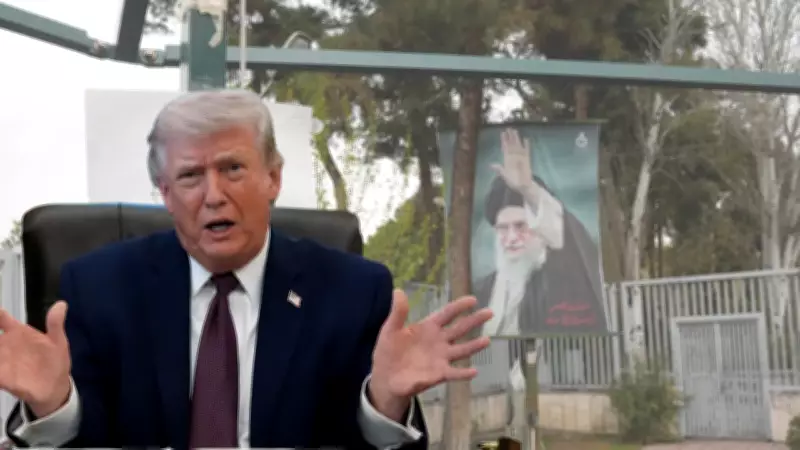
Trump Announces Progress on Iran Deal and Regional Security Developments
US President Donald Trump declared on Friday that any comprehensive agreement with Iran would only become operational after being fully finalized and signed. Speaking at a Turning Point USA event in Phoenix, Trump highlighted what he described as significant advancements in regional security, specifically mentioning the opening of the Strait of Hormuz and a ceasefire in Lebanon.
Trump's Statements on Iran and the Strait of Hormuz
"This will be a great and brilliant day for the world because Iran has just announced that the Strait of Hormuz is fully open and ready for business and full passage," Trump stated during his address. However, he emphasized that US pressure tactics would persist unabated. "But the naval blockade… will remain in full force and effect as it pertains to Iran until such time as our transaction with Iran is 100% complete and fully signed."
Trump further reiterated his assertion regarding Iran's nuclear materials, claiming, "The USA will get all nuclear dust...That white powdery substance created by our B-2 bombers… No money will exchange hands in any way or form." He added, "Iran, with the help of the USA, has removed or is removing all of the sea mines...They will never have a nuclear weapon."

Signaling ongoing diplomatic efforts, Trump noted, "We've had some very good discussions ... Talks are going on, and we'll go on over the weekend. A lot of good things are happening, and that includes Lebanon, too."
Iran's Strong Rejection of Trump's Claims
Iranian officials swiftly pushed back against Trump's assertions, firmly maintaining that control over the Strait of Hormuz resides exclusively with Tehran. Iranian Parliament Speaker Mohammad Bagher Ghalibaf criticized Trump's remarks in a post on X, stating, "The President of the United States made seven claims in one hour, all seven of which were false."
Ghalibaf elaborated with specific points:
- "They did not win the war with these lies, and they will certainly not get anywhere in negotiations either."
- "With the continuation of the blockade, the Strait of Hormuz will not remain open."
- "Passage through the Strait of Hormuz will be conducted based on the 'designated route' and with 'Iranian authorization.'"
- "Whether the Strait is open or closed and the regulations governing it will be determined by the field, not by social media."
Iran's foreign ministry spokesperson Esmaeil Baqaei reinforced this stance, asserting, "shipping through the Strait of Hormuz will be allowed along a pre-determined route by Iran." He issued a warning, "If the maritime blockade of Iran's ports continues, Iran will take reciprocal measures," adding that "Iran is the guardian of the Strait of Hormuz and will show leniency where necessary."
Baqaei also criticized the US approach, remarking, "We should not be influenced by the other side’s tweets." He stated, "The statements by American officials are filled with contradictions and lies, and this is nothing new. The opening or closing of the Strait of Hormuz does not happen on social media, but on the ground."
Background and Context of the Strait of Hormuz Tensions
These exchanges follow earlier comments from Iranian foreign minister Seyed Abbas Araghchi, who had indicated that passage for commercial vessels would remain open during the ceasefire period. "In line with the ceasefire in Lebanon, the passage for all commercial vessels through Strait of Hormuz is declared completely open… on the coordinated route," he said.
The Strait of Hormuz, a critical maritime chokepoint through which approximately 20% of global oil and gas supplies transit, has been a focal point of heightened tensions. This strategic waterway faced disruption earlier this year following US and Israeli military strikes on Iran in February, underscoring its geopolitical significance in ongoing Middle East conflicts.

The conflicting narratives from US and Iranian officials highlight the deep-seated mistrust and complex dynamics characterizing US-Iran relations. While Trump portrays diplomatic progress and regional stability, Iranian leaders vehemently reject external claims over their sovereign control, setting the stage for continued diplomatic maneuvering and potential escalations in this volatile region.





