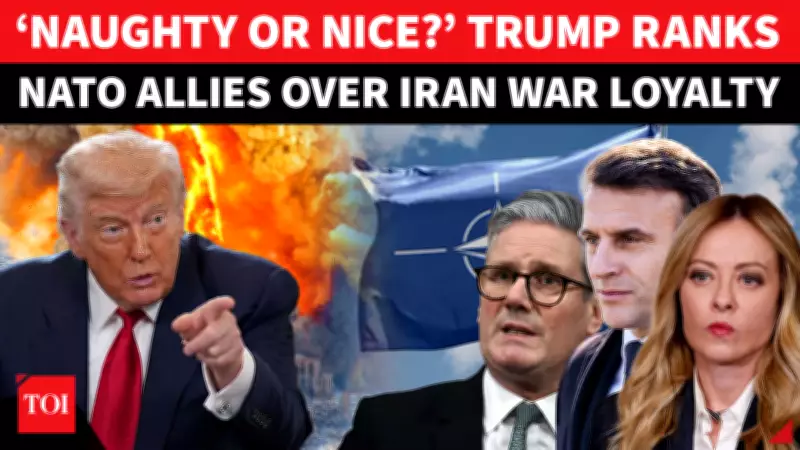
Trump's NATO Scorecard Ranks Allies on Iran War Loyalty, Ending Automatic Alliance Era
In a significant shift in international relations, the era of "automatic" military alliances appears to be over. President Donald Trump has authorized the creation of a confidential "Naughty or Nice" list that systematically ranks NATO member countries based on their demonstrated loyalty and support during the 2026 war with Iran.
Scoring System Divides Allies into Loyalty Categories
The controversial scoring system, which has been implemented by the Trump administration, categorizes NATO allies into distinct groups reflecting their commitment during the Iran conflict. According to sources familiar with the document, Poland and the Baltic states have received favorable ratings and are positioned on the "Nice" side of the ledger, reflecting their strong support for U.S. military operations.
Conversely, traditional allies including France and the United Kingdom have been placed on the "Naughty" list due to what Washington perceives as hesitation and insufficient commitment during critical phases of the Iran war. This unprecedented ranking system represents a fundamental departure from decades of NATO cooperation principles.

Defense Secretary Issues Stark Warning to Allies
Defense Secretary Pete Hegseth has delivered a clear message to NATO partners, emphasizing that the United States will no longer shoulder disproportionate security burdens for allies unwilling to contribute meaningfully to collective defense efforts. "America will no longer do the heavy lifting for allies who won't help clear a strategic strait or confront a direct threat," Hegseth stated in recent remarks that have reverberated through diplomatic circles.
This declaration underscores the administration's position that U.S. security guarantees now carry explicit conditions and expectations of reciprocal support from alliance members. The policy shift suggests that future American military protection will be contingent upon demonstrated loyalty and tangible contributions during international crises.
Strategic Implications for NATO's Future
The implementation of this loyalty scoring system has introduced unprecedented complexity into NATO's operational framework. Alliance members now face the reality that their standing with Washington is being formally evaluated and documented, with potential consequences for future security arrangements and military cooperation.
This development comes amid heightened tensions following the 2026 Iran conflict, which tested alliance cohesion and revealed divergent approaches among member states. The Trump administration's decision to formalize these assessments through a "Naughty or Nice" classification represents a deliberate strategy to reshape alliance dynamics according to perceived loyalty metrics.
The long-term implications of this policy shift remain uncertain, but it clearly signals Washington's intention to recalibrate its security relationships based on performance during international crises rather than traditional alliance commitments.