

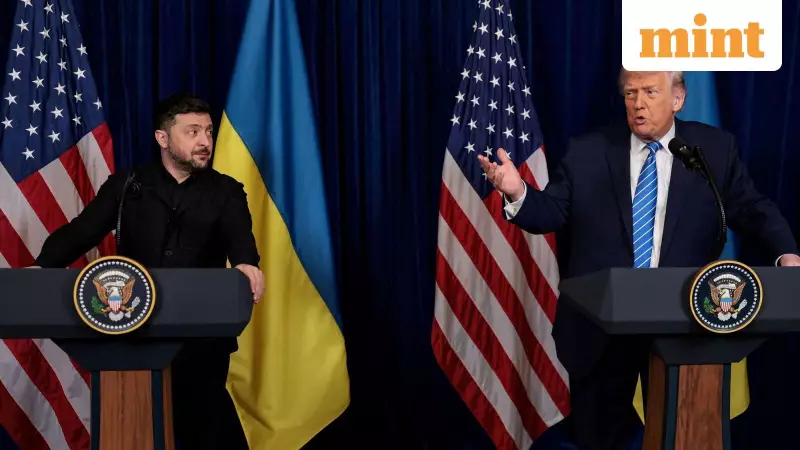
President Donald Trump's persistent efforts to broker a swift peace deal between Ukraine and Russia may be having the opposite of its intended effect, potentially pushing a conclusive end to the conflict further into the future, according to a stark analysis drawing parallels with past diplomatic failures.
The Zelensky Plea and the Trump Assumption
In a recent interview, Ukrainian President Volodymyr Zelensky emphasized his nation's desire not just for peace, but for a "just peace." This nuanced position, however, often clashes with a common assumption in international diplomacy, one that analysts suggest President Trump holds: that wars between other nations are fought for "stupid reasons" and should be stopped at all costs.
This outlook has defined the Trump administration's approach for the past year, marked by a flurry of diplomatic shuttles between Moscow and Kyiv. The focus has been overwhelmingly on ending the "bloodshed" and "killing," with less public emphasis on the war's underlying causes, its morality, or specific American strategic interests in its outcome. President Trump frequently cites having "ended" eight wars, valuing their cessation above their specific resolutions.

A Historical Parallel: Clinton's Failed Peace Process
This diplomatic fervor is drawing comparisons to a previous American presidential effort. Analysts note that President Trump begins to resemble President Bill Clinton at the end of his second term, who tried to forcefully mediate a final peace deal between Israel and the Palestine Liberation Organization (PLO) in the late 1990s and 2000.
That effort, aimed at a grand reconciliation, collapsed spectacularly. It was followed by the outbreak of the Second Intifada. Critics argue that the process failed because it ignored a fundamental reality: PLO leader Yasser Arafat had no genuine interest in a deal with an entity whose legitimacy he fundamentally rejected. The attempt to impose peace where the foundational will was absent proved futile.
The Luttwak Doctrine: War as Its Own Remedy
The analysis hinges on a perspective articulated by military scholar Edward Luttwak in a 2000 essay following the collapse of Clinton's peace process. Luttwak presented a counterintuitive argument: "If peace cannot be achieved by diplomacy, it may yet be achieved by war."
He described this not as a peace of reconciliation, but a "lesser peace of separation" born from exhaustion. War, he contended, destroys itself by consuming the resources, willpower, and hopes needed to sustain it. Unless one side achieves total annihilation—a historical rarity—combatants eventually accept the compromises necessary for cessation. "War can be its own remedy, if fought in earnest," Luttwak concluded.
This framework, analysts suggest, is what ultimately brought a tense stability to the Balkans in the 1990s after years of brutal conflict. Diplomacy formalized the outcome only after violence had run its course and "all passions [were] spent."
The Trump Paradox: Middle East vs. Ukraine
This creates a paradox in President Trump's foreign policy. In the Middle East, particularly during the recent Israel-Gaza conflict, his administration achieved a fragile calm through a different approach. By largely resisting calls for immediate intervention and allowing the belligerents to engage, the conflict reached a point of mutual exhaustion. The result is an imperfect "peace of separation." Hamas's leverage was reduced, Israeli hostages were returned, and the active carnage stopped, creating a space for difficult future discussions.
In contrast, the vigorous shuttle diplomacy in Ukraine, pursued even as Russian President Vladimir Putin daily demonstrates scorn for Ukrainian sovereignty, may only serve to delay the inevitable. Analysts argue that by attempting to force a deal, the US may be preventing the war from reaching the natural point of exhaustion that makes a sustainable ceasefire possible. The effect is to prolong the suffering it seeks to end.

The conclusion drawn is that only the participants—Ukraine and Russia—can decide when they cannot go on fighting. External diplomacy can pause the conflict, but pauses often mean delay. President Trump cannot end this war because he cannot alter Putin's worldview or soften his implacability. According to this analysis, only the grinding, tragic process of exhaustion can ultimately do that, making the current peace push a potentially counterproductive race against the grim clock of war.





