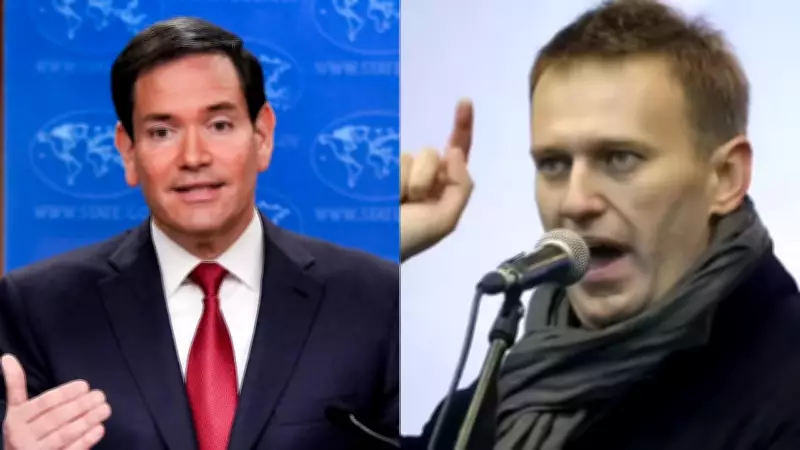
US Acknowledges European Report on Navalny Poisoning, Stops Short of Formal Endorsement
In a significant development regarding the death of Russian opposition leader Alexei Navalny, US Secretary of State Marco Rubio has stated that Washington is "not disputing" a report by five European countries which concluded that Navalny was fatally poisoned. This acknowledgment came during a news conference in Bratislava on Sunday, even as the United States refrained from formally associating itself with the findings.
Rubio's Cautious Statement on Troubling Report
Speaking to reporters while on an official visit, Rubio addressed the European report directly. "We obviously are aware of the report. It's a troubling report. We're aware of that case of Mr. Navalny and certainly... we don't have any reason to question it. We're not disputing. We're going to do a fight with these countries over it. But it was their report, and they put that out there," Rubio stated, as reported by Reuters. He emphasized that the US decision not to join the report "doesn't mean we disagree" with its conclusion that Navalny was poisoned with a rare toxin and that the Russian state was the prime suspect.
European Nations Point to Chemical Weapons Violation
The report in question was issued jointly on Saturday by the foreign ministries of the United Kingdom, France, Germany, Sweden, and the Netherlands. According to the Associated Press, laboratory analysis of samples taken from Navalny detected epibatidine—a potent toxin naturally found in the skin of South American poison dart frogs and not occurring in Russia. The European countries asserted that Russia possessed the "means, motive and opportunity" to administer the poison and announced plans to report Moscow to the Organisation for the Prohibition of Chemical Weapons for an alleged breach of the Chemical Weapons Convention.

British Foreign Secretary Yvette Cooper commented on the findings, stating that Russia viewed Navalny as a threat. "The use of such a poison shows the despicable tools it has at its disposal and the fear it has of political opposition," she added, highlighting the broader implications for political dissent in Russia.
Background on Navalny's Death and Previous Poisoning
Alexei Navalny, a prominent critic of President Vladimir Putin, died in an Arctic penal colony in February 2024 while serving a 19-year sentence that he claimed was politically motivated. His widow, Yulia Navalnaya, has declared that her husband's murder is now a "science-proven fact." This incident follows a previous poisoning in 2020, where Navalny survived an attack with a nerve agent that he blamed on the Kremlin. Russian authorities have consistently maintained that Navalny fell ill after a walk and died of natural causes, a stance that contrasts sharply with the European findings.
The US position, as articulated by Rubio, reflects a careful diplomatic balancing act—acknowledging the credibility of the European report without escalating tensions through formal endorsement. This approach underscores the complex geopolitical dynamics surrounding Navalny's death and the ongoing scrutiny of Russia's actions on the international stage.