

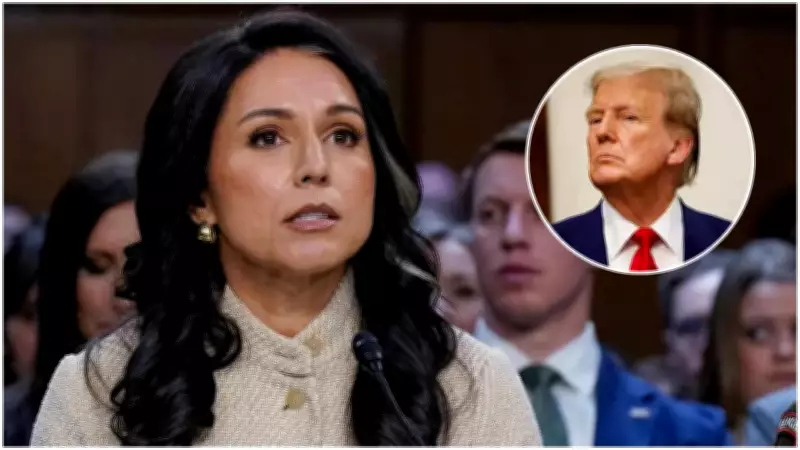
US Intelligence Chief Contradicts Trump's Iran Nuclear Threat Claims in Congress Hearing
In a significant development, US intelligence has concluded that Iran has not attempted to reconstruct the nuclear enrichment capacity destroyed in last year's joint US and Israeli strikes. This finding directly challenges one of President Donald Trump's central justifications for the current military conflict, as revealed in testimony delivered to Congress on Wednesday.
Gabbard's Written Testimony Undermines War Rationale
Director of National Intelligence Tulsi Gabbard, in prepared remarks to the Senate Intelligence Committee, stated unequivocally that there have been "no efforts" by Tehran to restore its enrichment capability following the June 2025 US attack, codenamed Operation Midnight Hammer. According to news agency AFP, Gabbard asserted, "As a result of Operation Midnight Hammer, Iran's nuclear enrichment program was obliterated. There has been no efforts since then to try to rebuild their enrichment capability."
This assessment carries immense weight because President Trump has repeatedly argued that he ordered the latest joint US-Israeli military campaign against Iran on February 28 due to an "imminent threat" from Tehran, claiming Iran was merely weeks away from obtaining a nuclear bomb. Notably, the UN nuclear watchdog and numerous independent observers have not supported this assertion. The report further indicated that Iran had been engaged in negotiations with Trump's envoys regarding a potential deal in the days preceding the attack.

Tensions Flare as Gabbard Avoids Public Reiteration
Despite including the finding in her written testimony, Gabbard conspicuously omitted it from her public remarks during the open hearing. When pressed by Democratic senators, she explained she had insufficient time to review the full testimony but did not dispute the written assessment. This evasion heightened tensions, with Democrats aggressively probing whether the intelligence community genuinely backs the administration's public case for war.
Gabbard repeatedly deflected questions about the intelligence she provided to Trump, frustrating Democratic senators who utilized the annual worldwide threats hearing to investigate the basis for the escalating Middle East conflict. When Senator Mark Warner inquired if she had warned Trump about Iran potentially closing the Strait of Hormuz if attacked, Gabbard declined to discuss internal advice, stating, "I have not and won't divulge internal conversations. I will say that those of us within the intelligence community continue to provide the president with all of the best objective intelligence available to inform his decisions," as quoted by news agency AP.
Resignation and CIA Chief's Stance Intensify Scrutiny
The hearing occurred amid heightened scrutiny following the resignation of Joe Kent, director of the National Counterterrorism Center, who stepped down on Tuesday citing an inability to "in good conscience" support the ongoing war. Kent argued that Tehran posed "no imminent threat" to the United States, a claim Trump angrily dismissed, labeling Kent "very weak on security" and asserting that officials who disagreed with the threat assessment were not wanted in the administration. The White House has since consistently rejected Kent's position, insisting Trump possessed "strong and compelling evidence" of Iran preparing a first strike.
Contrasting with Gabbard's written testimony, CIA Director John Ratcliffe adopted a firmer stance on Tehran's intentions, telling senators that Iran had not been serious in its pre-war diplomacy with Washington. "It was very clear that Iran, while they were talking, they had no intentions of following through," Ratcliffe said, rejecting Kent's assessment and claiming "the intelligence reflects the contrary."

Democrats Press Administration on War Justification
The hearing swiftly evolved into a critical test of the administration's war justification. Democratic Senator Michael Bennet accused Trump of abandoning his anti-interventionist message, remarking, "President Trump said, we are not the policemen of the world. He ran on that. Now he's turned us into the world's policeman, into its jury, into its judge, into its executioner." Democrats also sought to pressure officials on broader war consequences, including risks of Iranian strikes on Gulf countries or disruptions to the Strait of Hormuz, a vital oil and gas shipping route.
This scrutiny extends to the administration's conduct of the war, with reported concerns over a US missile strike that allegedly hit an Iranian elementary school, killing more than 165 people—an incident the White House states is under review.
Gabbard Assesses Iranian Regime and Global Threats
Despite extensive damage from weeks of attacks, Gabbard reported that the Iranian state remains intact, though weakened. She informed senators that US intelligence believes the regime is "intact but largely degraded due to attacks on its leadership and military capabilities," including the killing of longtime supreme leader Ayatollah Ali Khamenei. Gabbard warned that if the regime survives, it will likely embark on a years-long effort to rebuild its military, missile, and UAV forces.
Beyond Iran, Gabbard outlined the intelligence community's broader global threat assessment:
- Russia and Ukraine: US intelligence assesses that Russia maintains the upper hand in its four-year war against Ukraine, with ongoing US-led peace talks. Gabbard cautioned about an "escalatory spiral" potentially leading to nuclear weapons use.
- China: Beijing is rapidly modernizing its military with the long-term goal of seizing Taiwan, though intelligence suggests China still prefers conditions for eventual "peaceful reunification" without conflict.
The testimony underscores deepening divisions within the US government over the Iran conflict, with intelligence findings challenging presidential claims and raising critical questions about the war's foundation and future implications.





