

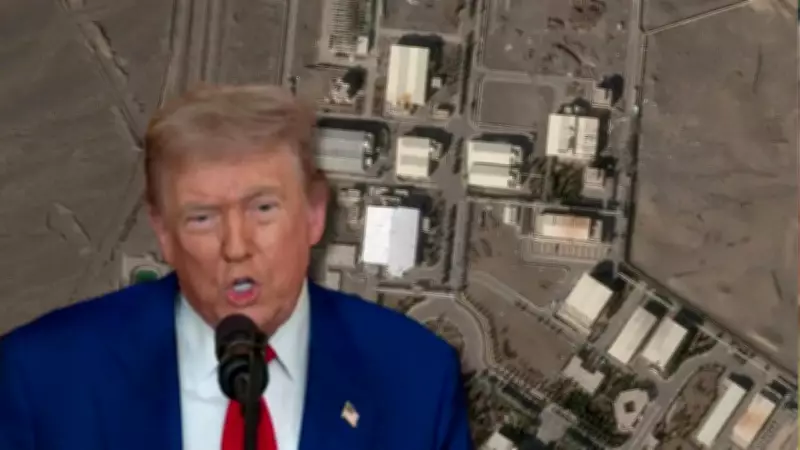
The United States and Iran have reached a preliminary agreement to end their war and reopen the Strait of Hormuz, according to officials from both countries, easing concerns over disruptions to global energy supplies while leaving Tehran's nuclear programme subject to further negotiations.
Framework Agreement and Oil Prices
The framework agreement, which includes ending the US blockade of Iran and restoring access through the strategic shipping corridor, sent oil prices lower amid expectations of reduced regional tensions. A memorandum of understanding is expected to be signed in Switzerland on Friday, though key details remain unresolved and the future of Iran's nuclear activities will be addressed in subsequent talks.
"The Deal with the Islamic Republic of Iran is now complete," US President Donald Trump wrote on his Truth Social platform on Sunday. Trump's statement came shortly after Pakistani Prime Minister Shehbaz Sharif, whose government has acted as a mediator between the two sides, announced that an agreement had been reached early Monday local time.

"The fate of Iran's nuclear program, another thorny issue, will also be addressed in those later talks," Reuters had reported, citing sources.
Timeline of Iran-US Relations
From Atoms for Peace to Nuclear Suspicion (1967-2006)
Iran's nuclear programme dates back to 1967, when it received the Tehran Research Reactor from the United States under Washington's 'Atoms for Peace' initiative. The programme largely stalled after the 1979 Islamic Revolution, which saw Ayatollah Ruhollah Khomeini come to power following the overthrow of Shah Mohammad Reza Pahlavi. The subsequent seizure of the US Embassy in Tehran triggered a 444-day hostage crisis and fundamentally reshaped relations between the two countries.
International concerns over Iran's nuclear activities intensified in August 2002 when Western intelligence agencies and an Iranian opposition group revealed the existence of the Natanz uranium enrichment facility. Diplomatic efforts followed. Britain, France and Germany entered talks with Tehran in 2003, leading Iran to temporarily suspend uranium enrichment. However, negotiations broke down after the election of hard-line President Mahmoud Ahmadinejad, and Tehran resumed enrichment activities in 2006. Britain, France and Germany walked out of stalled negotiations.
Secret Talks and the 2015 Nuclear Deal (2009-2015)
June 2009 – Iran's disputed presidential election returned incumbent President Mahmoud Ahmadinejad to power amid widespread allegations of electoral fraud, triggering the mass protests of the Green Movement and a sweeping government crackdown. A shift came under President Barack Obama. In October 2009, Washington and Tehran opened a secret communications channel through Oman. Face-to-face talks followed in July 2012.
Those negotiations culminated in July 2015 when Iran and world powers reached a landmark nuclear agreement that restricted Tehran's uranium enrichment programme in exchange for economic sanctions relief. According to AP, the deal was widely viewed as the most significant diplomatic breakthrough between Iran and the West in decades.
Trump's Withdrawal from Nuclear Deal and Rising Confrontation (2018-2020)
The agreement unraveled on May 8, 2018 when US President Trump announced his decision to withdraw from the failed Iran nuclear deal. The president has famously referred to it as 'the worst deal in history.' Its very premise has been betrayed by its own abysmal track record over the past two years. Trump also argued that a new agreement was needed to address Iran's missile programme and regional activities. A year later, Iran announced it would begin stepping away from its commitments under the deal.
Tensions escalated sharply in January 2020 when a US drone strike in Baghdad killed General Qassem Soleimani, a key architect of Iran's regional proxy wars. Iran retaliated days later by launching missiles at military bases in Iraq housing thousands of US troops. Several service members were injured. Meanwhile, unexplained attacks targeted Iran's nuclear infrastructure. A major explosion struck the Natanz centrifuge production facility in July 2020, while another attack hit the site in April 2021. Iran blamed Israel for both incidents.

Nuclear Talks Stall as Regional Crises Deepen (2021-2023)
Efforts by the Joe Biden administration to revive the nuclear agreement failed to produce a breakthrough. Indirect negotiations in Vienna began in April 2021 but ended without a deal. That same month, Iran announced it had started enriching uranium to 60 per cent purity, its highest level to date and a significant step closer to weapons-grade material.
On July 17, 2022, Kamal Kharrazi, an adviser to Iran's Supreme Leader, said: "Iran is technically capable of making a nuclear bomb, but has not decided whether to build one." Regional tensions increased further following Hamas' attack on Israel on October 7, 2023 and the subsequent war in Gaza. Iran-backed groups, including Yemen's Houthi rebels and Lebanon's Hezbollah, became increasingly active, drawing Washington and its allies deeper into regional security crises.
Direct Iran-Israel Conflict (2024)
The long-running shadow conflict between Iran and Israel entered a new phase in 2024. On April 14, 2024, Iran launched its first direct attack on Israel, firing more than 300 missiles and drones. Israel, supported by a US-led coalition, intercepted many of the incoming projectiles. Iran carried out a second direct attack on October 1, 2024, while Israel subsequently launched unprecedented direct strikes on Iranian territory later that month. The conflict intensified through a series of assassinations and military operations, including the killing of Hamas political leader Ismail Haniyeh in Tehran, Hezbollah leader Hassan Nasrallah in Lebanon and Hamas leader Yahya Sinwar in the Gaza Strip.
Return of Trump and Renewed Diplomacy (2025)
After returning to office on January 20, 2025, Trump renewed efforts to negotiate with Tehran. On March 7, 2025, Trump said he had sent a letter to Supreme Leader Ayatollah Ali Khamenei seeking a new agreement. Khamenei had earlier dismissed the prospect of talks, saying negotiations with Washington were 'not intelligent, wise or honorable'. Despite public disagreements over the format of discussions, the two sides began a series of meetings in Oman, Rome and elsewhere between April and May 2025. Oman repeatedly served as a mediator. Following a fifth round of negotiations in Rome on May 23, 2025, Omani officials said discussions had produced "some but not conclusive progress."
War and Ceasefire (2025)
The diplomatic process collapsed in June 2025. June 9, Iran signalled it won't accept a US proposal over the nuclear program. On June 12, the International Atomic Energy Agency's Board of Governors found Iran in non-compliance with its nuclear obligations. Tehran responded by announcing plans to activate a third uranium enrichment facility. A day later, Israel launched military operations against Iran. Over 12 days, it targeted Tehran's nuclear and military sites. The United States entered the conflict on June 22, 2025, carrying out strikes against three Iranian nuclear facilities. Iran responded by attacking a military base in Qatar used by US forces. On June 24, 2025, Trump announced a ceasefire. Subsequent negotiations involving Iran, European powers and the International Atomic Energy Agency attempted to address both sanctions and inspection concerns, but tensions remained high. On Dec 28, protests erupted in two major markets in central Tehran after the Iranian rial plunged to a record low of 1.42 million to the US dollar, intensifying inflationary pressures and driving up the cost of food and other essential goods.
Fresh Crisis and New Talks (Present Day)
Iran entered 2026 facing domestic unrest as economic conditions deteriorated. On January 3, 2026, Khamenei declared that "rioters must be put in their place," amid an escalating crackdown. The unrest coincided with renewed nuclear negotiations and a growing US military presence in the region. On Jan 13, Trump said he has called off any meetings with the Iranians and promises that unspecified 'help is on its way.' Later that month, the US aircraft carrier USS Abraham Lincoln along with three warships arrived in the Middle East amid Trump's threats to attack. In February 2026, a US Navy fighter jet shot down an Iranian drone approaching the Lincoln in the Arabian Sea. Indirect talks resumed in Oman and Geneva during February 2026, even as both sides accused each other of military provocations in the Strait of Hormuz.
Against that backdrop, US and Iranian negotiators resumed efforts to prevent a wider regional conflict. Israel and the United States launched a war against Iran on Feb 28, with Supreme Leader Ayatollah Ali Khamenei killed in the opening phase of the conflict. Iran appointed his son, Ayatollah Mojtaba Khamenei, as the new supreme leader on March 9. Several of Iranian leaders were killed and Iran later closed Strait of Hormuz. A fragile ceasefire was announced on April 7, though Israel was excluded from the talks. Days later, US Vice President JD Vance held high-level talks with Iranian officials in Islamabad, but negotiations ended without a breakthrough. The conflict continued to spill across the region, with Israel deepening its military operations in Lebanon. On June 15, the United States and Iran reached a preliminary agreement to reopen the Strait of Hormuz and extend the fragile ceasefire while pursuing broader peace talks.
While both sides have signalled support for the preliminary arrangement, significant issues remain unresolved, particularly regarding Iran's nuclear activities, sanctions relief and future international inspections.





