

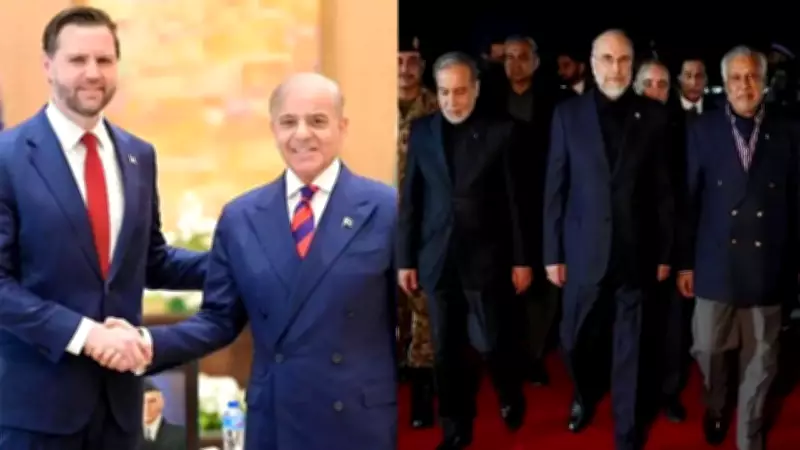
US-Iran Diplomatic Mission Ends in Failure, Ceasefire Hangs in Balance
A critical diplomatic mission spearheaded by United States Vice President JD Vance concluded without any agreement with Iranian representatives on Sunday, significantly increasing uncertainty surrounding the delicate ceasefire in the Gulf region. This breakdown dramatically elevates the likelihood of renewed military confrontation in the immediate hours and days ahead.
Vance Acknowledges Failure After Marathon Negotiations
Following nearly twenty-four hours of intensive discussions held in Islamabad, Pakistan, Vice President Vance openly conceded the mission's failure, adopting his characteristically direct tone before departing for Washington D.C. "We've had a number of substantive discussions with the Iranians. That's the good news. The bad news is that we have not reached an agreement," Vance stated in the early hours of Sunday, after all-night deliberations.
He added a cryptic warning, emphasizing an asymmetry in potential consequences: "I think that's bad news for Iran much more than it's bad news for the United States of America." Vance revealed that Tehran had formally rejected what Washington termed its "final and best offer," though he indicated the possibility of future dialogue remains. "We leave here with a very simple proposal: a method of understanding that is our final and best offer. We'll see if the Iranians accept it."

Iran Presents Contrasting Narrative of Impasse
Iranian officials provided a starkly different account of the stalled talks. Esmaeil Baqhaei, spokesperson for Iran's foreign ministry, communicated via social media that the negotiations covered an extensive agenda, including:
- The strategic Strait of Hormuz
- The nuclear question
- Sanctions relief for Iran
- War reparations
- A comprehensive ceasefire agreement
Baqhaei asserted that the ultimate stumbling block was the United States' refusal to acknowledge what Iran describes as its "legitimate rights and interests."
Core Disputes Prove Insurmountable
The collapse stemmed from several deeply entrenched disagreements where neither party demonstrated willingness to compromise.
The Nuclear Issue: Vice President Vance reiterated the US demand for an "affirmative commitment" that Iran will neither pursue nuclear weapons nor maintain the capability to rapidly develop them. "We need an affirmative commitment — they will not seek a nuclear weapon, now or long-term. That's President Trump's core goal," he declared. Iran maintains it has no intention to build nuclear weapons, aligning with its strategic doctrine and past international pledges, but staunchly defends its sovereign right to a civilian nuclear program. The US demand, perceived in Tehran as aimed at dismantling nuclear capability rather than preventing weaponization, created an irreconcilable divide.
Regional Security and Proxy Networks: American negotiators pressed for limitations on Iran's support for allied militant groups across the Middle East, particularly in Lebanon. Iranian officials dismissed these demands as "excessive" and beyond the scope of the immediate crisis discussions.
The Strait of Hormuz: This emerged as the most volatile point of contention. Iran seeks enhanced control over the critical waterway, framing it as a regional sovereignty and security imperative. The United States, supported by its allies, interprets any such move as a direct threat to global energy supplies and economic stability.
Additionally, Iran's demands for the unfreezing of its overseas assets and compensation for recent US-led military strikes were non-starters for Washington without broader concessions from Tehran.
Implications for Ceasefire and Global Stability
The failed negotiations cast immediate and serious doubt on the sustainability of the tenuous ceasefire that had temporarily halted escalating hostilities. While no formal announcement terminating the truce was made, the lack of progress combined with increasingly hardened rhetoric strongly suggests that renewed confrontation is a distinct and alarming possibility.

Vance's comments imply a Washington belief that strategic patience and pressure will prevail. By stressing the outcome is worse for Iran, he signaled confidence that sustained economic sanctions and military deterrence will eventually compel Tehran to resume talks on American terms. Conversely, Iranian leadership appears prepared for an extended stalemate, calculating that global reliance on Gulf energy exports will ultimately limit US strategic options.
Surreal Contrast: High Diplomacy and Prizefighting
Adding a layer of surreal contrast to the high-stakes diplomatic drama was President Donald Trump's schedule. As his vice president negotiated in Pakistan, President Trump traveled to Miami to attend an Ultimate Fighting Championship event—a spectacle often criticized for its choreographed brutality. Earlier, in Washington, Trump had displayed airy nonchalance, declaring the talks' outcome largely irrelevant: "We win, regardless. We've defeated them militarily."
This juxtaposition—peace talks in one hemisphere and prizefighting in another—vividly captured the paradoxical moment where diplomacy and brinkmanship continue to collide, with repercussions that could extend far beyond the Middle East.
Anticipated Financial Market Reactions
Financial markets across Asia are poised to react swiftly when trading opens on Monday. Historical patterns indicate that any threat to stability in the Strait of Hormuz typically triggers sharp spikes in global oil prices. Analysts widely anticipate a surge in crude oil prices due to heightened fears of supply disruptions. Equity markets, already sensitive to geopolitical risk, could experience broad sell-offs, particularly in energy-importing economies vulnerable to oil price volatility.





